



There’s a specific kind of loneliness that comes with this. You’re in the same home, maybe even the same bed, but something feels different. They’re quieter. Distant. Irritable. Harder to reach.
And you’re left asking questions you don’t say out loud: Is this depression… or is it us? Am I helping, or making it worse?
If you’ve been searching for how to help a depressed spouse, you’re not looking for a theory. You’re looking for something that actually works inside a relationship.
The sections ahead cover what may be happening underneath, the common misreads that damage marriages, what to say (and stop saying), how the first 90 days can unfold, how to navigate care in New Jersey, and when professional support may be worth asking about.
Quick Answer: Supporting a Partner with Depression
Supporting a depressed spouse means treating depression as an illness, not a personal rejection. Effective partners protect basic routines, avoid ultimatums and toxic positivity, support treatment without managing it, and preserve their own mental health. Here’s where to start:
- Treat it as a medical illness, not a choice.
- Share the load, don’t absorb it all.
- Be present without trying to fix.
- Support treatment without pressuring it.
- Protect your own mental health first.
Why Your Partner Seems Like a Different Person
Clinical depression is more than sadness. It’s a medical condition that can affect energy, focus, memory, motivation, and the ability to feel pleasure. That last part, anhedonia, means that things that used to feel good, including connection and intimacy, may no longer register the same way. It’s one reason your partner can seem distant, flat, or disengaged even when the relationship itself isn’t the main problem.
In long-term partnerships, depression often shows up as irritability or a short fuse rather than tearfulness. If your spouse seems angry, checked out, or disinterested in things they once loved, those shifts are frequently symptoms of the illness, not a lack of love for you.
Depression also often co-occurs with anxiety or increased alcohol use. If you’ve noticed your partner drinking more, worrying more, or layering sleep medication on top of everything else, these are clinically relevant patterns worth mentioning to a prescriber, not personal failings for you to manage on your own.
Is Your Support Helping, Enabling, or a Sign It's Time for More?
Partners rarely get a clear signal for when they’re doing it right, when they’ve tipped into over-functioning, and when the situation has outgrown what home support can hold. The framework below separates the three.
Revisit it every week or two. If the columns on the right start outnumbering the column on the left, it may be time to escalate, either to a higher level of care or to your own support.
| Helpful Support | Enabling / Over-Functioning | Signs It May Be Time to Escalate |
|---|---|---|
| Offering to drive to the first appointment. | Taking over all household tasks indefinitely. | New or increased statements about being a burden or wanting to end it. |
| Naming one small task per day they could try. | Managing their medication without prescriber involvement. | Inability to maintain hygiene, nutrition, or basic safety. |
| Sitting with them in silence when they can't talk. | Canceling your own plans to monitor them. | Weekly therapy has produced no observable change after 8–12 weeks. |
| Protecting sleep, meals, and basic routines. | Absorbing blame for every mood shift. | You are burning out faster than they are improving. |
| Staying emotionally available without absorbing blame. | Making every conversation about their symptoms. | Functional decline at work or with children. |
Four Misreads That Damage Marriages When One Partner Is Depressed
This is where most relationships quietly start to strain. Not because of bad intent, but because the symptoms look personal.
1. "They Don't Love Me Anymore"
Withdrawal is a core feature of depression, driven in part by a symptom called anhedonia, the reduced ability to feel pleasure or reward. When the brain’s reward processing is suppressed, the felt experience of connection can dampen for the depressed partner. According to the National Institute of Mental Health depression overview, loss of interest in activities and relationships is one of the core diagnostic features of major depressive disorder.
This is not a decision they made about the relationship. It’s a neurobiological symptom. A frequent mistake partners make here is reading flatness as rejection, then protecting themselves by pulling back emotionally, which can deepen the very distance they’re trying to survive.
2. "They're Just Being Lazy"
Unwashed dishes, forgotten errands, hours in bed, these can look like a character flaw. In reality, they often reflect executive dysfunction, a clinical feature of depression where the brain’s capacity to plan, initiate, and complete tasks is impaired.
This is one of the fastest ways resentment builds in a marriage. The non-depressed partner absorbs the household load, reads the imbalance as unfairness, and the illness gets mistaken for entitlement. Naming what’s actually happening, executive dysfunction, not laziness, reframes the situation and can lower the emotional charge on every missed task.
3. "If They Loved Me, They'd Get Help"
It can feel like your love should be enough motivation for your spouse to pursue treatment. But depression creates a fog of hopelessness and fatigue that can make help feel pointless, even to the person who needs it most. Ambivalence about treatment is a symptom of the illness, not a measure of commitment to the marriage.
This is one area where a collaborative, curiosity-based approach borrowed from motivational interviewing tends to outperform ultimatums. Asking “What would make a first call feel possible?” tends to move a depressed partner forward more often than pressure to comply, which can trigger shame, avoidance, or brief compliance followed by disengagement.
4. "Affection and Intimacy Will Fix This"
Low libido is a common physical symptom of depression and a known potential side effect of many antidepressants. When you reach for intimacy to feel reassured, your depressed partner may feel overwhelmed by the pressure to perform, which can deepen shame and withdrawal.
Physical closeness that doesn’t carry a performance expectation, sitting on the couch together, holding hands, sharing a meal in the same room, can often rebuild connection more reliably than sex during an active episode. The goal is presence, not performance.
Mistakes Well-Meaning Couples Make When Supporting a Partner with Depression
In an effort to save the relationship, partners sometimes default to behaviors that can increase the strain on the household.
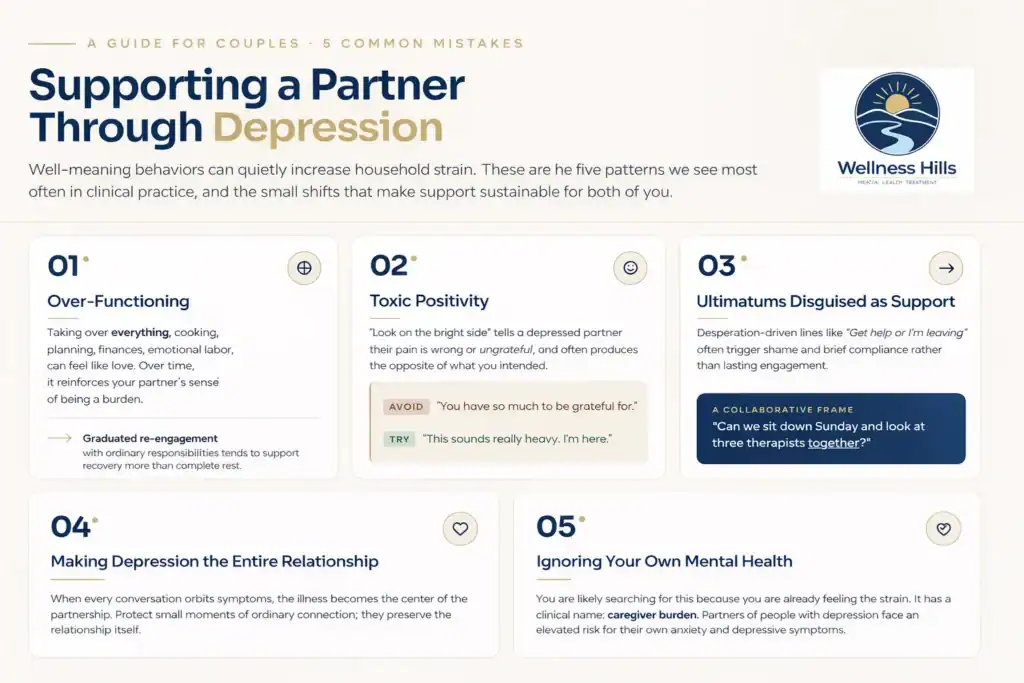
Over-Functioning
You take over everything: cooking, planning, finances, and emotional support. It can feel like love. But over time, a full takeover can reinforce your partner’s sense of being a burden and remove small opportunities for re-engagement that recovery often depends on.
When you absorb the tasks your spouse used to handle, you can unintentionally remove the small wins that behavioral activation, an evidence-based psychotherapy approach for depression (APA Clinical Practice Guideline), relies on. Recovery often requires graduated re-engagement with ordinary responsibilities, not complete rest from them.
Toxic Positivity
Phrases like “look on the bright side” or “you have so much to be grateful for” can come across as invalidating. They tell the depressed person their internal pain is wrong or ungrateful, and often produce the opposite of what you intended.
Ultimatums Disguised As Support
Statements such as “Get help, or I’m leaving” are sometimes delivered out of desperation. In clinical practice, ultimatums often trigger shame, avoidance, or brief compliance followed by disengagement rather than lasting treatment engagement.
A collaborative frame borrowed from motivational interviewing tends to work better: “I’ve been worried about both of us for a few weeks. Can we sit down on Sunday and look at three therapists together?” A specific day, a specific number, and a shared action reduce the activation friction that the depressed brain may not be able to overcome on its own.
Making Depression the Entire Relationship
When depression dominates daily life, couples can start talking about symptoms in every conversation. Over time, the illness becomes the center of the relationship. Protecting small moments of normal connection, watching a show together, taking a short walk, and sharing a meal, helps preserve the relationship itself.
Ignoring Your Own Mental Health
You’re likely searching for how to support a depressed partner without burning out because you’re already feeling the strain. This pattern has a clinical name: caregiver burden. Caregiver strain in mood disorders suggests that partners of people with depression face an elevated risk for their own anxiety and depressive symptoms. The Substance Abuse and Mental Health Services Administration publishes free resources specifically for family members and caregivers supporting a loved one’s mental health.
Sleep, movement, friendships, and your own support aren’t selfish. Consider reaching out to NAMI New Jersey family support groups for partners in similar situations, or talking to your own therapist about what you’re carrying. A steady, boundaried presence tends to be more sustainable than rescue.
What to Say and What to Avoid
When you’re trying to help a partner with depression, it’s less about having the perfect words and more about being present. The goal is to make the room feel safer, not to fix them. Use the table below as a starting point; your tone and proximity often land more than your specific vocabulary.
A calm voice, uncrossed posture, no phone in your hand, and no expectation of an immediate response can communicate safety more reliably than any script. Depressed partners often register how you are present before they register what you said.
| Say This | Avoid This |
|---|---|
| "I'm here. You're not in this alone." | "You should try to think positively." |
| "We can just sit here. We don't have to talk." | "But you have such a great life!" |
| "I've noticed you've been off, and I'm worried. How can I help?" | "I've dealt with worse." |
| "Take your time. I'm not going anywhere." | "Why can't you just…" |
For broader guidance on supporting any loved one, see our article on how to help someone with depression.
What the First 90 Days Can Look Like
One of the hardest parts of supporting a depressed spouse is calibrating your patience. You need a realistic map, not reassurance. The timeline below reflects patterns we see clinically in couples who enter our programs together. It is not a prediction for every case, but a reference for what is normal and when to watch more closely.
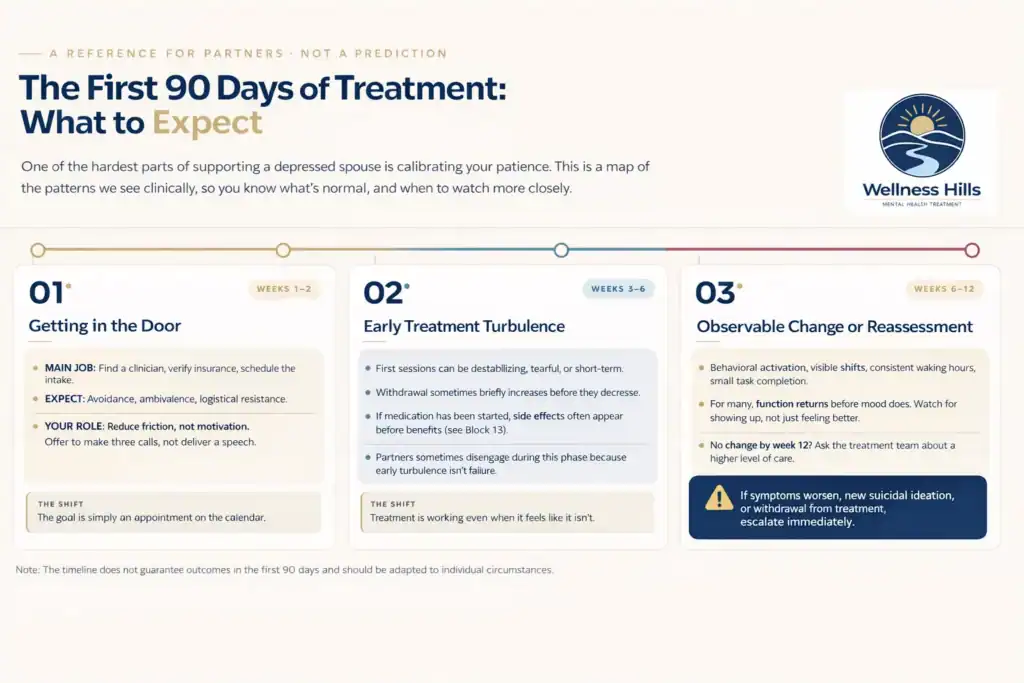
Weeks 1–2: Getting in the Door
- Main job: finding a clinician, verifying insurance, and scheduling the intake.
- What to expect from your partner: avoidance, ambivalence, logistical resistance; these can be symptoms, not refusal.
- Your job: reduce friction, not motivation. Offer to make three calls, not to deliver a speech.
Weeks 3–6: Early Treatment Turbulence
- First therapy sessions can be destabilizing, tearful, or irritable, or withdrawal, sometimes briefly increases before they decrease
- If medication has been started, side effects sometimes appear before benefits (see Block 13 on medication).
- Partners sometimes disengage during this phase because early turbulence can feel like treatment failure. It often isn’t.
Weeks 6–12: Observable Change or Reassessment
- Behavioral activation, when it’s working, often produces visible shifts, more consistent waking hours, small task completion, and re-engagement with one or two activities.
- For many people, function returns before mood does. Watch for them showing up, not just feeling happier.
- If you see no observable change by week 12, it may be appropriate to ask the treatment team whether a higher level of outpatient care could help.
- If symptoms worsen at any point, new suicidal ideation, inability to function, withdrawal from treatment, don’t wait for week 12. Escalate immediately.
Navigating the Hard Parts: Kids, Finances, Conflict, and Intimacy
The articles that tend to feel most useful to partners aren’t the ones that define depression. They’re the ones that meet you in the specific pressure points a depressive episode can create inside a committed relationship. Here’s how we think about the most common ones.

Talking to the Kids
Children often notice more than parents assume. Age-appropriate honesty, “Dad has an illness called depression. It makes him very tired and sad. He is getting help, and it is not your fault”, tends to land better than pretending nothing is wrong. Kids who are given language for what they’re observing often adjust more easily than kids who are told to ignore it.
Sharing the Load at Home
Household imbalance is one of the fastest-building resentments during a depressive episode. A workable framework: identify the two or three tasks your partner can still reliably do (even if slowly), protect those as their territory, and negotiate everything else honestly. Total takeover can undermine behavioral activation. Silent accumulation of tasks can undermine you.
Handling Conflict During an Episode
Not every disagreement during a depressive episode needs to be resolved in real time. A useful rule: if the conflict is about today (a logistical issue, a scheduling problem), address it. If it’s about the relationship itself, consider tabling it for a couples therapy session or for when your partner is more stable. Hot conflicts during active depression are often not representative of the relationship.
Intimacy When Libido Is Suppressed
Low libido is a common symptom of depression and a potential side effect of many antidepressants. Pushing for sex as a way to feel reassured can deepen shame on your partner’s side and rejection on yours. Non-sexual physical closeness, holding hands, sitting together, brief touch without expectation, can help rebuild the connection that later makes intimacy possible again.
When Resentment Shows Up
Feeling resentful at moments during a partner’s depressive episode is not a character failure. It’s a signal. The question is whether the resentment is acute (a hard week, a missed commitment) or chronic (you’ve lost yourself inside caregiving for months). Acute resentment can be resolved with a break and a conversation. Chronic resentment is often a sign that you need your own therapy, not a better performance.
What to Know If Your Spouse Starts Medication
If your partner has started or is about to start an antidepressant, the first few weeks can feel harder than you expected, for both of you. Knowing what’s typical versus what’s a warning sign is often the difference between holding steady and unraveling. What follows reflects what we see clinically, with patient-facing guidance from NIMH where it applies.

Why the First Weeks Can Feel Worse, Not Better
According to NIMH, SSRIs like sertraline, escitalopram, and fluoxetine can take four to six weeks to reach full therapeutic effect. Side effects sometimes appear before benefits do, which is why the early weeks can feel like the medication is making things worse. It usually isn’t the medication failing; it’s the order in which effects tend to emerge.
For you, this often means continuing to show up for a partner who seems less stable, not more, for the first month or so. That’s often normal. It’s also where a lot of partners lose faith in treatment right before it starts working.
Early Turbulence Is Often Not Relationship Failure
Increased irritability, sleep disruption, appetite shifts, or changes in libido in the first few weeks of a new antidepressant can be medication effects rather than signs your marriage is deteriorating. Try not to personalize them. Flag significant changes to the prescriber, not to your partner, in the middle of an argument.
Dose Adjustments Are a Normal Part of Treatment
Dose changes or medication switches during the first few months of treatment are routine as the prescriber calibrates. This is part of standard care, not evidence that treatment is failing.
Your Role Is Not to Evaluate the Medication
You are not the prescriber. Your role is to support appointment adherence and flag meaningful changes to the treatment team: new or increased suicidal ideation, severe agitation, manic symptoms, or significant side effects. Never encourage your partner to stop a medication abruptly; discontinuation syndrome and relapse are real risks that belong to the prescriber to manage.
Alert the Prescriber Promptly If You Notice
- New or worsening thoughts of self-harm or suicide.
- Severe agitation, restlessness, or pacing.
- Unusually elevated mood, rapid speech, or inability to sleep (possible signs of a manic episode).
- Severe physical side effects affecting daily function.
Opening the Door to Professional Support
Moving toward professional care shouldn’t feel like a battle. The goal is to reduce the friction, the effort it takes for your partner to start treatment at all.
Start small. Instead of pushing for a full program admission, suggest a single consultation call or a primary care visit to screen for depression. Offer logistics: “I’ll find three therapists covered by our insurance this week,” or “I can drive you to the first appointment.”
If weekly therapy isn’t producing observable change after 8–12 weeks, or if your partner’s ability to function at work or at home is declining, a clinical assessment can help determine whether a more structured level of care may be appropriate. Intensive Outpatient Programs (IOP) and Partial Hospitalization Programs (PHP) are levels of outpatient care that provide more support than weekly therapy but do not require inpatient admission.
When to Get Immediate Help
Safety is the one situation where you don’t wait for your partner to be ready. Seek immediate help if your spouse:
- Talks about being a burden, wanting to end things, or being better off dead.
- Gives away meaningful possessions or starts settling affairs.
- Becomes unusually calm after a prolonged period of severe depression.
- Cannot maintain basic hygiene, nutrition, or personal safety.
In a crisis, call or text 988, the Suicide & Crisis Lifeline, or go to the nearest emergency room. In New Jersey, you can also reach NJ MentalHealthCares at 1-866-202-HELP for statewide behavioral health information and referrals.
Consider a Safety Plan
A safety plan is a written, clinician-supported document that lists a person’s warning signs, internal coping strategies, people to contact, professional resources, and steps to make the environment safer. If your partner has expressed any suicidal ideation, even briefly, consider asking their therapist or psychiatrist about creating one together. Safety plans are a standard clinical tool, not an escalation of the situation.
Frequently Asked Questions
These are the questions partners and spouses ask us most often during a loved one’s depressive episode.
What if my partner says they’re fine?
Many people minimize their pain out of shame. You don’t need them to agree on a diagnostic label to express concern. Focus on specific changes you’ve noticed, sleep patterns, missed meals, withdrawal from activities they used to enjoy, rather than trying to diagnose.
Can I help without becoming their therapist?
Yes, and you should. Your role is partner, not clinician. A loving, boundaried presence is often what depressed partners benefit from most. The clinical work is conducted by a trained treatment team.
Should we go to couples therapy?
Couples therapy can improve communication and reduce conflict, but when one partner has moderate-to-severe depression, the depression itself often also needs direct treatment, individual therapy, medication evaluation, or both, alongside any couples work. Sequencing tends to matter: couples therapy often works better once the depressed partner is also in active individual treatment.
What if they refuse help?
You generally cannot force someone into treatment unless there is an active safety emergency. You can, however, set limits for your own well-being, stay in your own therapy, keep the door open for when they are ready, and let a clinician guide the next step during moments when readiness may temporarily increase.
Can depression make my spouse fall out of love with me?
Depression can suppress the brain’s capacity to feel connection, including love, for everyone and everything, not just you. For many couples, the feeling of connection returns as depression remits. Decisions about the relationship itself tend to be more reliable in stable periods than during active illness.
Is it normal to feel resentful toward my depressed spouse?
Periodic resentment during a partner’s depressive episode is clinically common. It can become a warning sign when it’s chronic rather than acute, when you’ve lost yourself inside caregiving for months. That signal often means you need your own therapy, not a better attitude.
Can I burn out from supporting my depressed partner?
Yes. Caregiver burden in depression is well-documented in research on mood disorders. Partners supporting a depressed spouse face elevated risk for their own anxiety and depressive symptoms. Protecting your sleep, your friendships, your physical activity, and your own therapy isn’t selfish; it’s how you stay available long enough to be useful.
If You’re the One Holding It Together
The exhaustion you feel is real. Watching the person you love slip into depression is one of the hardest things a human being can do. If you’re wondering whether weekly therapy is enough for your spouse, our team at Wellness Hills Mental Health can help you think through the next step.
A confidential assessment at our Chester, NJ facility is a conversation, not a commitment. Partners are welcome to call on behalf of their spouse, whether to ask about weekly therapy, a structured outpatient program, or simply to think through what’s next together.
Wellness Hills Mental Health Treatment: 425 Main St., Floor 1, Chester, NJ 07828. Call 973-532-5139. Hours: Open Monday-Sunday, 24 hours.
Serving couples and families from Chester, Morristown, Madison, Mendham, and the broader Morris, Sussex, and Warren County area. Accessible from Routes 206, 24, and 80. Major NJ insurers, including Horizon BCBSNJ, Aetna, Cigna, and UnitedHealthcare, are generally required under the mental health parity law to cover outpatient behavioral health on comparable terms to medical care. Our admissions team can verify your specific benefits on a confidential call.
Not ready to call? Our admissions page answers the most common questions partners ask before reaching out.
Sources:
Depression | National Institute of Mental Health (NIMH) – Explains what depression is, how it can affect feelings, thinking, sleep, eating, and work, and links readers to symptoms, treatment information, and help resources.
Clinical Practice Guideline for the Treatment of Depression Across Three Age Cohorts | American Psychological Association (APA) – Supports evidence-based treatment language for depression, including psychotherapy and medication recommendations across age groups.
Resources for Families Coping with Mental and Substance Use Disorders | Substance Abuse and Mental Health Services Administration (SAMHSA) – Supports family-focused language about how loved ones can provide support, connect someone to treatment, and use coping resources during mental health struggles.
NAMI New Jersey – Support for Mental Health | NAMI New Jersey – Provides New Jersey-specific mental health education, family support resources, support groups, and local affiliate connections for people supporting a loved one with a mental health condition.
Mental Health Medications | National Institute of Mental Health (NIMH) – Supports medication-related sections, including antidepressant basics, common medication classes, expected time to benefit, and common side effects.
988 Lifeline | 988 Suicide & Crisis Lifeline – Supports crisis guidance by confirming that people can reach the Lifeline by call, text, or chat for immediate emotional support.
New Jersey Mental Health Cares | Mental Health Association in New Jersey (MHANJ) – Supports New Jersey referral language by identifying a statewide behavioral health information and referral service that helps people find mental health services and other supports; it also clarifies that emergencies should go to 988 or 911.
Editorial Standards
Our Editorial Policy
Our editorial standards keep our mental health content accurate, compassionate, and evidence-informed. Articles are developed using credible sources, reviewed for medical accuracy when needed, and regularly updated.