


Starting care can feel harder than admitting you need it. Many adults know something isn’t working, sleep is off, anxiety is rising, motivation is dropping, yet they pause because they don’t know the first step. If you’re searching for how to start mental health treatment in NJ, the goal is not to have everything figured out today. The goal is to take one clear, informed step toward the right level of support.
This guide removes the common friction points: who to call, what to say, how to prepare, and what actually happens before treatment begins. It is not emergency care guidance, but if you are in immediate danger, call 911 or dial 988 for the Suicide & Crisis Lifeline.
Quick Answer: What To Do First
If you need to know how to start treatment immediately, these core steps may help:
- Identify Your Goal: Decide whether you need an initial mental health assessment to determine your level of care.
- Choose an Entry Point: Select between outpatient therapy, a psychiatric evaluation, or a structured program (PHP or IOP).
- Verify Your Benefits: Contact your provider to confirm your insurance coverage for mental health treatment and ask about prior authorization.
- Prepare Your History: You may need to keep a 7-day log of symptoms such as panic, avoidance, or sleep disruption to help your clinician.
- Safety First: If you are in immediate crisis, call or text 988 or 911 for 24/7 support; Wellness Hills focuses on structured outpatient care, not emergency services.
This Guide Covers Everything Before Treatment Begins: So You Know What to Do First
Most resources tell you what happens during therapy, but very few explain the chaotic week before you walk through the door. This guide focuses strictly on the pre-treatment phase: the phone calls, the paperwork, and the mental preparation.
By the time you finish reading, you will know how to start therapy with confidence. For information on what happens once you are enrolled, you can explore our guide on What to Expect in Mental Health Treatment in NJ. If you are still deciding which program intensity fits your life, refer to our comparison of PHP, IOP, and Outpatient Therapy.
Step 1: Pick the Right Starting Point (Therapy vs Psychiatry vs Program Intake)
When people decide to start therapy, they often worry about choosing the wrong one. In reality, care is flexible, stepping up or stepping down is normal as needs change.
Outpatient Therapy
OP can be a good starting point when:
- You are functioning at work or school, even if it takes effort
- Anxiety, depression, overwhelm, or avoidance are present but manageable between sessions
- You want skill-building, insight, and structured support
This is commonly referred to as outpatient therapy, and it typically involves weekly sessions.
Psychiatry and Medication Evaluation
Consider this entry if:
- Symptoms feel persistent despite coping strategies
- Sleep disruption is affecting daily functioning
- You feel plateaued in therapy
- A clinician has suggested medication may help stabilize symptoms
A psychiatric evaluation does not automatically mean medication; it clarifies options.
Program Intake and Assessment
A structured mental health assessment in New Jersey may be recommended if weekly therapy is not enough support.
Light indicators:
- Symptoms interfere with daily functioning
- You feel unstable between sessions
- Progress has stalled
Clinicians may evaluate whether an IOP or PHP will provide the right structure, without locking you into long-term intensity.
Therapist vs. psychiatrist: where should you start?
If unsure, begin with an assessment. It reduces guesswork and improves clinical fit.
According to Leigh Rasmussen, LPC, LCADC, the program director at Wellness Hills, patients typically begin IOP when symptoms interfere with daily functioning and safety remains stable.
Modalities Often Used at Each Level of Care
Understanding the therapies available at each level of care can clarify why a clinician may recommend one path over another.
| Level | Modalities Commonly Used |
|---|---|
| Outpatient therapy (OP) | CBT, ACT, skills-based therapy |
| Intensive Outpatient Program (IOP) | DBT, trauma-informed therapy, structured group work |
| Partial Hospitalization Program (PHP) | Intensive multi-modal care, psychiatry support, coordinated therapies |
Step 2: The First Call Script
Perhaps you’re wondering what to say when calling a mental health provider in NJ. Remember: you are sharing patterns. You aren’t proving severity. You do not need the perfect words, just clarity.

Copy and Paste Phone Script
“Hello, I am calling because I wanted to know how to start mental health treatment at your facility. I’m calling because I’ve been struggling with [briefly name main concern, e.g., increasing anxiety, low mood, sleep issues, and feeling overwhelmed or panic attacks that are harder to manage]. I’d like to know whether your center could help with an assessment to determine the right next step. Can you tell me about your intake process and whether you accept my insurance?”
If They Ask X, Say Y
If they ask: “What is your primary concern?” * Say: “I’ve noticed a change in my functioning regarding work and sleep over the last month.”
If they ask: “Are you looking for a specific program?” * Say: “I’m not sure yet; I’d like a clinical assessment to help determine if I need OP, IOP, or PHP.”
If they ask: “Are you in immediate danger?” * Be honest. If you are safe but struggling, say, “No, but my symptoms are becoming unmanageable.”
Everything discussed is confidential under HIPAA; no information goes to employers, family, or others without your signed release. This privacy protection applies throughout New Jersey providers.
Step 3: Insurance Verification (What to Ask So You Don’t Waste a Week)
Financial uncertainty is a major barrier to care. When you call to verify insurance for mental health treatment, do not just ask, Do you take my insurance? You may need to ask questions like:
- Does my plan cover the specific level-of-care (OP, IOP, or PHP) I am seeking? Some plans cover therapy but require separate riders for intensive programs.
- Is a prior authorization required before I can begin my intake appointment? In NJ, failing to obtain this pre-approval can lead to claims being denied later.
- What is my estimated out-of-pocket responsibility, including my deductible and co-pay?
Remember: Clinical fit is just as important as insurance coverage. A provider may accept your insurance but may not specialize in the symptom pattern you are experiencing.
Step 4: How to Prepare for Your Intake (A Simple 7-Day Notes Checklist)
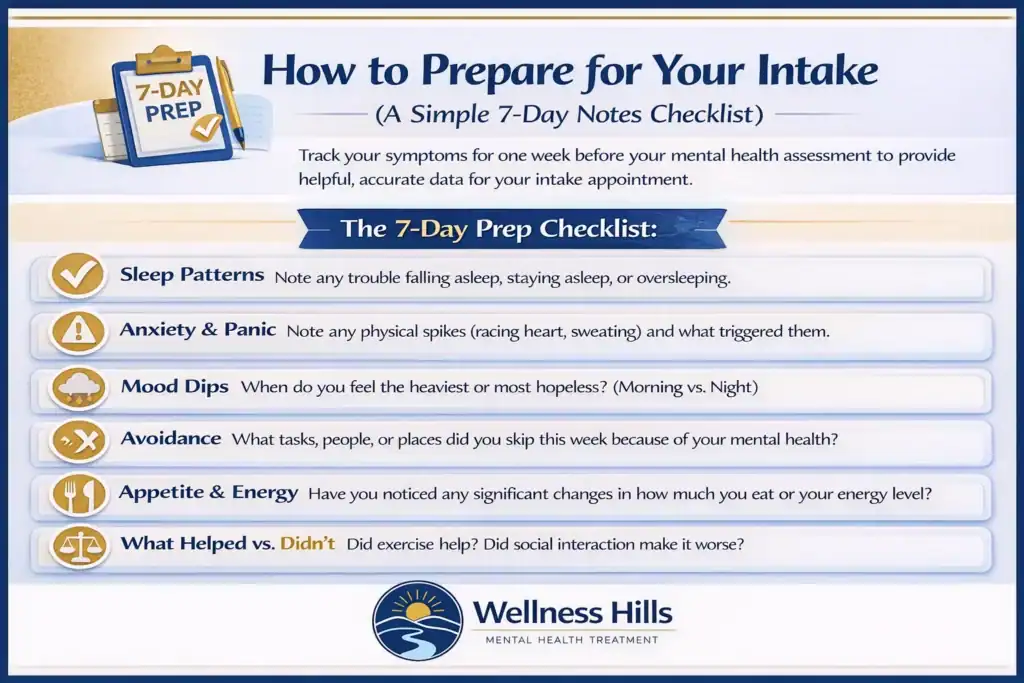
To ensure your mental health assessment results in the most accurate treatment plan, track your symptoms for one week before your appointment. This provides data that helps a clinician see beyond how you feel in the moment of the interview.
The 7-Day Prep Checklist:
- Sleep Patterns: Note any trouble falling asleep, staying asleep, or oversleeping.
- Anxiety & Panic: Note any physical spikes (racing heart, sweating) and what triggered them.
- Mood Dips: When do you feel the heaviest or most hopeless? (Morning vs. Night).
- Avoidance: What tasks, people, or places did you skip this week because of your mental health?
- Appetite and Energy: Have you noticed any significant changes in how much you eat or your energy level?
- What Helped vs. Didn’t: Did exercise help? Did social interaction make it worse?
This checklist is meant to help ensure you don’t blank out during your intake appointment for mental health treatment.
New Jersey Practicalities That Make Starting Easier
Navigating the Garden State’s healthcare landscape requires a bit of local realism:
- Schedule Realism: In NJ, many intensive programs run in 3- to 5-hour blocks. Factor in the commute to Chester, or look for providers that offer telehealth options, if your shift work is unpredictable.
- The Prior Authorization (often called pre-auth or simply auth): Prior authorization timelines vary by plan and provider. Some approvals are quick, while others can take several business days. Ask your insurer what to expect and whether anything is needed from the provider.
- Plan B Providers: Availability in North Jersey can fluctuate. If your first choice has a long waitlist, request an immediate assessment; they can often refer you to a trusted partner.
- Local Support: For non-emergency navigation help, you can always reach out to NJ 211 or the 988 lifeline.
What Clinicians Look For During Intake (So the Plan Fits Your Real Life)
During your mental health assessment, a clinician isn’t just looking for a diagnosis; they are looking for clinical fit. They will evaluate:
- Functioning: Can you still perform at work and school? Are you maintaining basic hygiene and nutrition?
- Symptom Pattern: How long have these feelings lasted? Is it a crisis or a chronic baseline?
- Between-Session Stability: If you leave the office, are you safe until the next appointment, or do you need the daily structure of IOP?
- Environment: Do you have a supportive home life, or is your current environment contributing to your stress?
Your treatment plan is a living document that adjusts as your functioning improves.
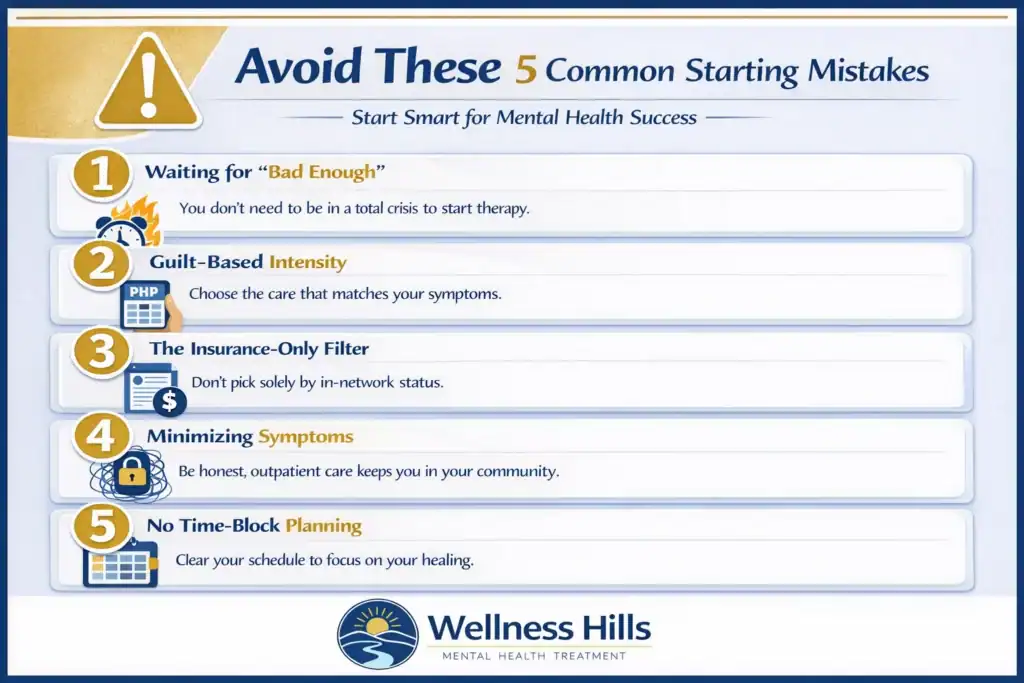
Avoid These 5 Common Starting Mistakes
- Waiting for “Bad Enough”: You don’t need to be in a total crisis to start therapy. Starting care earlier can reduce the risk that symptoms worsen or further disrupt functioning. Your timeline still depends on severity, co-occurring conditions, treatment fit, and consistency.
- Guilt-Based Intensity: Don’t choose a lower level of care (like once-a-week therapy) just because you feel guilty about taking time for a PHP or IOP. Choose what matches your symptoms.
- The Insurance-Only Filter: While cost matters, choosing a provider solely because they are in-network, without verifying whether they treat your specific symptom pattern, can stall progress.
- Minimizing Symptoms: Some patients downplay their struggle during an intake appointment for mental health treatment because they fear being locked away. Be honest, outpatient care is designed to keep you in your community.
- No Time-Block Planning: If you start a program without clearing your schedule for the required hours, the added stress of juggling can undermine your healing.
If You’re Unsure About OP vs IOP vs PHP, Use This 60-Second Check
- Outpatient Therapy (OP) fits when: You are struggling but still meeting all work and home deadlines, and feel safe between weekly sessions.
- IOP fits when: You are starting to mask at work but crashing at home, or when weekly therapy isn’t providing enough relief.
- PHP fits when: Your functioning is severely impaired, and you need a reset with full-day clinical support without staying overnight in a hospital.
How Clinicians Determine Your Level of Care (Clinical Criteria)
A trained provider decides the right level of care using structured clinical judgment. They may evaluate symptom acuity, risk assessment (harm to self and others), and functional impairment in daily life. They also reference standard manuals, like the DSM-5 diagnostic clusters, to help confirm severity and diagnostic fit. Together, these criteria ensure treatment intensity matches your clinical needs, neither too minimal nor unnecessarily restrictive.
For a deeper dive into these differences, see our full guide: PHP vs IOP vs Outpatient Therapy in NJ.
Frequently Asked Questions About Starting Mental Health Treatment
If you’re ready to start care, these are the questions that usually come up right before or during the first call. Use them to stay clear-headed, get a better recommendation, and match your schedule to the right level of care.
What if I’m fine at work but fall apart at night or on weekends?
This is a common sign that you are high-functioning but burning out. A clinician can help you determine if outpatient therapy is sufficient or if a more structured program is needed to build better coping tools.
What should I write down before I call so I don’t freeze up?
Keep your insurance card, your primary symptoms (e.g., panic or avoidance), and your general weekly availability in front of you.
How do I start if my schedule changes weekly?
Mention this during your first call. Many providers offer flexible outpatient therapy slots (sometimes including afternoon, evening, and weekend hours), though intensive programs (IOP and PHP) usually require fixed time blocks.
What’s the fastest way to get the right recommendation?
Schedule a formal mental health assessment. This assessment-first approach skips the trial-and-error of randomly selecting a therapist and places you at the right level of care.
If I tried therapy before, what should I do differently this time?
Focus on clinical fit. Ask the provider about their experience with your specific symptom pattern and whether they offer measurement-based care to track your progress.
If You’re On the Fence, Take the Next Small Step
You don’t have to commit to a six-month plan today. You only need to commit to a ten-minute clarity exercise: Sit down with the 7-day checklist above and write down three things that feel unmanageable right now.
The most effective next step is a professional assessment. This is a privacy-forward, non-pushy way to get a clinical perspective on your symptom pattern. Whether you choose Wellness Hills or another provider, getting a professional recommendation is the best way to stop the guesswork.
Wellness Hills is licensed by the New Jersey Department of Health (License No. 70290104) and provides PHP, IOP, and outpatient mental health treatment in Chester, NJ.
Safety reminder: This guide is for non-emergency access to treatment. If you are in immediate danger, call 911. If you have thoughts of hurting yourself, call or text 988 for free, 24/7 help.
Sources:
HIPAA Privacy Rule and Sharing Information Related to Mental Health, 2024) | HHS.gov (PDF) – Explains when protected health information can be shared, what HIPAA allows in mental health situations, and common privacy questions for patients and families.
DSM-5® Assessment Measures (Educational Resources, 2025) | Psychiatry.org – Downloadable symptom and functioning measures used in clinical assessment and progress tracking, including tools clinicians may use during intake and treatment planning.
Editorial Standards
Our Editorial Policy
Our editorial standards keep our mental health content accurate, compassionate, and evidence-informed. Articles are developed using credible sources, reviewed for medical accuracy when needed, and regularly updated.