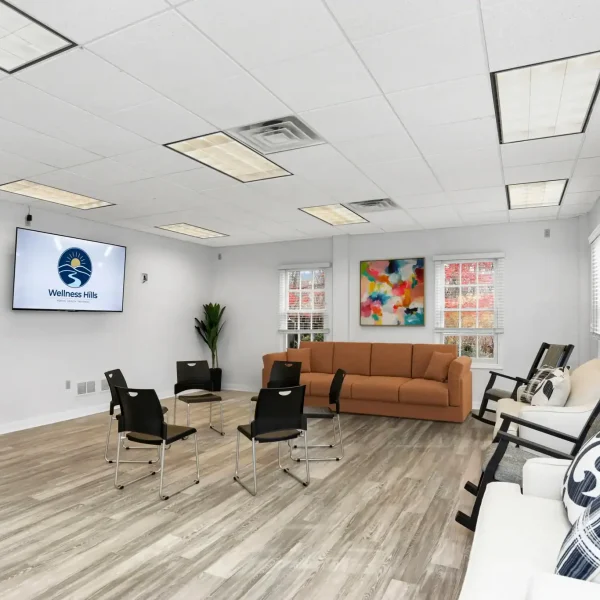

If you’re looking for CBT therapy in New Jersey, Wellness Hills Mental Health Treatment in Chester provides structured, skills-based care across outpatient, IOP, and PHP.
Cognitive Behavioral Therapy (CBT) is a structured, evidence-based mental health treatment that helps individuals identify and change thought and behavior patterns that contribute to emotional distress and functional impairment. In New Jersey, CBT is commonly delivered within structured outpatient, Intensive Outpatient (IOP), and Partial Hospitalization Program (PHP) settings, depending on clinical need.
At Wellness Hills Mental Health Treatment in Chester, New Jersey, CBT is provided across multiple levels of care following a comprehensive clinical assessment. Treatment is goal-oriented, skills-based, and designed to help clients build practical tools to manage symptoms, reduce avoidance, and improve daily functioning.
Facility Credential: Wellness Hills Mental Health Treatment is licensed by the New Jersey Department of Health (License No. 70290104).


CBT differs from unstructured talk therapy in that it is present-focused, time-limited, and skills-driven. Sessions follow a clear structure, emphasize collaboration, and require active participation both during and between sessions.
CBT is a form of psychotherapy that examines the interaction between thoughts, emotions, behaviors, and physiological responses. The underlying principle is that inaccurate or unhelpful thinking patterns can maintain emotional distress and maladaptive behavior. When these patterns are identified and modified, symptom reduction and functional improvement often follow.
Clients are taught specific cognitive and behavioral skills and are guided in applying them to real-life situations. Improvement is measured not only by insight, but by observable changes in behavior, coping ability, and symptom severity.
CBT targets self-reinforcing cycles that maintain distress rather than offering short-term symptom reassurance alone. A common maintenance loop may look like this:
Trigger → Automatic Thought → Emotional Response → Behavior → Short-Term Relief → Long-Term Symptom Maintenance
A situation triggers an automatic thought, like (“I can’t handle this”). It fuels a strong emotion like anxiety. And finally, leading to a behavior such as avoidance. While avoiding might bring short-term relief, it often reinforces the belief that the situation was too threatening, strengthening the pattern.
At Wellness Hills Mental Health Treatment, CBT is delivered in structured phases with clear goals, between-session practice, and progress tracking so treatment stays focused and measurable. Thus, clinicians may shift emphasis toward behavioral experiments, exposure-based interventions, or structured activity scheduling, depending on what is maintaining symptoms.




This page does not provide diagnoses. However, CBT is a first-line, evidence-based treatment for symptoms commonly associated with several DSM-5-aligned condition groups.
CBT is most commonly used for anxiety-spectrum and avoidance-driven conditions, including:
CBT is also frequently incorporated into treatment plans for depressive disorders, trauma-related symptoms, and sleep disturbances. An example is insomnia treated through CBT-I protocols.
Many individuals seeking cognitive behavioral therapy in NJ experience co-occurring conditions. It can increase clinical complexity and may require adjustments in structure, pacing, or level of care.
At Wellness Hills Mental Health Treatment, clinicians provide structured CBT services aligned with common treatment pathways patients search for, including:
Certain warning signs indicate a need for immediate, intensive support.
Some signs indicate a critical need for immediate intervention.
If you or someone you know is experiencing these, seek urgent professional support:
Symptoms such as suicidal thoughts, psychosis, or mania require immediate clinical attention.
If there is immediate danger, call 911.
For suicidal thoughts, call or text 988 (Suicide & Crisis Lifeline).
Clinicians evaluate severity and functional impairment to determine the appropriate level of care. Factors may include:
Standard outpatient therapy is not always sufficient. In these cases, structured programs such as PHP mental health programs in NJ or IOP mental health treatment plans may be clinically indicated.

Find out your personal coverage & options for treatment with a free verification of benefits from our admissions team. Whether you come to our programs or not we will ensure that you receive personalized recommendations for treatment based on your needs.






CBT at the program level is not improvised. Treatment follows manualized, evidence-based protocols tailored to the client’s goals and symptom profile.
Exposure-based interventions, such as exposure therapy, are essential and integral components of an effective program offering cognitive behavioral therapy in NJ, especially for anxiety-related issues.
All exposure work is clinically supervised and never self-directed or extreme.





Average 5.0 Rating
"I felt supported, understood, and never judged. The therapists here actually listen, and the groups helped me build confidence and skills I didn’t even know I needed. I’m healthier, calmer, and finally hopeful about my future. I’m so grateful for the care I received.”
Client Satisfaction


The correct program intensity, degree of structure, supervision, and clinical contact depend directly on your safety status, symptom severity, functioning, and support system. Explore our programs.
While some centers offer residential/inpatient care, these are the most common programs:
Placement into outpatient therapy, IOP, or PHP is based on clinical thresholds. Not preference alone. Factors considered include:
While CBT is a core approach, other evidence-based therapies may better suit specific clinical goals.
CBT primarily focuses on identifying and changing the link between specific unhelpful thoughts and behavioral patterns to address current problems. In contrast:
Given the range of options, the most appropriate therapeutic fit is determined through a collaborative clinical assessment that weighs your unique symptoms and overall treatment goals.
Medication management, when overseen by a qualified psychiatrist or PMHNP, may reduce acute symptom severity, allowing clients to engage more effectively in CBT. CBT provides the long-term coping and behavioral skills necessary to maintain gains.
Medication decisions are made only between the client and their prescriber.


These FAQs address the most common CBT questions we hear, so you can make an informed decision before scheduling an assessment.
CBT often needs 12 to 20 weekly sessions. However, CBT is not defined by a fixed number of sessions; it is defined by behavioral change milestones. For many conditions, early improvement depends on when avoidance, reassurance, or rumination behaviors are actively reduced, not on time alone.
The CBT model remains the same, but how quickly learning is consolidated changes with intensity, ranging from Outpatient CBT, IOP CBT, to PHP CBT. Higher levels of care are used when avoidance, panic, or compulsions overwhelm between-session practice, not because CBT is different.
Yes, but only when exposure is central, not optional.
Yes. However, CBT is effective for OCD only when it includes Exposure and Response Prevention (ERP). ERP must be clinician-guided and carefully paced to prevent symptom reinforcement.
Yes, and in some cases, medication can improve CBT effectiveness. Medication may reduce symptom intensity enough to allow engagement in exposure or behavioral activation. Medication decisions are always made collaboratively with a qualified prescriber.


Insurance coverage for CBT varies by plan and level of care.
Many individuals seeking CBT covered by insurance in NJ programs want to understand what services are included before starting treatment. Our admissions team provides insurance verification to help clarify this early in the process. During verification, we check:
We will explain your benefits and any potential costs in clear, straightforward terms before you begin. If you have questions about self-pay options or financial arrangements, we can discuss those as well.
Intake includes assessment of symptoms, safety, history, goals, and co-occurring conditions. Clinicians determine the most appropriate level of care. Clients receive:
Next steps are clearly outlined. We ensure clients understand what to expect and how to engage in therapy confidently.
Each CBT session is productive and skill-focused. Clinicians organize sessions into three distinct segments, typically in a 60-minute session:
First segment:
Second segment:
Third segment:
This structured approach ensures consistency, encourages active skill practice, and supports measurable progress across PHP, IOP, or outpatient CBT sessions.
CBT services at Wellness Hills Mental Health Treatment in Chester, New Jersey, are delivered by a multidisciplinary team. They are New Jersey–licensed mental health clinicians and behavioral health professionals, practicing within their respective professional scopes and under structured clinical supervision and care coordination.
All clinicians are licensed by the State of New Jersey and are qualified to provide assessment, psychotherapy, and treatment planning consistent with their credentials and training. Psychiatric services, when indicated, are provided by licensed medical professionals authorized to evaluate, diagnose, and prescribe.
Our clinical team includes:
At Wellness Hills Mental Health Treatment Center of New Jersey, data guides decisions, ensuring treatments match your response and support steady improvement. We administer validated tools based on your symptom presentation, such as:
How we use these tools:
If scores are not improving, we adjust treatment intensity (more frequent sessions, additional exposure work, skills practice structure), consider a higher level of care (IOP/PHP), and coordinate psychiatric evaluation when clinically appropriate.
Change in CBT involves effort and can include temporary challenges, which are normal parts of the process. Progress is individualized and often non-linear, particularly during the early phases of treatment.
These responses are expected clinical signals, not indicators of treatment failure.
While timelines vary based on symptom severity, treatment intensity, and co-occurring conditions, CBT often progresses through the following phases:
If progress is slower than expected, clinicians review factors like skill application, barriers, or current program intensity (e.g., outpatient vs. IOP or PHP mental health care). They may adjust emphasis, such as increasing behavioral experiments or guided exposure, based on your response and clinical assessment.
This adaptive process helps ensure that treatment remains responsive, structured, and clinically appropriate, rather than repetitive or stagnant.

To begin your cognitive behavioral therapy in NJ, contact our admissions team for a confidential assessment. The process includes:
Your assessment may include guidance regarding:
All information is handled in accordance with HIPAA and strict confidentiality standards.
DSM-5 (American Psychiatric Association) – DSM-5 contents reference used for DSM-5-aligned condition groups.
988 Suicide & Crisis Lifeline (New Jersey DMHAS) – NJ resource page for calling/texting 988 and accessing crisis support.
Cognitive Behavioral Therapy (Cleveland Clinic) – Overview of CBT (referenced for typical treatment course/session range).