


When standard weekly therapy no longer provides the stability or symptom relief you need, an IOP for depression offers a structured, clinician-guided path forward. An Intensive Outpatient Program (IOP) is a step-up in support, providing several hours of evidence-based treatment per week without requiring the overnight stay associated with residential care.
At Wellness Hills Mental Health, our depression treatment program in New Jersey is guided by trained clinicians and moves at a steady, manageable pace. It focuses on helping you make real progress and improve how you function in daily life.
Some people join the program after completing a more intensive program, such as a Partial Hospitalization Program (PHP). Others come because their depression symptoms have become harder to manage on their own. In both cases, we provide a structured and supportive environment that helps you track your progress and start moving forward again.
A Note From Our Clinical Director
By Leigh Rasmussen, LPC, LCADC – Program Director, Wellness Hills
“IOP is so beneficial for people who struggle with depression. Depression can tell us to remain isolated, reduce stimulation, and that we have no motivation or care to accomplish the simplest of tasks. Those thoughts and actions only strengthen depression symptoms; one of the ways to heal depression is through connection.
IOP gives people a safe place to express these emotions and feel a supportive community that understands those feelings. Attending a group setting can feel overwhelming, but in my experience, many clients have been amazed by the commonality participants share.”
When Depression No Longer Responds to Weekly Therapy
Weekly therapy can be helpful for many people. However, depression can sometimes feel so heavy that seeing a therapist just once a week isn’t enough to keep you safe or help you feel better. When things get that difficult, you may need a higher level of support than standard appointments can provide.

A Quick Way to Tell if IOP is the Right Next Step
If you’re unsure if you’ve reached the threshold for intensive care, you may consider these functional patterns:
- Stalled Progress: You’ve been in therapy for months, but your symptoms remain stagnant or are worsening.
- Functional Decline: You are struggling to meet basic responsibilities at work, school, or home.
- Worsening Isolation: You find yourself withdrawing from social supports and spending most of your time alone.
- Sleep Reversal: Your circadian rhythm is disrupted, leading to daytime exhaustion and nighttime racing thoughts.
- Loss of Routine: Simple ADLs (activities of daily living), like showering or meal prep, feel insurmountable.
- Frequent Crisis Moments: You are increasingly relying on crisis hotlines or emergency resources between sessions.
Severity and Impairment Indicators Clinicians Consider
Clinicians often use the PHQ-9 (Patient Health Questionnaire) to gauge the depth of a depressive episode. While a score of 15 (moderately severe) or 20 (severe) is a significant clinical indicator, our team at Wellness Hills looks beyond the number.
We weigh these scores against your level of functional impairment. If your mental health and motivation have dipped to the point where you can no longer engage in relationships or maintain employment, the clinical need for an IOP for depression in New Jersey is high.
When IOP is Not Enough and What Level of Care Fits Better
IOP is an ideal middle ground for those with stable housing who can maintain safety outside program hours. However, if a client is experiencing active suicidal ideation with plan or intent, psychosis, or an utter inability to function safely at home, an escalation to PHP for depression or inpatient evaluation is required. If you are in immediate danger, please contact 988 or go to the nearest emergency room.
Depression Presentations IOP Commonly Treats
Depression is rarely a singular experience; it is a spectrum of disorders and specifiers that dictate how a person interacts with the world. Understanding your specific presentation allows us to match the intensity of care to your unique needs.

DSM-5 Aligned Depressive Conditions That May Fit IOP
The conditions we treat at our depression treatment program in NJ may include:
- Major Depressive Disorder (MDD): Both single episodes and recurrent patterns.
- Persistent Depressive Disorder (Dysthymia): Long-term, chronic low mood that has lasted two years or more.
- Bipolar Disorder: Specifically, during depressive phases where stabilization is the priority.
Specifiers That Change Pacing and Treatment Focus
The flavor of your depression, known as specifiers, drastically changes the clinical approach. Anxious distress requires more focus on nervous system activation and calming the fight-or-flight response.
Melancholic features or a seasonal pattern might require a heavier emphasis on behavioral activation. If you are experiencing peripartum onset, our pacing will account for the unique stressors of new parenthood. These specifiers affect our sequencing, not your worth.
Co-Occurring Patterns That Change Level of Care
We rarely see depression in a vacuum. It often arrives alongside:
- Anxiety disorders and panic features.
- Trauma/PTSD symptoms that trigger avoidance behavior.
- Substance use concerns used to numb the pain.
- ADHD and executive dysfunction, which worsen anxiety and focus problems.
At Wellness Hills, we match intensity to safety and daily functioning, ensuring every co-occurring layer is addressed. If you are managing depression alongside significant anxiety symptoms, our IOP for co-occurring depression and anxiety is structured specifically for how these two conditions reinforce each other.
Depression IOP Schedule in Chester, NJ (IOP 3 Evenings vs IOP 5 Mornings)
The power of our IOP lies in its structure. By providing consistent, multi-day support, we help clients build muscle memory for coping skills. In early weeks, many clients don’t feel better right away. Motivation can drop, attendance can feel hard, and the work can feel slow before momentum builds.
That’s normal, depression often improves after routine and behavior shift first, not before. We plan for the hard part: building consistency, practicing skills between sessions, and creating a structure that holds even when you don’t feel like you can.
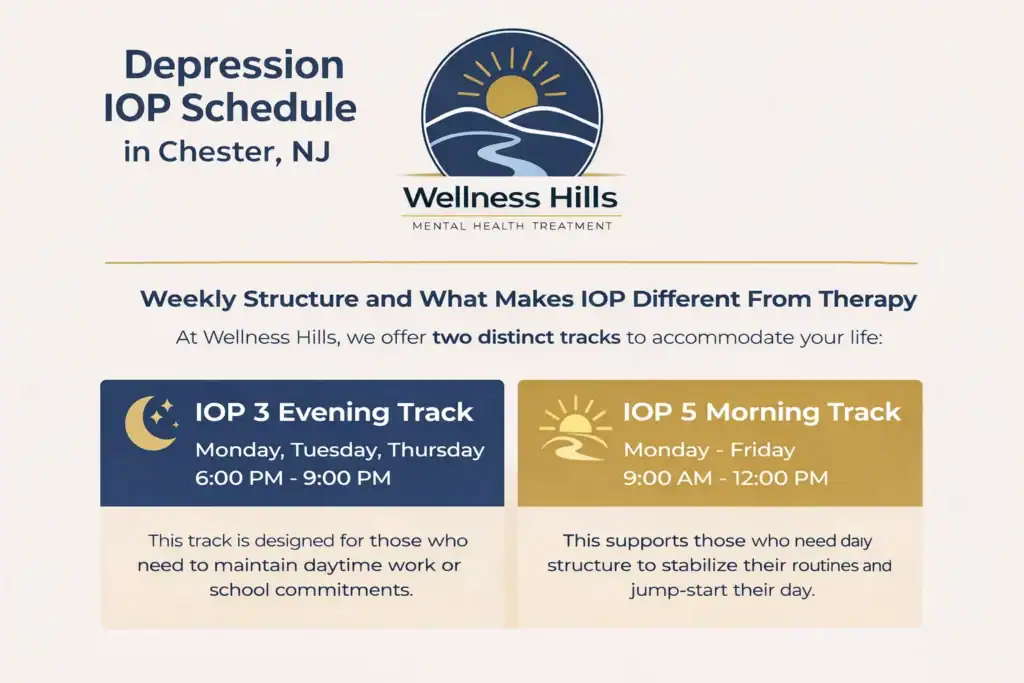
Weekly Structure and What Makes IOP Different From Therapy
At Wellness Hills, we offer two distinct tracks to accommodate your life:
- IOP 3 Evening Track: Monday, Tuesday, Thursday, 6:00 PM – 9:00 PM. This track is designed for those who need to maintain daytime work or school commitments.
- IOP 5 Morning Track: Monday – Friday, 9:00 AM – 12:00 PM. This supports those who need daily structure to stabilize their routines and jump-start their day.
Both tracks meet structured intensive treatment expectations, with IOP commonly delivered at 9+ hours per week when clinically indicated. Your week will typically include:
- Group Therapy: Both skills-based (learning new tools) and process-based (sharing experiences).
- Individual Therapy Touchpoints: Focused time with your primary therapist, such as Abby Goodrich, LAC.
- Care Coordination: Ongoing discharge planning and family involvement.
- Medication Management Coordination: Access to or coordination with a prescriber.
Modalities Used in Depression IOP and What Each Targets
We utilize several evidence-based modalities to attack depression from multiple angles:
- CBT (Cognitive Behavioral Therapy): Targets many issues, including rumination and distorted thinking.
- Behavioral Activation: Specifically fights anxiety and lack of motivation by reintroducing rewarding activities.
- DBT Skills: Focuses on distress tolerance and emotion regulation.
- ACT (Acceptance and Commitment Therapy): Connects your actions to your core values.
Between-Session Practice and Accountability
IOP doesn’t end when the group finishes. We help you create an activation plan to manage the hours between sessions. This includes support for sleep routines and targets for real-world skills rehearsal, ensuring that your anxiety and productivity improve in your actual environment, not just in a clinician’s office.
How Long IOP Lasts and What Changes By Phase
Most clients stay in IOP for 8–12 weeks, but the length depends on symptom severity, functioning, and safety.
Weeks 1–2: Stabilize routine, attendance consistency, safety plan, sleep and wake structure, and initial skills practice.
Weeks 3–6: Increase behavioral activation and skills repetition; reduce isolation; build momentum through measurable weekly goals.
Weeks 7–12: Strengthen relapse-prevention plan, step-down planning, and outpatient handoff.
Step-down is considered when symptoms are more stable, functioning is improving (work, school, home responsibilities are more manageable), and safety can be maintained reliably outside program hours.
Medication Management and Coordination When Indicated
While therapy is the backbone of IOP, many clients find that medication provides the necessary floor for therapy to be effective. We view medication as a tool for stabilization, not a substitute for the hard work of healing.

When Medication is Part of the Plan and Who Oversees it
If medication is clinically indicated, you will work with a psychiatric provider, such as a Board-Certified PMHNP-BC, to review your options. Not everyone in IOP needs or receives medication; the decision is always collaborative.
What Medication Support Looks Like Inside a Structured Program
Inside a structured depression treatment program, medication support goes beyond a simple prescription. It includes:
- Medication Review: Assessing if current dosages are effective.
- Side-Effect Monitoring: Closely tracking how your body reacts to new antidepressants.
- Adherence Support: Helping you build the routine necessary to take meds as prescribed.
When Medication Changes Require a Higher Level of Monitoring
If a medication change leads to a quick destabilization of symptoms or a spike in side effects, our clinical team, led by Program Director Leigh Rasmussen, LPC, LCADC, will evaluate if a step-up to PHP is needed for your safety.
Cases are reviewed in scheduled treatment-team check-ins to ensure the plan reflects current risk level and real-world functioning, not just session attendance.
IOP vs PHP vs Outpatient Therapy for Depression
Choosing a level of care can feel like a maze. Here is the plain-language breakdown of how these programs compare in terms of intensity:
| Feature | Outpatient (OP) | Intensive Outpatient (IOP) | Partial Hospitalization (PHP) |
|---|---|---|---|
| Hours per week | 1–2 hours | 9–15 hours | 20–30 hours |
| Medical Support | Minimal/Offsite | Coordinated | High/Onsite |
| Living Situation | Home | Home | Home |
| Structure | Low | Medium/High | Very High |
How clinicians decide level of care: We use structured decision support tools, such as the LOCUS (Level of Care Utilization System), to ensure you are in the least restrictive environment that still keeps you safe and moving forward.
Insurance Coverage, Cost, and Admissions in New Jersey
Navigating insurance coverage in NJ shouldn’t be your burden when you are already struggling with depression.
What Insurance Typically Requires For IOP Approval
Most insurance providers, including those in the New Jersey market, require medical necessity. This means the provider must prove that traditional outpatient therapy is insufficient and that the client’s functional impairment warrants a higher level of care. We handle the documentation and prior authorization process to minimize your stress.
What to Do if Insurance Denies IOP
If your insurance issues an adverse determination, you have rights. In New Jersey, the IHCAP (Independent Health Care Appeals Program) allows for an external review of medical necessity decisions. We support our clients in navigating these hurdles whenever possible.
Admissions Steps From First Call to First Group
- Phone Screen: A 10–15-minute call with one of our admissions coordinators, such as Hannah Johnson.
- Benefits Verification: We confirm your coverage details.
- Intake Assessment: A formal evaluation with a licensed clinician.
- Start Date: Typically within 48 to 72 hours of your assessment.
Measurement-Based Care and Outcomes Tracking
At Wellness Hills, we don’t guess; we measure. This is what sets our IOP for depression in NJ apart from generic programs.

What We Measure and Why it Matters
We utilize a battery of validated tools to monitor your progress:
- PHQ-9: For depressive severity.
- GAD-7: For co-occurring anxiety levels.
- C-SSRS: To monitor safety and suicide risk.
- WSAS (Work and Social Adjustment Scale): To track real-world functioning.
We track both symptoms and functioning so the plan can be adjusted, not just repeated.
How Measurement Changes the Plan in Real Time
If your PHQ-9 score isn’t budging, we don’t just keep doing the same thing. We might adjust your skills focus, increase your individual touchpoints, or coordinate a medication review with Paula Weisman, PMHNP-BC. Our goal is to help you return to life, work, relationships, and routines, not just get through sessions.
When Progress Stalls (Our Non-Response Pathway)
If symptoms or functioning are not improving, we do not wait it out. We look for specific causes and respond with defined changes, such as:
- Plateau in depressive severity: Adjust therapy focus (e.g., behavioral activation dose, cognitive restructuring targets), increase individualized touchpoints, and tighten between-session practice.
- Function still impaired (work, school, home): Add concrete routine-building supports and revise goals toward daily living and re-engagement outcomes.
- Safety risk increases: Increase monitoring and revise the safety plan; if the risk cannot be supported safely at the IOP level, we recommend a higher level of care.
- Medication may be indicated: Coordinate a medication review when clinically appropriate (not automatic or one-size-fits-all).
Depression treatment isn’t linear; some weeks are about regaining routine and safety before symptoms lift. We plan for that reality so treatment doesn’t become a cycle of talking about depression without measurable change.
Frequently Asked Questions About IOP Therapy For Depression
If you’re weighing an IOP program for depression, the details matter: time commitment, duration, and whether you can keep work or school. Here are quick, direct answers to the questions people ask most before starting.
How many days per week is depression IOP?
Depending on your track, it is either 3 evenings or 5 mornings per week.
How long does depression IOP usually last?
While every case is unique, a typical stay lasts 8 to 12 weeks.
Can I work or attend school during IOP?
Yes, our Evening IOP track specifically supports those maintaining full-time daytime responsibilities.
Will I see a psychiatrist in IOP?
Yes, medication management and psychiatric reviews are available and coordinated for all clients.
Begin Depression IOP at Wellness Hills Mental Health Treatment in Chester, New Jersey
Our facility at 425 Main St, Floor 1, Chester, NJ, is a licensed, safe, and welcoming space for those ready to break the cycle of depression. Wellness Hills Mental Health Treatment is licensed by the New Jersey Department of Health (License #70290104).
What Your First Appointment Includes
Your initial intake includes a comprehensive review of your symptom pattern, a safety screen, and a personalized level-of-care recommendation.
Insurance Verification and Next Steps
Our admissions team will verify your benefits and explain your out-of-pocket costs (if any) before you ever commit to a start date.
Verify insurance or schedule your assessment to get a clear plan and the right level of support.
Sources:
Independent Health Care Appeals Program (IHCAP), 2022) | NJ.gov – Explains New Jersey’s external review program for adverse utilization management determinations (medical necessity, experimental and investigational, etc.), who administers it, and how external appeals are handled.
APA PsycNet Bibliographic Record (Record ID: 1999-15470-006) | psycnet.apa.org – Bibliographic listing for an APA-indexed publication relevant to behavioral health and clinical treatment.
Editorial Standards
Our Editorial Policy
Our editorial standards keep our mental health content accurate, compassionate, and evidence-informed. Articles are developed using credible sources, reviewed for medical accuracy when needed, and regularly updated.