


You’ve likely heard the advice to just push through or take it one day at a time. But when you are carrying the dual burden of clinical depression and persistent anxiety, a single day can feel like a marathon. It’s the exhaustion of low mood meeting the high-voltage electricity of a racing mind.
At Wellness Hills Mental Health Treatment, our IOP for depression and anxiety is built around a co-occurring protocol, meaning every group session, individual check-in, and psychiatric consultation is designed for adults managing both conditions at once.
This is not a general IOP that happens to accept patients with anxiety and depression. It is a program structured specifically for the way these two conditions reinforce each other: the avoidance that anxiety drives and the withdrawal that depression deepens.
An Intensive Outpatient Program (IOP) provides a level of care higher than weekly therapy but allows you to remain living at home in Chester, Mendham, or the surrounding Morris County area. You attend structured clinical sessions multiple days per week while keeping your connection to family, work, and community.
Wellness Hills accepts most major insurance plans, including Aetna, Cigna, Blue Cross Blue Shield, United Healthcare, Optum, Oxford, Humana, AmeriHealth, Anthem BCBS, Empire BCBS, MultiPlan, NYSHIP, and UMR. Our admissions team verifies benefits before your first appointment, so there are no surprises.
Not sure if this is the right fit? A confidential assessment can help clarify whether IOP is the right level of care for your situation.
When Depression and Anxiety Start Disrupting Daily Life
For many, the struggle doesn’t fit into a single diagnostic box. You may experience the heavy symptoms of depression, low motivation, withdrawal, and a sense of hopelessness, while simultaneously battling the sharp symptoms of anxiety, such as panic, dread, and physical agitation.
How Symptoms Shift From Manageable to Functionally Impairing
When depression and anxiety hit at the same time, things go from difficult to overwhelming. The combination tends to escalate in a predictable pattern: anxiety-driven avoidance leads to isolation, which deepens depressive withdrawal, which increases the stakes of re-engagement, which amplifies anxiety further.
Understanding this cycle is central to how our IOP structures treatment. When you are dealing with treatment for co-occurring depression and anxiety, the symptoms often feed one another:
- Avoidance combined with withdrawal from social or professional responsibilities.
- Difficulty falling asleep because of worry, followed by exhaustion the next day.
- Trouble concentrating at work or school.
- Increased irritability, agitation, or emotional numbness.
- Falling behind on routines that once felt manageable.
Why People in Moderate-to-Severe Distress Often Delay Stepping Up in Care
Most people wait longer than they should. Common reasons include:
- Minimizing: It’s not that bad. Other people have it worse.
- Pushing through: You’ve been managing this for a long time; maybe if you just try harder.
- Feeling guilty about needing more support: Weekly therapy already feels like it should be enough.
- Fear that a structured program sounds too serious: IOP isn’t inpatient, but the word program can feel like a bigger step than it is.
- Not knowing where IOP fits: If you’ve never needed this level of care before, you don’t know what it looks like or whether it’s meant for someone with both depression and anxiety.
If any of these sound familiar, you are not unusual. Most of the patients who enter our program describe weeks or months of debating whether they needed this level of support. The average person who contacts our admissions team has been managing symptoms for longer than six months before reaching out.
When to Seek Emergency Evaluation Instead of Program Intake
An IOP is a structured treatment program, but it is not meant for emergencies. If any of the following are happening, you should seek immediate help instead of starting program intake:
- You are having active thoughts of suicide or have a plan to harm yourself.
- You feel unable to keep yourself safe.
- You are in a serious mental health crisis that needs immediate care.
In these situations, please call 911, go to the nearest emergency room, or contact 988 for crisis support.
Once you are safe and stable, we will be here to help you take the next step in your treatment.
Signs That IOP-Level Support May Be the Right Next Step
Weekly therapy is a vital tool, but it has limitations. A 60-minute session once a week provides 167 hours of unsupervised time between appointments. For many, that gap is where the progress stalls.

Clinical Indicators That Weekly Therapy is No Longer Creating Momentum
A common sign that weekly therapy is no longer enough is that insight is increasing, but day-to-day functioning is not. Someone may understand their patterns, attend sessions consistently, and still keep repeating the same week because there is not enough treatment contact to interrupt avoidance, reinforce new behavior, or monitor deterioration in real time.
Signs of stalling include:
- Repeated stalls between sessions
- Difficulty applying skills outside therapy
- Worsening routines or sleep disruption
- Growing avoidance of responsibilities
- Increasing withdrawal or shutdown
- Declining work or academic functioning
When contact with clinicians is limited to one hour per week, it can be difficult to create enough support for meaningful change. An intensive outpatient program for depression and anxiety offers more frequent therapy, skill practice, and clinical monitoring.
Risk Patterns That Call for Prompt Clinical Assessment
A prompt assessment for IOP for depression and anxiety in New Jersey is often indicated when functioning becomes unpredictable:
- Symptoms are worsening across both depression and anxiety domains, not just one.
- Increased instability in functioning, missed work, dropped responsibilities, withdrawn from people.
- Recent urgent mental health evaluation without inpatient admission.
- Need for closer monitoring and more coordinated support than outpatient therapy alone can provide.
Depression, Anxiety, and Co-Occurring Conditions Treated in IOP
Accurate diagnosis guides effective treatment. The clinical team at Wellness Hills conducts structured diagnostic assessments aligned with DSM-5-TR criteria to identify the specific pattern of depression and anxiety each patient presents with.
This matters because the treatment plan for someone with major depressive disorder and generalized anxiety looks different from someone managing recurrent depression with panic symptoms.
For patients whose primary condition is depression without significant co-occurring anxiety, Wellness Hills also offers a depression-focused IOP with a treatment protocol tailored to unipolar depressive disorders.
Depressive Disorders Treated in This Program
The depression and anxiety treatment program in New Jersey at Wellness Hills works with a range of depressive conditions, including:
- Major depressive disorder
- Recurrent depression
- Persistent depressive symptoms
- Depression with anxious distress
In our IOP, depressive symptoms are tracked weekly using the PHQ-9. Common presentations include persistent low motivation that makes attending group feel like a significant effort (which we address directly through behavioral activation early in treatment), cognitive slowing that affects concentration during sessions, and withdrawal patterns that the group therapy environment is specifically designed to counter.
Anxiety Disorders Treated in This Program
The IOP at Wellness Hills treats Generalized Anxiety Disorder (GAD), panic disorder, and social anxiety disorder as part of the co-occurring protocol. Each anxiety presentation is addressed with targeted interventions: GAD-related chronic worry is treated through CBT-based cognitive restructuring and scheduled worry exposure.
Panic symptoms are addressed with interoceptive exposure techniques and distress tolerance skills drawn from DBT. Social anxiety, which is particularly relevant in a group therapy setting, is treated progressively, with clinicians structuring early group participation to reduce avoidance without overwhelming the patient.
Co-Occurring Conditions and Dual-Diagnosis Treatment Planning
It is rare for these conditions to exist in a vacuum. We often see overlap with:
- Trauma-related symptoms
- Substance use concerns
- Adult ADHD or executive functioning challenges
- Chronic sleep disruption
For example, a person with depression and panic symptoms may need a different starting point than someone whose depression is complicated by trauma-related hypervigilance or executive functioning problems.
In practice, clinicians may need to decide whether the first priority is to stabilize sleep, reduce avoidance, increase behavioral activation, improve distress tolerance, adjust medication, or slow treatment demands so the person can participate consistently.
That integrated approach is central to treatment for co-occurring depression and anxiety.
How IOP Treats Depression and Anxiety
We utilize a multi-modal approach because no single tool can address the complexity of a dual-symptom presentation.
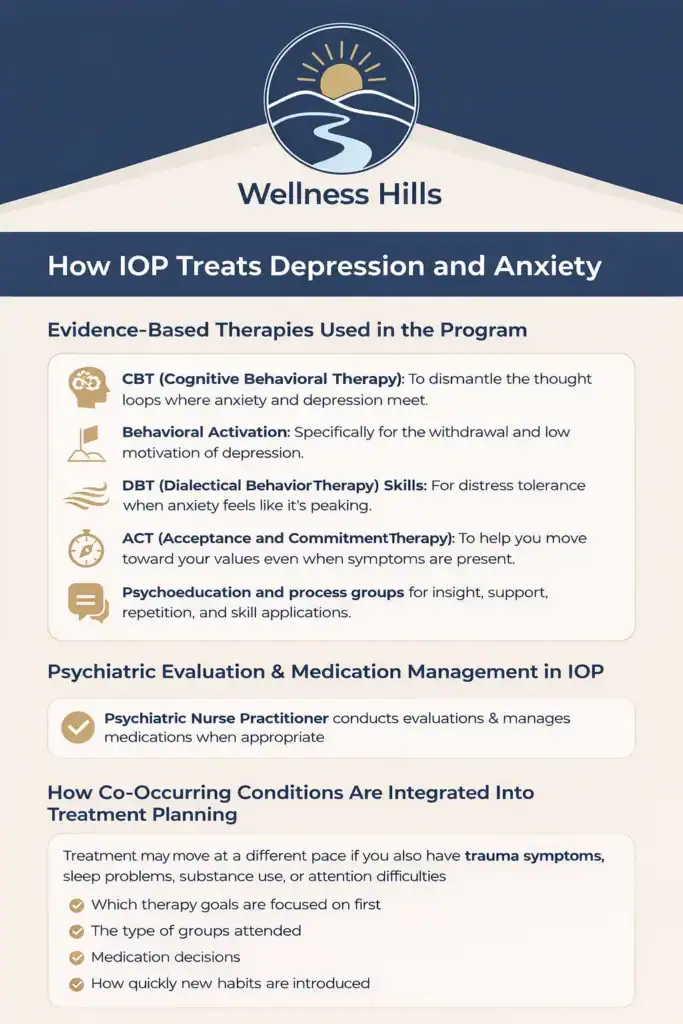
Evidence-Based Therapies Used in the Program
Treatment for co-occurring anxiety and depression requires a specific sequencing of interventions, not just a list of modalities applied simultaneously. At Wellness Hills, the clinical team structures the therapeutic approach based on each patient’s symptom severity and functional status at intake.
- CBT (Cognitive Behavioral Therapy): To dismantle the thought loops where anxiety and depression meet.
- Behavioral Activation: Specifically for the withdrawal and low motivation of depression.
- DBT (Dialectical Behavior Therapy) Skills: For distress tolerance when anxiety feels like it’s peaking.
- ACT (Acceptance and Commitment Therapy): To help you move toward your values even when symptoms are present.
- Psychoeducation and process groups for insight, support, repetition, and skill applications.
Psychiatric Evaluation and Medication Management in IOP
While medication is not a requirement for everyone, our Psychiatric Nurse Practitioner, Paula Weisman, PMHNP-BC, conducts initial psychiatric evaluations and manages ongoing medication decisions within the program.
In an IOP setting, medication review can happen alongside frequent therapist feedback so we can monitor side effects and symptom changes in real-time, several days a week, rather than once a month.
How Co-Occurring Conditions Are Integrated Into Treatment Planning
Treatment may move at a different pace when someone is dealing with more than one concern. Things like trauma symptoms, sleep problems, substance use, or attention difficulties can affect:
- Which therapy goals are focused on first
- The type of groups someone attends
- Medication decisions
- How quickly new habits or goals are introduced
Instead of putting everyone through the exact same program, clinicians adjust the treatment plan based on each person’s symptoms, daily functioning, and safety needs.
What to Expect From IOP at Wellness Hills
Wellness Hills offers two IOP scheduling tracks. The track you enter depends on your symptom severity, your current level of daily functioning, and your work or family obligations.
Your clinician and the admissions team will recommend a track during intake, though patients can transition between tracks if their needs change during treatment.

IOP 3 Evening Schedule for Adults Managing Work, School, or Family
This track is designed for the high-functioning adult who needs support but cannot take a leave of absence.
- Days: Monday, Tuesday, and Thursday
- Time: 6:00 PM to 9:00 PM
- Focus: Skill application, processing the day’s stressors, and maintaining existing roles.
IOP 5 Morning Schedule for Adults Who Need More Structure
This is for the individual whose daily routine has collapsed. If you are struggling to get out of bed or maintain a basic schedule, the depression and anxiety IOP schedule in the morning provides the necessary anchor for your week.
- Days: Monday through Friday
- Time: 9:00 AM to 12:00 PM
- Focus: Stabilizing routines, intensive skill building, and daily accountability.
What Your First Week in IOP Looks Like
The first week of IOP is focused on orientation, assessment, and building initial comfort with the program structure. Here is what most patients experience:
Day 1 – Intake and Orientation: You complete a clinical intake with your assigned therapist, including a diagnostic assessment, treatment history review, baseline PHQ-9 and GAD-7 scoring, and an initial discussion of your goals. If psychiatric evaluation is indicated, it is typically scheduled within the first few days.
Days 2–3 – First Group Sessions: Group therapy can feel uncomfortable at first, particularly if you have social anxiety or have never been in a therapeutic group before. Clinicians structure early sessions to build safety and reduce pressure, you are not expected to share your full history on day one. Early groups focus on psychoeducation, skill introduction, and getting used to the rhythm of the program.
By End of Week 1: Your treatment plan is in place, your baseline scores are established, and you have attended your first two to three sessions. Most patients describe the first week as harder than they expected emotionally, but more manageable logistically than they feared.
How Therapy, Family Involvement, and Discharge Planning Work Together
Group therapy forms the foundation of the IOP experience at Wellness Hills.
Additional components may include:
- Individual therapy or clinician check-ins
- Family involvement when clinically appropriate
- Psychiatric support when needed
Discharge planning begins early. The goal is to prepare the next stage of care, rather than waiting until the final week of treatment.
How Wellness Hills Tracks Progress and Plans Next Steps
Progress in IOP is measured, not assumed. The clinical team tracks symptom severity and daily functioning using validated instruments at regular intervals throughout treatment.
Validated Tools Used to Monitor Depression and Anxiety
We use the PHQ-9 (for depression), the GAD-7 (for anxiety) as clinical benchmarks, and the C-SSRS (when suicide risk monitoring is clinically indicated). By tracking these scores over time, we can see exactly how your symptoms are responding to treatment.
We also monitor functional metrics. Are you sleeping better? Are you engaging more at work? Are you withdrawing less? Tracking both symptoms and functioning helps guide treatment adjustments.
How Discharge Planning and Step-Down Support Are Built-In
From your first day, we are planning your last day. This is called step-down planning. Next steps may include:
- Internal Step-Down: Moving to a less intensive level of care within the Wellness Hills network to maintain continuity with familiar providers.
- Outpatient & Medication Management: Transitioning to regular therapy and psychiatric care for long-term support.
- Higher-Intensity Referral: If more structure is needed than outpatient care but less than residential treatment, a patient may be referred to a Partial Hospitalization Program (PHP).
The discharge process typically begins around the midpoint of treatment, when the clinical team can assess whether the patient’s symptom trajectory supports a step-down or indicates the need for additional time.
Each patient receives a written discharge plan that includes their recommended next level of care, referrals to specific providers (not just general recommendations), updated medication instructions if applicable, and a relapse prevention framework developed in the final phase of group therapy. The goal is to ensure that no patient leaves IOP without a concrete next step already scheduled.
How IOP Compares With Therapy, PHP, and Inpatient Care
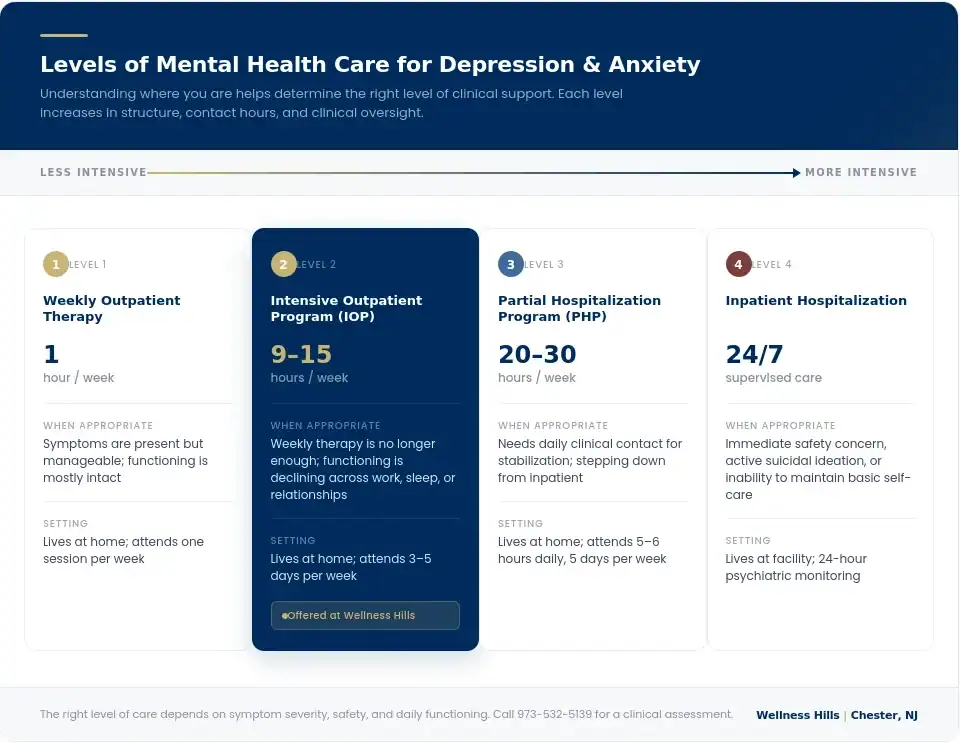
Choosing the right level of care depends on symptom severity, safety considerations, and the amount of structure you need to function day to day. Here is how the levels compare for individuals managing depression and anxiety:
When Weekly Outpatient Therapy Remains the Appropriate Level of Care
Some individuals benefit from traditional outpatient therapy when symptoms remain stable, and functioning is mostly intact. In these cases, additional structure may not be necessary.
When IOP is the Right Level of Care
IOP therapy for depression and anxiety may be appropriate when someone needs:
- More frequent contact with clinicians
- Structured group therapy
- Greater accountability for skill use
- Support between therapy sessions
When PHP is the Safer or More Clinically Appropriate Step
A Partial Hospitalization Program (PHP) offers more intensive daytime support.
This level of care may be recommended when symptoms require:
- Extended daily treatment
- Closer monitoring
- Greater stabilization support
At Wellness Hills, patients who need this higher level of support can transition into our PHP for depression without changing facilities or clinical teams.
When Inpatient or Emergency Evaluation is the Better Fit
If safety concerns escalate or psychiatric instability becomes severe, inpatient or emergency evaluation may be necessary. Clinicians help guide individuals toward the most appropriate level of care based on current needs.
Insurance, Cost, and Starting IOP in New Jersey
Cost is one of the most common reasons people delay starting an IOP, and one of the most common areas of confusion. The reality is that most patients at Wellness Hills do not pay the full cost of treatment out of pocket.
Insurance coverage has improved significantly under federal and state parity laws, and our admissions team handles verification before your first session, so you know exactly what to expect financially. Below is how coverage, authorization, and cost typically work.

NJ Mental Health Parity and What it Means for IOP Coverage
Many insurance plans may provide coverage for mental health IOP in NJ when treatment is considered medically necessary.
New Jersey and the federal mental health parity laws, including MHPAEA (The Mental Health Parity and Addiction Equity Act), aim to support access to behavioral health services.
However, coverage varies depending on:
- Individual plan benefits
- Network status
- Authorization requirements
How Insurance Verification, Prior Authorization, and Length of Stay Work
Before starting a program, admissions teams typically verify insurance benefits.
The process may include:
- Benefits review
- Prior authorization from the insurer
- Clinical documentation to establish medical necessity
Length of stay in an IOP varies based on clinical progress, symptom severity, and payer requirements.
Questions to Ask Before Starting an IOP Program
Before enrolling in any IOP program, consider asking these questions; they will help you distinguish between programs that sound similar on paper but differ significantly in practice:
- What specific clinical instruments do you use to track my progress, and how often are they administered?
- Will I have access to a psychiatric prescriber within the program, or will I need to see someone externally for medication?
- How are treatment plans individualized for someone with both depression and anxiety, as opposed to just one condition?
- What does the step-down process entail, and will my next provider be identified before I am discharged?
- What happens if my symptoms worsen during the program? Is there a protocol for escalating to a higher level of care?
- Can I see the credentials of the clinicians who will be leading my groups?
Serving Morris County and Northern New Jersey From Chester
Licensing, clinical credentials, and physical accessibility all matter when choosing an IOP, especially for a program you will attend multiple days per week for several months. Here is how Wellness Hills is structured, who provides your care, and where the facility is located relative to the communities we serve.

NJ Licensing and Clinical Oversight at Wellness Hills
Wellness Hills Mental Health Treatment Center operates as a licensed provider in New Jersey through the New Jersey Department of Health (License No. 70290104).
The clinical team includes licensed professionals and program leadership, such as:
- Leigh Rasmussen, LPC, LCADC – Program Director
- Abby Goodrich, LAC – Primary Therapist
- Paula Weisman, PMHNP-BC – Psychiatric Nurse Practitioner
This matters because treatment quality depends not only on which therapies are offered but also on who supervises care, who monitors symptom change, and who is responsible for adjusting the plan when progress is limited or risk increases.
Communities and Service Areas Within Reach of Our Chester Location
Wellness Hills Mental Health Treatment is located at 425 Main St., Floor 1, Chester, NJ 07930, in western Morris County. The facility serves adults throughout Morris County and the surrounding areas of Northern New Jersey, including Mendham, Morristown, Randolph, Denville, Parsippany, Long Valley, Hackettstown, Bernardsville, and Basking Ridge.
The Chester location provides access via Route 206, Route 24, and I-287, making it reachable within 20–35 minutes from most of Morris County and the surrounding Somerset, Hunterdon, and Sussex County communities. Reliable access to care is an important part of completing an intensive outpatient program for depression and anxiety.
Frequently Asked Questions About IOP For Anxiety and Depression
These are the questions our admissions team and clinicians hear most often from people considering treatment. If your specific question isn’t answered here, contact us for a confidential conversation with the admissions team.
How long does IOP for anxiety and depression usually last?
While it varies, many clients find that 6 to 12 weeks provides the necessary time for neurological and behavioral recalibration.
Does IOP help if I have both depression and anxiety?
Yes. Treatment planning in an intensive outpatient program for depression and anxiety often focuses specifically on how mood symptoms and anxiety symptoms interact.
Will my employer know I'm in an IOP?
No. IOP participation is protected health information under HIPAA. Wellness Hills does not contact employers or disclose treatment participation to anyone without your written consent.
What happens if I miss a session?
If you need to miss a session, contact the program as soon as possible. The clinical team will work with you to determine whether a make-up session is needed or whether the absence can be accommodated within your treatment plan.
Can I switch between the morning and evening IOP track?
Yes, when clinically appropriate. Some patients begin in the five-day morning track for stabilization and transition to the three-day evening track as functioning improves and they return to work. Others may step up from the evening track to the morning track if symptoms require more intensive support.
Take the Next Step
If depression and anxiety are affecting your ability to work, sleep, or engage with the people around you, and weekly therapy is no longer enough, an IOP may be the right next step.
To find out, call the Wellness Hills admissions team at 973-532-5139 for a confidential assessment. During this call, you can verify your insurance, request a confidential assessment, or speak with the admissions team to determine whether IOP is the appropriate level of care. Most intake assessments are scheduled within days of the initial call.
Sources:
Mental Health Parity and Addiction Equity Act (MHPAEA) | CMS – Explains mental health parity requirements for health plans, including equal treatment of mental health and substance use disorder benefits compared with medical and surgical benefits.
988 Suicide & Crisis Lifeline | 988 Lifeline – Explains that 988 provides free, confidential, 24/7 support by call, text, or chat for people experiencing mental health struggles, emotional distress, and for those helping a loved one.
Editorial Standards
Our Editorial Policy
Our editorial standards keep our mental health content accurate, compassionate, and evidence-informed. Articles are developed using credible sources, reviewed for medical accuracy when needed, and regularly updated.