


When you or a loved one is struggling with mental health, the terminology used by providers can feel like a secondary barrier to getting help. You may hear acronyms like PHP, IOP, or OP and wonder which one actually fits your life. The biggest difference between these options is how many hours per week you receive care and how much structure and support are built into your schedule.
At Wellness Hills in Chester, NJ, we offer a full continuum of support to meet you where you are. We offer an Outpatient Program (OP), a traditional weekly counseling program; an Intensive Outpatient Program (IOP) that provides more frequent, structured support several days per week; and a Partial Hospitalization Program (PHP), a full-day program for maximum support without an overnight stay.
An assessment can help you choose the level of care that safely fits your symptoms, schedule, and daily life.
Quick Comparison: Time, Structure, and Best Fit
OP, IOP, and PHP aren’t better or worse; they’re different levels of weekly structure. The fastest way to tell them apart is by hours per week and how much support you need between sessions.

The Main Difference is Hours Per Week and Structure
- Outpatient therapy (OP) offers the least structure, typically with one session per week. It relies heavily on what you practice between sessions.
- The Intensive Outpatient Program (IOP) provides moderate structure, with sessions several days a week. At Wellness Hills, it is offered in both day and night programs to accommodate work schedules.
- A Partial Hospitalization Program (PHP) provides the highest level of structure without overnight care, resembling a structured daytime therapeutic program.
Outpatient Therapy is the Most Flexible Option
OP usually involves one or two sessions per week, making it easy to balance with a full-time job or school schedule. This option can be a good fit if you can manage your daily routine (like school, work, and family responsibilities) and practice new coping skills on your own between visits.
IOP Adds Structured Support Several Days Per Week
An Intensive Outpatient Program offers a middle ground between outpatient and inpatient care, with more repetition and accountability. These programs often include group therapy sessions and can be a good fit for those who need more support than a weekly visit can provide. It can be a good step up when symptoms feel more difficult to manage on your own.
PHP Provides the Highest Support Without Overnight Care
A Partial Hospitalization Program is a day program where you receive frequent support and help rebuilding your daily routine. While it provides many hours of therapy each day, it is not inpatient care; you still return home every evening.
An Assessment Helps Match the Right Level of Care
A professional evaluation can be a good way to determine your needs. Aim to start where care is enough to help you move forward safely and successfully.
What PHP, IOP, and Outpatient Therapy Mean in Plain Terms
Beyond the acronyms, here’s what each level involves in practical, clinical terms at Wellness Hills.
Outpatient Therapy (OP)
Most programs offering outpatient mental health therapy in New Jersey are designed to be flexible, allowing individuals to receive professional support while maintaining their independence.
You usually attend therapy once or twice a week. Each session lasts about 45-60 minutes. Appointments can be in the morning, afternoon, or evening to fit around work, school, or family duties. It can work best if you manage your daily routine and have a safe place to live. You use the coping skills you learn in your everyday life between sessions, and medication may be included if a doctor decides it is necessary.
Intensive Outpatient Program (IOP)
IOP is a structured treatment plan that provides extra support several days a week while you live at home. You typically attend sessions 3 to 5 days a week for a few hours each time, and often recommended when regular weekly therapy isn’t enough to stop a downward spiral or when you need more structure to keep moving forward in your recovery.
You can continue working or attending school because a typical intensive outpatient program in New Jersey is designed to fit into your daily life.
Partial Hospitalization Program (PHP)
Most outpatient facilities offering a partial hospitalization program in New Jersey provide it as their highest level of intensive care without an overnight stay. It can be a good fit for people who have serious symptoms that make it hard to handle daily life, but are safe enough to sleep at home at night.
Patients typically attend treatment 5 to 6 hours daily, five days a week (typically weekdays). PHP is often used as a step-down for those transitioning from inpatient care. Sometimes, it can also serve as a step-up for individuals whose symptoms are not managed by standard outpatient therapy.
How to Choose Between PHP, IOP, and Outpatient
To choose between OP, IOP, and PHP, focus on how much structure you need each week to stay stable and make progress. The steps below help you quickly identify which level is most likely to match your current needs.
Step 1: Check Daily Functioning
Think about your daily routine. If you are missing work or school, struggling to care for your home, or not sleeping or taking care of yourself, you may need more structure, like a PHP. Outpatient therapy can be a good option when you can use coping skills on your own between sessions. If you cannot manage that yet, more support may be needed.
Step 2: Check Support Between Sessions
If you have a stable place to live and people to help you, OP or IOP are usually enough. These work well if you feel confident that you can show up to your appointments on your own. If you feel lonely, have limited support, or your living situation is stressful, a PHP may be a better option. It gives you a safe place to go every day for extra support and a routine.
Step 3: Check Safety and Urgency
Your safety comes first. If you feel unable to keep yourself safe or are having serious thoughts of harming yourself, you need immediate emergency help. This guide is only for planning care levels and does not replace crisis or emergency services.
The Bandwidth Test
Think about your mental energy. If all your energy goes into just getting through the day, you may not have enough left to do therapy work on your own. In that case, weekly outpatient therapy may not be enough. IOP or PHP can provide more structure and support when your energy is low.
The Spiral Speed Test
Notice how quickly your symptoms are worsening. If things are slowly getting harder, outpatient therapy may still work. If your symptoms worsen rapidly over a few days, you may need more frequent care, such as IOP or PHP, to slow the progression and help stabilize you.
When Stepping Up Care is Usually Recommended
Step-up care is commonly advised when weekly therapy stalls, avoidance of daily tasks expands, or conflict in your relationships increases to an unmanageable level.
When Stepping Down Care May Make Sense
Moving to a lower level of care is a great sign of progress. It may make sense when:
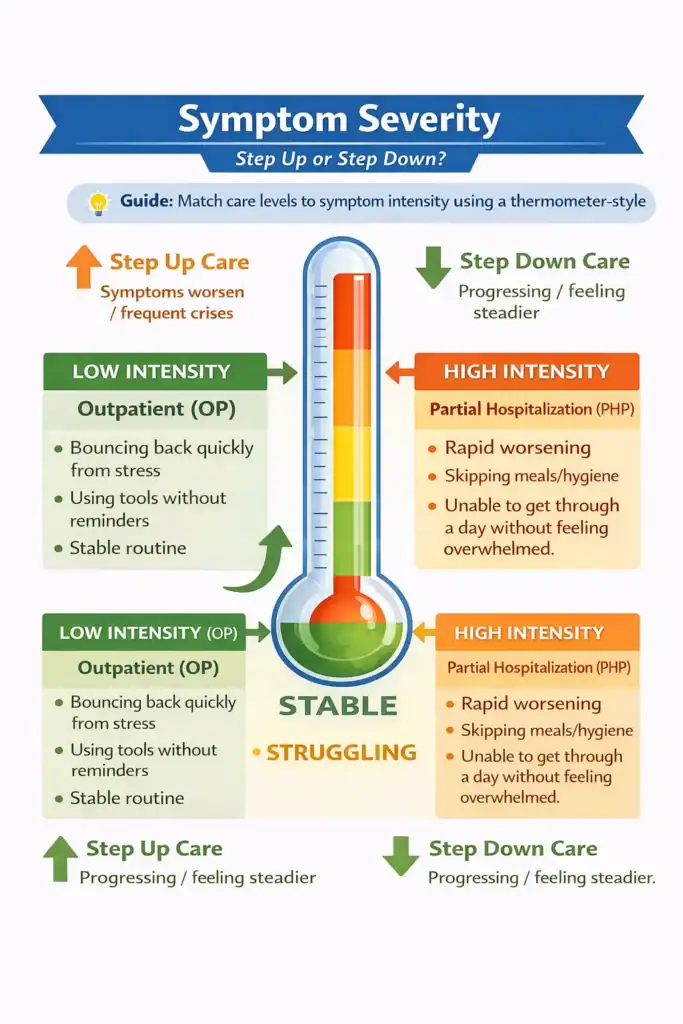
- You feel steadier: Your moods don’t jump up and down as much, and you feel more in control of your emotions.
- You bounce back faster: When you have a bad day or a stressful moment, you can get back to feeling okay much more quickly than before.
- You use your tools on your own: you apply the skills you learned in therapy in your daily life, without a counselor reminding you.
When these things happen, it usually means you are ready to spend less time in treatment and more time enjoying your daily life.
Side-by-Side Comparison of OP, IOP, and PHP
If you’re choosing between OP, IOP, and PHP, the simplest way to compare them is by hours per week, structure, and how much support you get between sessions. The table below summarizes the practical differences at a glance.
| Feature | Outpatient (OP) | Intensive Outpatient (IOP) | Partial Hospitalization (PHP) |
| Hours/Week | Roughly 1–2 Hours | Roughly 9–15 Hours | Roughly 25–30 Hours |
| Accountability | Individual/Independent | High (Group + Individual) | Maximum (Daily Contact) |
| Primary Goal | Target Change | Stabilization & Skills | Routine Rebuilding |
Note: Specific hours and structure vary by provider and insurance authorization.
Weekly Time Commitment
Relative ranges vary by provider and insurance authorization. Typically, OP is the least time-intensive, while PHP is a full-time commitment during the day.
Treatment Structure and Accountability
OP depends heavily on your ability to practice between sessions. IOP and PHP add repetition and structure, making it appropriate, especially if you have concerns that symptoms could derail your progress between visits.
Group Therapy vs. Individual Sessions
Individual therapy is often one-on-one. This means you meet with your therapist alone. However, more intensive programs (such as IOP and PHP) typically include many group sessions. In these programs, you work in a group but also have quick, private talks with a therapist.
Group is not better, but it offers more practice and support from peers navigating similar challenges.
Skill Building and Real-World Practice
At all levels, CBT skills and DBT skills are taught, but in IOP and PHP, you have more opportunities to apply them under clinical supervision before going home.
What Each Level of Care Feels Like Week to Week
No matter which level you start in, progress usually follows a similar pattern: stabilize, practice skills, then stress-test those skills in real life. Here’s what that often looks like week to week.
Week 1: Starting Care and Building a Plan
This first week is all about getting your treatment plan in place. We’ll sit down together to figure out what you want to achieve, understand what causes you stress, and see where you’re starting from. We’ll have a thorough discussion to ensure we’re zeroing in on the right issues while being realistic about what we can accomplish.
Weeks 2 to 4: Practicing Skills and Rebuilding Routines
This is when practice really makes a difference. You’ll join groups focused on managing your emotions and handling tough times. Small, daily changes, like keeping a regular sleep schedule, start to become part of your daily rhythm.
Weeks 4 to 8: Strengthening Consistency Under Stress
Setbacks can ensue, but progress is measured by how quickly you bounce back. We’ll concentrate on preventing relapse and making sure your skills hold up even when you encounter real-world triggers.
How Progress is Tracked
At Wellness Hills, we use simple checklists to monitor your progress. These help us understand both how you feel and how you are handling daily life.
Here is what we track:
- PHQ-9: Checks how strong your sadness or depression feels.
- GAD-7: Tracks how much worry or anxiety you have.
- CGI: A quick look at how much your symptoms are affecting your general life.
- ORS: You rate how well you are doing at home, at work, and with others.
- SRS: You may be asked to rate your therapy session to let us know if it was helpful and if you felt heard.
What Setbacks Can Look Like
Having a bad day doesn’t mean you have failed or that your hard work is gone. Instead, think of it as a learning moment to see what else you might need. Your team of counselors is there to support you. If things get tough, they will simply change your plan to give you more help until you feel steady again.
Outpatient Therapy in New Jersey: Who it Often Fits Best
Outpatient mental health therapy in New Jersey can fit well for those with a stable routine and mild-to-moderate symptoms. It can be effective if you attend sessions consistently and apply the tools taught (such as CBT-based therapy approaches) between appointments.
Common Reasons OP is Enough
- A stable daily routine and a supportive home environment.
- Ability to practice coping strategies independently.
- Symptoms do not significantly impair work or parenting.
IOP in New Jersey: Who it Often Fits Best
When weekly therapy has not been enough, an intensive outpatient program in NJ offers the necessary support. It is commonly suggested for those whose symptoms affect their work or relationships most days.
When Weekly Therapy Has Not Been Enough
If you’ve hit a plateau or stalled in your progress, the added frequency of IOP can provide the breakthrough you need.
When Symptoms Affect Work, School, or Relationships Most Days
A key indicator that IOP is right for you is the impact on your daily functioning. For example, if anxiety or depression makes it hard to focus at work, attend school, or stay connected with loved ones most days of the week, the increased structure of an IOP can provide the stability you need to get back on track.
What a Typical IOP Week Can Include
In an IOP, you aren’t alone. You will:
- Talk in group meetings with others.
- Practice new skills to handle stress.
- Have check-ins to see how you are feeling.
- Go to the center 3 to 5 days a week, though every program is a little different.
PHP in New Jersey: Who it Often Fits Best
A Partial Hospitalization Program (PHP) offers the most intensive support available while still allowing you to go home at the end of the day. It is an ideal bridge for those who need a high level of clinical care to stay stable and safe.
When Symptoms Disrupt Daily Life and Routine Stability
This level of care is commonly suggested when mental health symptoms make it difficult to manage basic responsibilities. This includes situations where sleep, hygiene, eating habits, parenting, or work routines are significantly impacted. If you find it hard to get through a normal day without feeling overwhelmed, the structure of a PHP provides the necessary external support.
What a Typical PHP Day Can Include
A typical PHP follows a day program structure, typically running from morning until mid-afternoon. Your day includes multiple group therapy sessions, clinical check-ins with therapists, and activities focused on stabilizing your daily routines. It provides a safe, consistent environment where you can focus entirely on your health before returning home each evening.
PHP vs. Inpatient Hospitalization
The main difference is that PHP is not an overnight program. Inpatient hospitalization is reserved for acute safety needs requiring 24-hour medical supervision. PHP allows you to receive a similar level of intensive daytime therapy while maintaining the comfort of sleeping in your own bed.
PHP vs. Residential Treatment
Residential treatment involves living on-site at a facility for several weeks or months. In contrast, PHP is a structured day treatment. You spend your days at the New Jersey treatment center while continuing to live at home throughout the process.
Step Up and Step Down Care: How Movement Between Levels Works
Levels of care aren’t fixed; they’re adjusted based on how you’re doing week to week. Here’s how clinicians typically decide when to increase support or taper intensity.
How Stepping Up Care is Typically Decided
Stepping up can occur when your symptoms worsen, and you need more support (e.g., you are having more trouble managing daily life).
How Stepping Down Care is Typically Decided
Stepping down often occurs when you feel stable and consistent and are successfully using your new skills in your everyday life. You need less support.
PHP to IOP Step-Down Timeline Factors
Everyone heals differently, so we don’t have set timelines. Your readiness to move forward and attend your sessions is the most important factor.
IOP to Outpatient Step-Down Timeline Factors
This step depends on stability in life and daily routine, as well as a clear relapse-prevention plan.
Continuity of Care and Relapse Prevention Planning
Staying connected to care during transitions matters. Ongoing support helps reduce setbacks and keeps progress going.
Scheduling and Access in New Jersey: What to Plan For
The best program is the one you can consistently attend. Here’s what to consider in New Jersey: commute time, daily energy, scheduling options, and telehealth vs in-person care.
Choosing a Program Schedule You Can Actually Attend
It is very important to attend your appointments every time. If your therapy schedule is too hard to keep, it will just cause you more stress.
Commuting and Energy Limits in New Jersey
Driving in New Jersey can be exhausting due to heavy traffic. When selecting a treatment facility, consider how far you have to drive. You don’t want to be tired out by the commute before your therapy even starts.
Work, School, and Parenting Logistics
Most people have jobs, classes, or children to look after. Some locations offer morning sessions, while others offer evening sessions. Make sure to ask about the exact times so you can build a plan that fits around your responsibilities.
Telehealth vs In-Person Care in New Jersey
Many New Jersey counseling centers let you choose between in-office therapy and therapy online (Telehealth). Using a computer or phone for therapy can save you travel time, but you should check with your provider to see if it is a good fit for your specific needs.
Understanding Insurance Terms in New Jersey
- Prior Authorization: Before you start certain treatments, your insurance company must approve them. They review your records to make sure the care is truly needed for your health.
- Medical Necessity: This means the care you receive must match the severity of your symptoms and the trouble you’re having. It must be necessary for your health.
- In-network vs. Out-of-network: Coverage differences that affect your deductible and copay.
- Deductible/Coinsurance: The portion of costs you pay out-of-pocket before and after insurance kicks in.
How Wellness Hills Approaches Level of Care Decisions
At Wellness Hills, our goal is to give you the perfect amount of support, not too much, not too little. We match you with a program that helps you live your daily life successfully.
The “Just Right” Amount of Help
- Our main goal is to find the lowest level of care that still keeps you safe and helps you make progress.
- We want to avoid giving you too little help, which isn’t safe.
- We also don’t want to give you so much structure that it messes up your normal routines.
- We help you find that perfect, healthy balance.
Minimum Effective Intensity Matching
Our goal is to give you the lowest level of care that still keeps you safe and helps you move forward. We don’t want to give you too little help, but we also don’t want to give you so much that it interferes with your normal life. We help you find the perfect balance.
Skills-Based Care Built Around Real-Life Functioning
We teach you practical tools that you can use right away. Using methods like CBT and DBT, we show you how to handle everyday problems at your job, with your family, and in your friendships. It’s about making your daily life easier.
Trauma-Informed Pacing and Stabilization First
If you have been through something scary or painful (trauma), we make sure not to overwhelm you. We start by helping you feel stable and safe. We move at a pace that feels comfortable for you, so you never feel too stressed or overwhelmed by the process.
Progress Monitoring That Supports Step-Down Decisions
We use simple check-ins to see how you are doing. We assess how you feel and how you handle daily tasks. As we see you getting stronger and steadier, we can discuss moving you to a program with fewer hours, so you have more free time.
The Leadership Team:
The clinical integrity of our OP, IOP, and PHP programs at Wellness Hills is maintained by a specialized leadership team with deep experience in high-acuity behavioral health care:
- Leigh Rasmussen, LPC, LCADC – Program Director with extensive experience in trauma-informed treatment. Leigh is in charge of all the therapy programs. She makes sure every person gets the right kind of treatment, whether it is for mental health or drug and alcohol concerns. Her job is to ensure your care is safe, helpful, and fits your specific needs.
- Abby Goodrich, LAC – She focuses on teaching you practical skills to handle your feelings and stay calm.
- Paula Weisman, PMHNP-BC – Board-Certified Psychiatric Mental Health Nurse Practitioner. If you need medicine to help you feel more stable or less stressed, she will meet with you to see what works best. She works closely with your therapists to make sure your medication and talk therapy are working well together.
Safety Note: When to Seek Immediate Help
This article isn’t a substitute for emergency care. If you are in danger or feel like you might hurt yourself or someone else, use these ways to get help:
- For immediate danger: Call emergency services or go to the nearest emergency room right away.
- If you are in a crisis: Call or text a suicide and crisis hotline. You can also Chat Online at 988lifeline.org to talk to someone who can help, 24 hours a day.
- Morris County Crisis Hotline: Call 973-625-6160 or 973-625-0280 to reach Saint Clare’s Psychiatric Emergency Services.
If you live in New Jersey: You can find a local place to get checked out immediately by visiting the NJ County Screening Centers list.
Frequently Asked Questions About PHP, IOP, and OP
These are the questions people most often ask when deciding between outpatient therapy, IOP, and PHP in New Jersey. The answers below cover scheduling, insurance, and signs you may need more or less structure.
Can I work or go to school while in IOP or PHP?
IOP is often designed to work around a job or school schedule. PHP is a full-day commitment and usually requires a temporary leave of absence.
Is PHP the same as inpatient hospitalization?
No. Inpatient is 24/7 care in a hospital setting. PHP is a day program where you return home each night.
How do I know if weekly therapy is not enough anymore?
If you are having frequent crises between sessions or if your avoidance of life is expanding despite therapy, you may need more structure.
Does insurance usually cover PHP or IOP in New Jersey?
Yes. Most New Jersey insurance plans cover these programs if a clinician documents medical necessity. You can verify your specific coverage through the NJ Department of Banking and Insurance.
Can I start in outpatient and step up later?
Absolutely. We adjust the intensity of care based on your response to treatment.
What is the biggest sign I need IOP?
When mental health symptoms significantly impair your daily functioning, making it difficult to maintain work, school, or home responsibilities, while you remain stable enough to live at home.
What if I can’t attend PHP five days per week?
Your treatment should fit your life. If attending PHP five days a week is not possible, providers can often discuss IOP options or alternative schedules that still provide the support you need within your limits.
How many hours per week are PHP vs IOP vs outpatient therapy in New Jersey?
Roughly: OP (1–2 hrs/week), IOP (9–15 hrs/week), PHP (25–30 hrs/week). Exact schedules vary by provider and insurance authorization.
Next Step: Get Matched to the Right Level of Care
A clinical assessment helps determine the right level of care based on your current needs. Our team can also review your insurance and explain the next steps in a private, confidential manner.
To get a clear recommendation and the right level of support for your symptoms and daily life, you can call 973-532-5139 or use our contact form.
We are licensed by the New Jersey Department of Health (License No. 70290104).
Sources:
Crisis Intervention & Emergency Care (Saint Clare’s Health, n.d.) | SaintClares.com – Overview of psychiatric emergency and crisis programs, PES screening and crisis stabilization, and 24-hour hotline access in Denville, NJ.
Designated Screening Services in New Jersey (Updated: December 1, 2025) (New Jersey Department of Human Services – Division of Mental Health and Addiction Services, 2025) | NJ.gov (PDF) – County-by-county list of primary psychiatric screening services and 24-hour hotlines for crisis intervention, information, and referral.
Editorial Standards
Our Editorial Policy
Our editorial standards keep our mental health content accurate, compassionate, and evidence-informed. Articles are developed using credible sources, reviewed for medical accuracy when needed, and regularly updated.