


Burnout and depression can feel almost identical: the same exhaustion, the same loss of drive, the same sense that something is off. As clinicians treating both conditions at our New Jersey mental health center, we hear one question more than almost any other: ” Am I dealing with stress, or something more serious?
The distinction matters because the response is different. Burnout is tied to a specific stressor and tends to improve when that stressor is reduced. Depression spreads across all areas of life and typically persists regardless of environmental changes. But the overlap between them is significant, and long-term burnout can progress into clinical depression.
This article compares depression vs burnout using the same framework our clinical team uses during intake assessments, so you can start making sense of what you’re experiencing and understand what to do next.
Quick Answer: Am I Burned Out or Depressed?
Burnout is a stress response tied to a specific source, usually your job, but also caregiving, academic pressure, or parenting. Depression is a clinical condition that affects all areas of your life, regardless of circumstances.
Two directional signals help separate them:
| Feature | Burnout | Depression |
|---|---|---|
| Scope | Tied to one area (e.g., work). You may still feel like yourself on weekends or with friends. | Spreads across work, relationships, self-worth, and physical health. Affects nearly everything. |
| Response to Rest or Change | More likely to ease when the stressor is removed or reduced. | More likely to persist even when circumstances improve. |
| Emotional Tone | Frustration, cynicism, detachment — directed at the situation. | Hopelessness, emptiness, numbness — directed at yourself and life in general. |
| Diagnostic Status | Classified as an occupational phenomenon in ICD-11. Not a mental health diagnosis. | Major Depressive Disorder (MDD) is a clinical diagnosis with specific criteria in the DSM-5-TR. |
| Duration Pattern | Builds over weeks or months of sustained stress. Can resolve with structural change. | Episodes last at least 2 weeks. Often recurrent. May develop without a clear external trigger. |
| Physical Symptoms | Exhaustion and sleep disruption that improve with time off. | Fatigue, appetite changes, unexplained pain, psychomotor changes that persist regardless of rest. |
These are directional signals, not diagnostic rules. They can co-occur, and they often do. If you’re asking, “Am I depressed or burned out?” that uncertainty is itself a reason to seek a professional evaluation.
What Burnout Actually is and isn’t
Burnout is defined in the World Health Organization’s (WHO) ICD-11 as an occupational phenomenon, not a mental health disorder. It has three core dimensions:
- Emotional exhaustion
- Cynicism or detachment from work
- Reduced sense of effectiveness
Clinicians often assess burnout severity using validated tools like the Maslach Burnout Inventory (MBI), which measures these three dimensions on a spectrum. Burnout is not binary; it ranges from mild detachment to complete functional breakdown.
While the official definition focuses on the workplace, Leigh Rasmussen, LPC, LCADC, our Program Director, notes that clinicians increasingly recognize similar patterns in non-work roles. This includes the heavy toll of long-term caregiving, parenting, or intense academic pressure.
Burnout is not laziness. It’s not a lack of discipline. And it’s not the same as depression.
Research has investigated whether depression and burnout share biological mechanisms, particularly involving the HPA axis (the body’s central stress response system) and cortisol regulation.
A 2019 narrative review on burnout and endocrine function found that, while chronic stress leads to burnout, existing studies have produced inconsistent results, indicating that the biological connection remains an active area of research rather than an established fact.
What is more clearly supported is the behavioral pathway: prolonged burnout erodes coping capacity, disrupts sleep, and reduces engagement in protective activities, creating conditions under which clinical depression is more likely to develop.
What Depression Looks Like: Beyond Feeling Sad
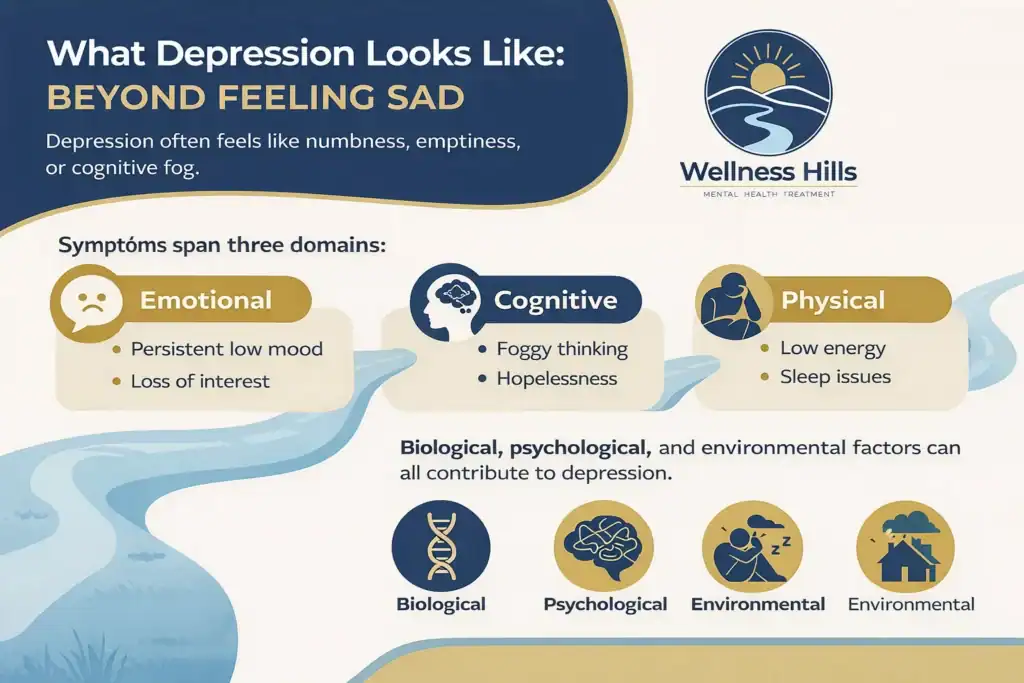
Depression is not just sadness. Many people describe numbness, emptiness, or cognitive fog more than sadness, which is exactly why it gets confused with burnout.
Major Depressive Disorder (MDD) is a clinical diagnosis with specific criteria in the DSM-5-TR. Symptoms span three domains:
- Emotional: persistent low mood, irritability, loss of interest or pleasure (anhedonia, the inability to enjoy things you used to love).
- Cognitive: trouble concentrating, indecision, negative self-talk, hopelessness.
- Physical: sleep disruption, appetite changes, low energy, unexplained aches.
Depression also does not require a clear cause. It can develop from biological factors (genetics, neurochemistry), psychological factors (cognitive patterns, trauma history), or environmental factors (chronic stress, loss, isolation). Long-term, unresolved burnout can be one of those environmental pathways; a 2021 meta-analysis found a significant positive correlation between burnout severity and depressive symptom intensity.
The Overlap: Why It's So Hard to Self-Diagnose
Both conditions share a significant symptom footprint. Both can include exhaustion, difficulty concentrating, irritability, social withdrawal, sleep disruption, and low motivation. This overlap is not superficial; a 2023 study found that burnout overlapped more with non-melancholic depression than with melancholic depression, suggesting the two conditions may sit on a shared spectrum rather than being entirely distinct categories.
The directional signals in the table above can help you orient, but they are not rules:
- Some burnout doesn’t lift after time off, especially if it has been building for months or years.
- Some depression can feel temporarily lighter in certain environments, mimicking the weekend relief pattern of burnout.
- Both conditions can co-occur, and often do. Individual risk factors for depression, such as prior depressive episodes, are also predictors of burnout, suggesting shared vulnerability.
A clinical assessment does not just ask “which one is it?” It examines the pattern, timeline, severity, and functional impact to determine what combination of support will actually help.
5 Escalation Signals: When Burnout May Be Crossing Into Depression
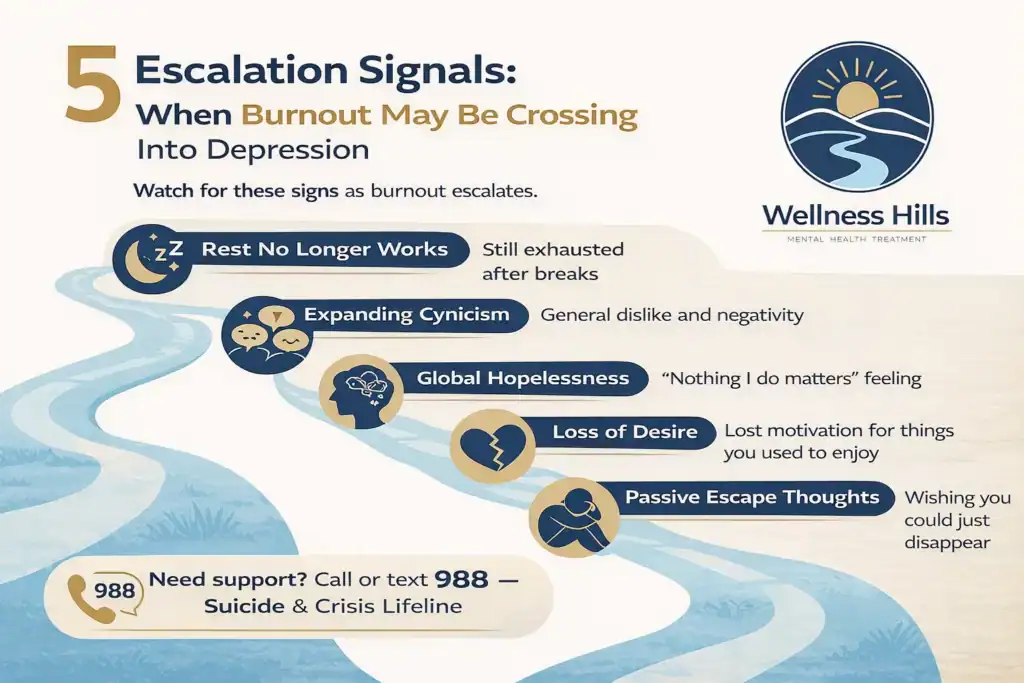
Burnout turning into depression rarely happens overnight. More often, symptoms slowly change in character. Early burnout may feel like intense frustration or exhaustion tied to a specific role. Over time, the emotional tone can shift.
Possible escalation signals include:
- Rest No Longer Works: You feel just as exhausted on Monday morning as you did on Friday night.
- Expanding Cynicism: Your frustration with work has turned into a general dislike for people or activities you once valued.
- Global Hopelessness: Your self-talk shifts from “this job is hard” to “nothing I do will ever matter”.
- Loss of Desire: You no longer even want to do the things that used to make you happy.
- Passive Escape Thoughts: You find yourself wishing you could just disappear, or stop existing for a while.
These escalation patterns are especially common among working professionals in high-demand roles, long-term caregivers, and parents managing chronic stress without adequate support. Research on the sandwich generation, adults simultaneously caring for children and aging parents, shows particularly elevated risk for burnout-to-depression progression.
Contrast that with more typical burnout discomfort:
- Dreading workdays but feeling better during weekends
- Feeling flat at work but engaged with friends or family
- Sleep disruption that improves during time off
- Frustration directed mainly at the situation, not yourself
If thoughts about harming yourself appear, that is an important signal that support is needed. In the United States, you can call or text 988 to reach the Suicide & Crisis Lifeline.
Seeking help is not a sign that you failed to cope. It is a sign that the load has been heavy for too long.
The Gray Zone: When It's Not Clearly Burnout or Depression
Not everyone fits cleanly into burnout or depression. In clinical practice, several conditions occupy the space between them:
Adjustment disorder with depressed mood develops in response to an identifiable stressor (like burnout) but involves symptoms that exceed what would be expected from the stressor alone. It is time-limited and typically resolves within 6 months after the stressor ends.
Persistent depressive disorder (dysthymia) involves a chronically low mood lasting two years or more. Symptoms are less severe than major depression but more persistent. Many people with dysthymia describe it as “just how I’ve always been,” which is why it often goes unrecognized.
Subsyndromal depression describes depressive symptoms that don’t meet the full DSM-5-TR criteria for MDD but still cause meaningful impairment. You might have three symptoms instead of five, or they might not persist for the full two-week threshold. The impact on your life is still real.
You don’t need a formal diagnosis for your experience to be valid, and you don’t need to reach a crisis point to benefit from support. What matters is whether your baseline has shifted and whether what you’re doing now is actually working. If it’s not, a clinical evaluation can help identify what’s driving the impairment, even when the answer isn’t a clean label.
What Clinicians Actually Evaluate When You’re Not Sure
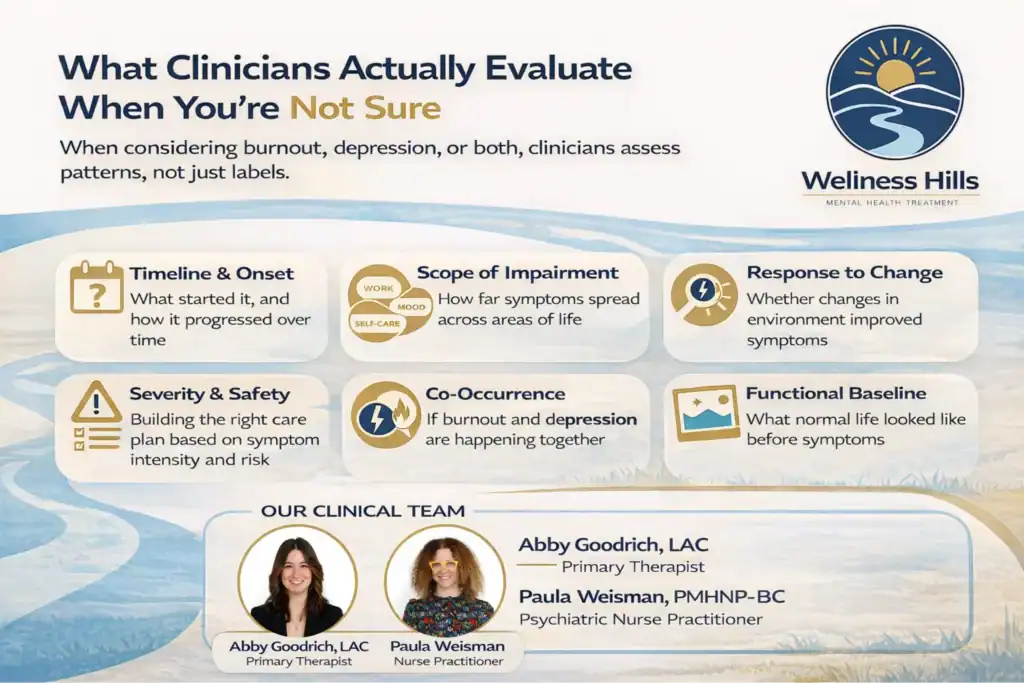
When someone comes in asking, “Am I burned out or depressed?” clinicians are not looking for a quick label. They are looking for patterns.
Here is what they typically assess:
Timeline and Onset: Was there a clear stressor that started this, or did it develop without a clear trigger?
Scope of Impairment: Clinicians assess whether symptoms are confined to one domain, suggesting burnout, or have spread across work, relationships, self-care, and enjoyment of life, suggesting depression or co-occurrence. See the comparison table above.
Response to Change: A key diagnostic signal is whether meaningful environmental changes, such as time off, workload reduction, or role change, produced measurable improvement. If not, that suggests the problem has moved beyond situational burnout.
Severity and Safety: Tools like the PHQ-9 help measure symptom intensity. Clinicians also screen for suicidal thoughts or substance use. This is about matching you to the right level of care, not labeling you.
Co-Occurrence: It is common for both depression and burnout to be present. The question becomes which one is driving the current impairment.
Functional Baseline: What did your life look like before this? That helps set realistic goals for recovery.
The clinical team, including professionals like Abby Goodrich, LAC, and psychiatric providers such as Paula Weisman, PMHNP-BC, uses this information to shape a plan that fits your situation. No two plans look the same.
Should I Get Evaluated? A Self-Check Before Your First Appointment
This is not a diagnostic tool. It cannot tell you whether you have burnout, depression, or both. But it can help you organize what you’re experiencing before a conversation with a clinician.
Consider the following questions honestly:
- Where do your symptoms show up? If exhaustion, irritability, and detachment are mostly limited to work or one specific role, this leans toward burnout. If they follow you into weekends, relationships, hobbies, and self-care, this may involve depression.
- What happens when circumstances change? Think about your last vacation, long weekend, or period of reduced responsibility. Did your symptoms meaningfully improve? If yes, burnout is more likely. If you felt the same or couldn’t enjoy the break, depression may be involved.
- How long has this been going on? Burnout typically builds over weeks to months of sustained stress. If you have felt this way for most days over the past two months or longer, regardless of changes in your environment, clinical evaluation is warranted.
- Has your sense of self changed? Burnout usually preserves your identity; you still feel like you, just an exhausted version. If you’ve noticed persistent hopelessness, self-blame, feelings of worthlessness, or loss of interest in things that used to define you, that pattern is more consistent with depression.
- Are you having thoughts about escaping, disappearing, or not existing? Any passive or active thoughts about self-harm, including wishing you could just stop existing for a while, should be discussed with a professional. This is not something to wait out. Call or text 988 for immediate support.
If you answered “yes” or “I’m not sure” to two or more of these questions, a clinical evaluation would help clarify what’s happening and which level of support fits. You can also take a brief depression screening to see where your symptoms fall before your first conversation with a clinician, or call 973-532-5139 or verify your insurance to start the process.
What If It's Both? How Co-Occurring Burnout and Depression Are Treated
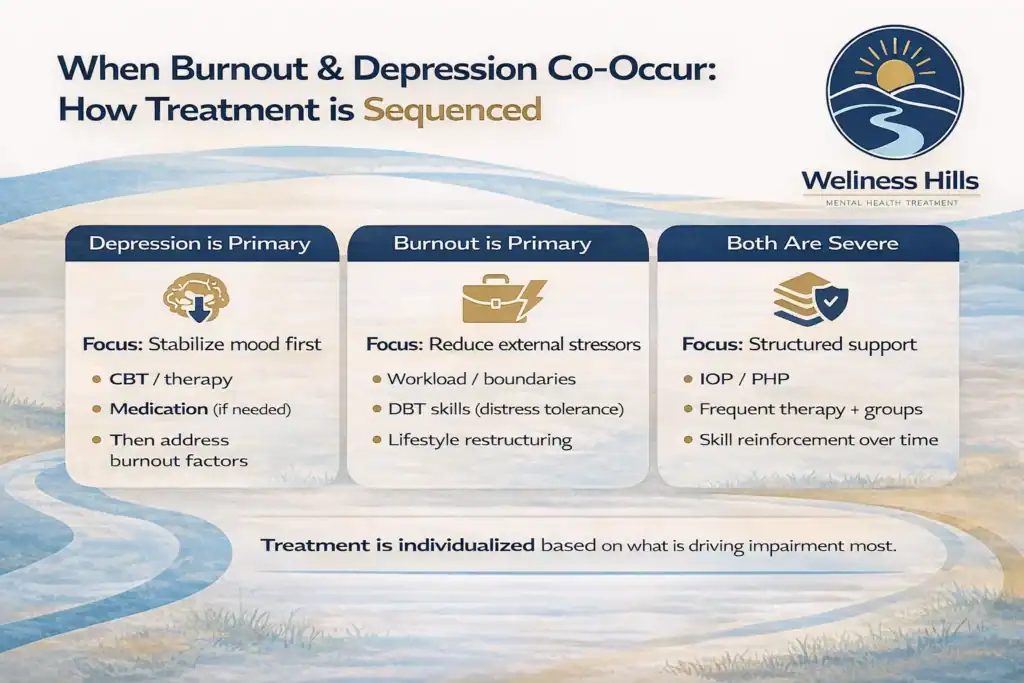
Co-occurring burnout and depression are common, and the combination is harder to recover from than either alone. When both are present, clinicians assess which condition is primary (driving the most impairment) and which is secondary (making recovery harder).
In many cases, the burnout came first: months of chronic workplace stress eroded coping capacity, sleep quality, and emotional resilience until depressive symptoms emerged. In other cases, an underlying depressive vulnerability made a person more susceptible to burnout under stress that others might tolerate.
The treatment sequencing depends on the pattern:
When Depression is Primary: Mood stabilization takes priority. This typically involves psychotherapy, most commonly Cognitive Behavioral Therapy (CBT), which is the most extensively studied therapy for depression, and may include psychiatric medication such as SSRIs or SNRIs prescribed by a psychiatric provider. Once the mood is more stable, workplace and lifestyle factors driving the burnout component can be addressed more effectively.
When Burnout is Primary: Structural changes (workload reduction, boundary setting, role modification) are the first line of intervention. Therapy focuses on distress tolerance and sustainable coping. Dialectical Behavior Therapy (DBT) is particularly useful here because its distress tolerance and emotion regulation modules address both the overwhelm of burnout and the mood instability of depression simultaneously.
When Both Are Severe: A structured program like IOP or PHP provides the frequency and clinical oversight needed to address both layers at once. Skills are practiced in group and individual settings, not learned once but reinforced over weeks until they become automatic.
At Wellness Hills, treatment plans for co-occurring depression and burnout are built collaboratively with the clinical team.
Treatment Options in New Jersey and How to Find the Right Fit
For many people seeking depression treatment in New Jersey, the biggest obstacle is logistics. Long commutes, demanding work schedules, and caregiving pressures make stepping away for care feel impossible.
The right level of care depends on symptom severity, functional impairment, and safety considerations. Not everyone needs a structured program:
Weekly outpatient therapy may be sufficient if symptoms are manageable, limited to one area of life, and you can maintain daily functioning.
Intensive Outpatient (IOP) is appropriate when symptoms are affecting multiple areas, coping strategies aren’t working, and you need more structure than weekly sessions, but can still maintain work or school.
Partial Hospitalization (PHP) is the highest level of outpatient care, appropriate when symptoms are severe, functioning is significantly impaired, and daily clinical structure is needed for stabilization.
Inpatient or residential care may be needed if there is active suicidal ideation, inability to maintain basic self-care, or safety concerns that cannot be managed in an outpatient setting. Wellness Hills can help facilitate referrals when a higher level of care is clinically indicated.
Treatment must work around your life. Here are the primary outpatient structures available at Wellness Hills in Chester, NJ:
- IOP 3 Evening (Mon/Tue/Thu, 6–9 PM): This fits around full-time work. It is the most common starting point for working professionals who need structure without leaving their jobs.
- IOP 5 Morning (Mon–Fri, 9 AM–12 PM): This is a more intensive option for those with flexible schedules who need faster stabilization.
- PHP (Mon–Sat, 6 days/week): This is the highest level of outpatient care. PHP typically requires stepping back from full-time work for a short period. For some people, that intensive daily structure is exactly what is needed to break a downward spiral. Many clients stabilize quickly and step down to an IOP within 3 to 5 weeks.
To give you an idea of what this looks like, imagine a professional commuting from Morris County who realizes her symptoms have not improved after taking a week off. Her clinician might recommend an evening IOP for depression so she can maintain her role while learning coping skills.
After several weeks of measurable progress, she steps down to traditional weekly outpatient therapy. This scenario is purely illustrative. Every plan is individualized based on clinical assessment.
Frequently Asked Questions
These are the questions we hear most often from people trying to figure out whether what they’re experiencing is burnout, depression, or something in between.
Can burnout turn into depression?
Yes. Chronic, unresolved burnout is a recognized risk factor for major depressive disorder. The transition is typically gradual, and exhaustion and cynicism once tied to work begin to spread into relationships, self-image, and the capacity to experience pleasure. Burnout and depression may share underlying biological mechanisms, including HPA axis dysregulation, which helps explain the progression.
How do I know if it's burnout or depression?
The clearest directional signals are scope and response to rest. Burnout tends to stay connected to a specific stressor and improve with time away. Depression spreads across all areas of life and persists regardless of environmental changes. However, these signals overlap significantly, and both conditions can co-occur. A clinical evaluation using tools like the PHQ-9 is the most reliable way to differentiate them.
Should I see a therapist for burnout or only for depression?
Both are valid reasons to seek professional support. A therapist can help determine whether burnout remains situational or has progressed into something broader requiring clinical treatment. For burnout specifically, therapy can also help you develop sustainable coping strategies and set boundaries before symptoms escalate. You do not need a diagnosis to benefit from professional guidance.
Can I do IOP while working full-time in NJ?
Yes. Wellness Hills’ evening IOP meets Monday, Tuesday, and Thursday from 6 to 9 PM, specifically designed for working professionals in New Jersey. Most clients maintain their regular work schedules throughout treatment. The program provides 9 hours of weekly clinical contact, including group therapy, individual sessions, and skills training.
What's the difference between IOP and PHP?
IOP: 9–12 hours per week. You can typically maintain work. PHP: 5–6 days per week, more intensive structure, generally requires stepping back from full-time work.
What happens during the first appointment?
The initial clinical assessment at Wellness Hills evaluates your symptom timeline, functional impairment, response to previous changes, co-occurring conditions, and safety considerations. The clinical team uses this information to recommend a specific level of care and begin building a treatment plan. You leave with a clear recommendation, not an obligation. The goal is clarity, not pressure.
You Don't Need a Diagnosis to Reach Out
You don’t need to decide whether this is burnout, depression, both, or something that doesn’t fit cleanly into either category. That’s what the clinical assessment is for.
The first conversation at Wellness Hills is about understanding what’s happening, not pushing you into a program. You’ll speak with a member of our team who will help you make sense of your symptoms, assess what level of care fits, and outline a clear path forward.
If you’re ready to have that conversation, call 973-532-5139 or verify your insurance benefits to schedule an assessment. Wellness Hills Mental Health is licensed by the New Jersey Department of Health (License #70290104).
If you are in immediate distress or having thoughts of suicide, call or text 988 for confidential, 24/7 support. You can also chat at 988lifeline.org.
Sources:
ICD-11 | World Health Organization (WHO) – Official ICD-11 classification resource and browser from WHO, useful for confirming how burnout is classified within the international diagnostic system.
Endocrine and immunological aspects of burnout: a narrative review | European Journal of Endocrinology – Narrative review examining endocrine and immune-system findings related to burnout, including HPA-axis and cortisol research, while noting that biomarker evidence remains inconsistent.
What Is Depression? | American Psychiatric Association (APA) – Patient-friendly overview of depression from the APA, covering symptoms, diagnosis, and treatment context.
Burnout phenomenon: neurophysiological factors, clinical features, and aspects of management | Journal of International Medical Research – Review article on burnout as an occupational phenomenon, covering clinical features, neurophysiological factors, and management considerations.
Burnout and depression: Points of convergence and divergence | Journal of Affective Disorders – 2023 research paper comparing where burnout and depression overlap, where they differ, and why causal factors may matter more than symptoms alone when trying to tell them apart.
Patient Health Questionnaire-9 (PHQ-9) | American Psychological Association (APA) – Official PHQ-9 screening questionnaire used to assess depressive symptoms over the prior two weeks.
988 Lifeline | Suicide & Crisis Lifeline – Official crisis support resource offering free, confidential help by call, text, or chat, available 24/7.
Editorial Standards
Our Editorial Policy
Our editorial standards keep our mental health content accurate, compassionate, and evidence-informed. Articles are developed using credible sources, reviewed for medical accuracy when needed, and regularly updated.