



If you’re researching the cost of anxiety treatment, you’re probably not trying to learn about anxiety; you’re trying to figure out whether help is financially possible.The sharper question sits one layer down: what level of care fits your symptoms, and what does it cost with your insurance? Below: real ranges, what changes your bill most, and how to make the math defensible before assuming treatment is out of reach.
Ranges below reflect typical published figures and vary significantly by provider, plan, location, and program length.
- Outpatient therapy: $100-$300/session self-pay; $20-$60 copay in-network.
- Psychiatry: $150-$500 for an initial evaluation; $75-$200 for follow-ups.
- IOP (full program): $3,500-$10,000 self-pay; deductible plus coinsurance when billed through insurance.
- PHP (full program): $8,000-$30,000 self-pay; often well-covered when medical necessity criteria are met.
- The number that actually matters: your projected out-of-pocket responsibility after deductible, coinsurance, copay, network status, and authorization requirements are reviewed, not the self-pay sticker.
How these cost ranges were estimated:
Self-pay ranges reflect typical published rates for outpatient mental health services, intensive outpatient programs, and partial hospitalization programs in the Northeast U.S.
They are drawn from publicly available provider pricing pages, the Kaiser Family Foundation’s behavioral health coverage briefs, NAMI’s mental health treatment cost resources, and Wellness Hills’ internal benefits verification data from Q1-Q3 2025.
In-network cost-sharing reflects common commercial plan designs subject to deductible, copay, and coinsurance structures.
Your actual cost depends on your specific plan, network status, medical necessity determination, and authorization requirements. A benefits verification produces an estimate based on plan information available at the time of the call; the final amount owed may differ after claims are processed.
Cost by Level of Care
One clarification: anxiety covers several distinct DSM-5 conditions, generalized anxiety disorder, panic disorder, social anxiety disorder, and specific phobias, alongside related conditions like OCD and PTSD that are now classified separately but often present together.
Treatment intensity, duration, and therefore cost can differ across these. The ranges below broadly cover anxiety-disorder treatment; a clinical assessment narrows them to your specific presentation.
| Level of Care | Self-Pay Range | Typical In-Network Cost | What Changes the Total |
|---|---|---|---|
| Outpatient therapy (per session) | $100–$300 | $20–$60 copay | Session frequency, therapist credentials, network status |
| Psychiatry / medication management | $150–$500 initial; $75–$200 follow-up | $30–$75 copay | Initial vs. follow-up, medication monitoring frequency |
| Intensive Outpatient Program (IOP), full program | $3,500–$10,000 | Deductible + coinsurance | Program length, days per week, and authorization approval |
| Partial Hospitalization Program (PHP), full program | $8,000–$30,000 | Deductible + coinsurance | Daily structure, psychiatric oversight, length of stay, step-down planning |
These ranges are a planning tool, not a final quote. The same level of care can cost different amounts for two people, depending on deductible status, network status, authorization, and the length of clinically recommended treatment.
Outpatient Therapy
Weekly 50-minute sessions, usually built around CBT, DBT, or exposure therapy. This level fits mild-to-moderate anxiety where daily function is largely intact, you’re working, sleeping, and managing relationships, even if anxiety is making all three harder than they should be. It carries the lowest per-session cost of any level of care, and the longest timeline to significant change.
Medication Management
Psychiatric and PMHNP evaluations are typically billed separately from therapy. The initial appointment runs longer and costs more than follow-ups, which are shorter and less frequent once a regimen stabilizes. Medication is a clinical decision tied to symptom presentation, not a cheaper substitute for therapy; many people benefit most from both together.
Intensive Outpatient Program (IOP)
IOP runs 9-12 hours per week across roughly 3 days, combining group therapy, individual therapy, and skills training. At Wellness Hills, IOP 3 Evening meets Monday, Tuesday, and Thursday from 6-9pm; IOP 5 Morning meets Monday through Friday from 9am-12pm.
Partial Hospitalization (PHP)
PHP is the highest level of outpatient care, 25-30+ hours per week across 5-6 days, with integrated psychiatric oversight built into the daily structure. Wellness Hills runs PHP Monday through Saturday.
Does Insurance Cover Anxiety Treatment
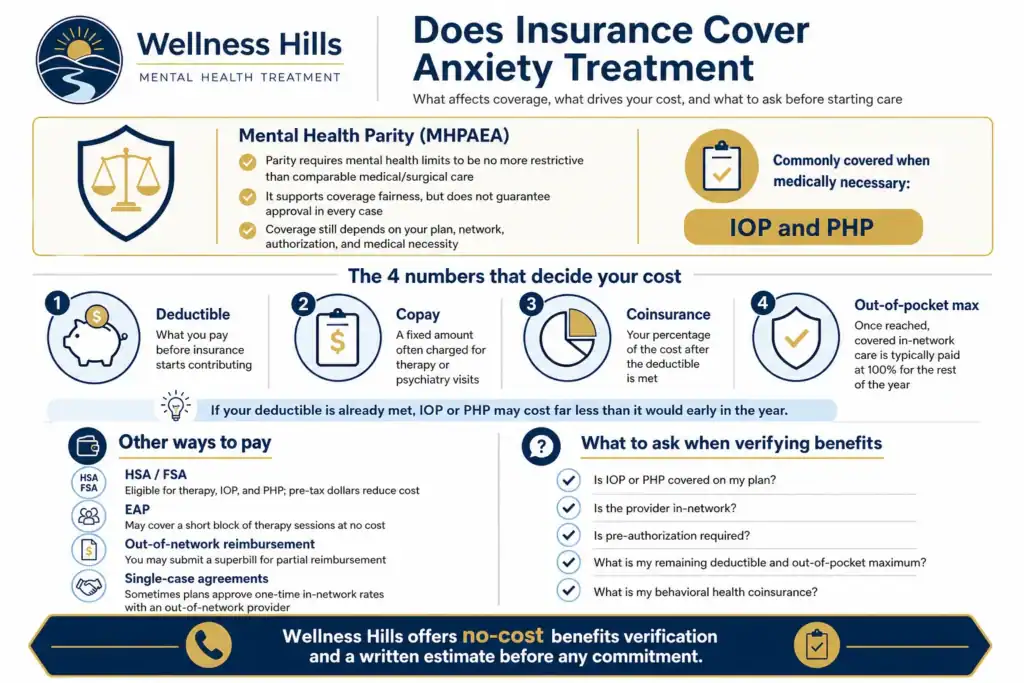
Whether anxiety treatment is covered, and what you’ll actually pay, depends on a few specific elements of your plan. The sections below cover the federal parity law that shapes mental health coverage, the four plan variables that drive your out-of-pocket cost, and the payment options available beyond standard insurance.
How the Mental Health Parity and Addiction Equity Act (MHPAEA) Affects Anxiety Coverage
The Mental Health Parity and Addiction Equity Act of 2008 (29 U.S.C. § 1185a) is the federal statute requiring group health plans that offer mental health benefits to apply financial requirements and treatment limits no more restrictively than those applied to comparable medical and surgical care. Parity is a floor, not a guarantee; it shapes what plans are allowed to do, not what they must approve in any individual case.
In practice, that means many commercial plans cover IOP or PHP for anxiety when the service is medically necessary, and the plan includes those benefits. Coverage still depends on your plan, network, authorization rules, and medical necessity review.
The Four Numbers That Decide Your Cost
These four figures, pulled from your plan documents or member portal, do most of the work in projecting what you’ll actually pay:
- Deductible: The amount you pay out of pocket each plan year before insurance starts contributing toward covered services.
- Copay: A fixed dollar amount you pay at the time of service, common for therapy and psychiatry visits.
- Coinsurance: The percentage of a covered service you pay after your deductible is met (often 10-30% for behavioral health).
- Out-of-pocket maximum: Once you hit your out-of-pocket maximum, covered in-network services are typically paid at 100% for the rest of the plan year.
If you’ve already met your deductible this year, IOP or PHP can cost a fraction of what someone starting fresh in January would pay for the same program.
Other Ways to Pay: HSA, FSA, EAP, and Out-of-Network Reimbursement
Insurance is the primary lever, but it isn’t the only one:
- Health Savings Account (HSA) and Flexible Spending Account (FSA): Mental health treatment, including therapy, IOP, and PHP, is eligible. Pre-tax dollars effectively reduce your cost by your marginal tax rate.
- Employee Assistance Program (EAP): Many employer EAPs cover an initial block of therapy sessions at no cost. EAP sessions don’t typically extend to IOP or PHP, but they’re a no-cost way to start an assessment.
- Out-of-network reimbursement: If your plan has OON behavioral health benefits, you pay the provider directly and submit a superbill for partial reimbursement. Rates vary; check your plan’s allowed amounts before assuming the math works.
- Single-case agreements: When in-network options are limited, some plans will negotiate a one-time agreement with an out-of-network provider at in-network rates. This is plan-dependent and not guaranteed.
What to Ask When Verifying Benefits
- Is this level of care (IOP or PHP) a covered benefit on my plan?
- Is the provider in-network?
- Is pre-authorization required, and who submits it?
- What’s my remaining deductible and out-of-pocket maximum for the year?
- What’s my coinsurance for behavioral health services?
Wellness Hills runs benefits verification at no cost and provides a written estimate before any commitment.
Serving New Jersey
Wellness Hills is located in Chester, New Jersey (Morris County), works with most major commercial insurance plans, including Horizon BCBSNJ, Aetna, Cigna, and United, and serves clients across northern and central New Jersey. Plan-specific coverage varies; our intake team can verify your benefits before any commitment is made.
What This Looks Like in Practice: Two Cost Scenarios
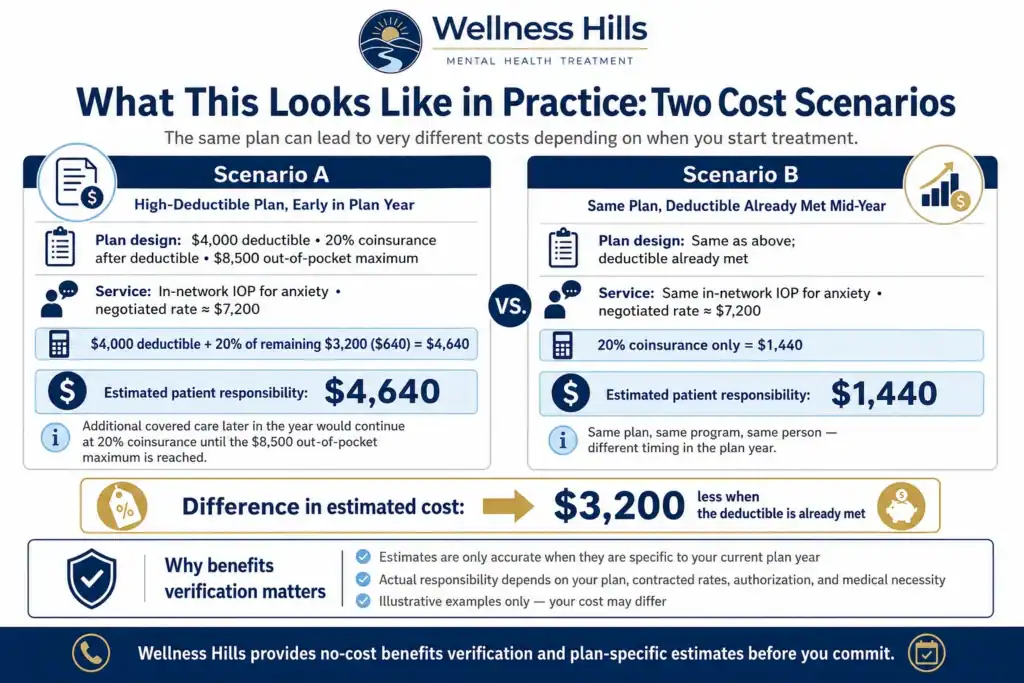
The four numbers above only mean something when you run them. Two illustrative examples using common commercial plan designs:
Scenario A: High-Deductible Plan, Early in Plan Year
- Plan design: $4,000 deductible, 20% coinsurance after deductible, $8,500 out-of-pocket maximum
- Service: IOP for anxiety, in-network negotiated rate ≈ $7,200 for the program
- Patient pays: $4,000 (deductible) + 20% of remaining $3,200 ($640) = $4,640
- The remainder counts toward your out-of-pocket maximum. If additional covered care is needed in the same plan year, you’d pay 20% coinsurance until you hit $8,500 total, after which covered in-network services are paid at 100%.
Scenario B: Same Plan, Deductible Already Met Mid-Year
- Plan design: Identical to above, deductible already met from earlier in the plan year
- Service: Same IOP at $7,200 negotiated rate
- Patient pays: 20% coinsurance only = $1,440
Same plan, same program, same person, different timing. This is why benefits verification yields a useful estimate only when it’s specific to your plan year.
These scenarios are illustrative. Your actual responsibility depends on your specific plan, contracted rates, authorization, and medical necessity determination.
How to Estimate Your Real Anxiety Treatment Cost Before Starting
A four-step sequence that replaces guessing with a defensible number:
- Identify the clinically appropriate level of care: A clinical assessment determines whether outpatient therapy, IOP, or PHP fits your symptoms. Cost estimates without this step are guessing, and the wrong level of care almost always costs more over time.
- Confirm network status: In-network rates are typically 30–60% below the self-pay sticker price for outpatient sessions and are contracted as flat or per diem rates for IOP and PHP. Out-of-network coverage exists on some plans, but reimburses only the allowed amounts, not the full charges.
- Pull your four numbers: Deductible, copay, coinsurance, and out-of-pocket maximum, and where you currently sit in your plan year on each. These are in your member portal or plan documents.
- Confirm authorization requirements: For IOP and PHP, most commercial plans require prior authorization based on medical necessity criteria. Confirm who submits it, the expected timeline, and what documentation is needed.
Two people receiving the same level of care can still have different total costs because treatment length, authorization scope, and clinical progress vary. A clinical assessment and benefits verification work best together: one determines the appropriate level of care, the other estimates the financial responsibility.
Steps 1, 2, and 4 happen during a no-cost benefits verification with our intake team. Step 3 is information you can pull yourself before the call.
Three Common Misreads About Cost
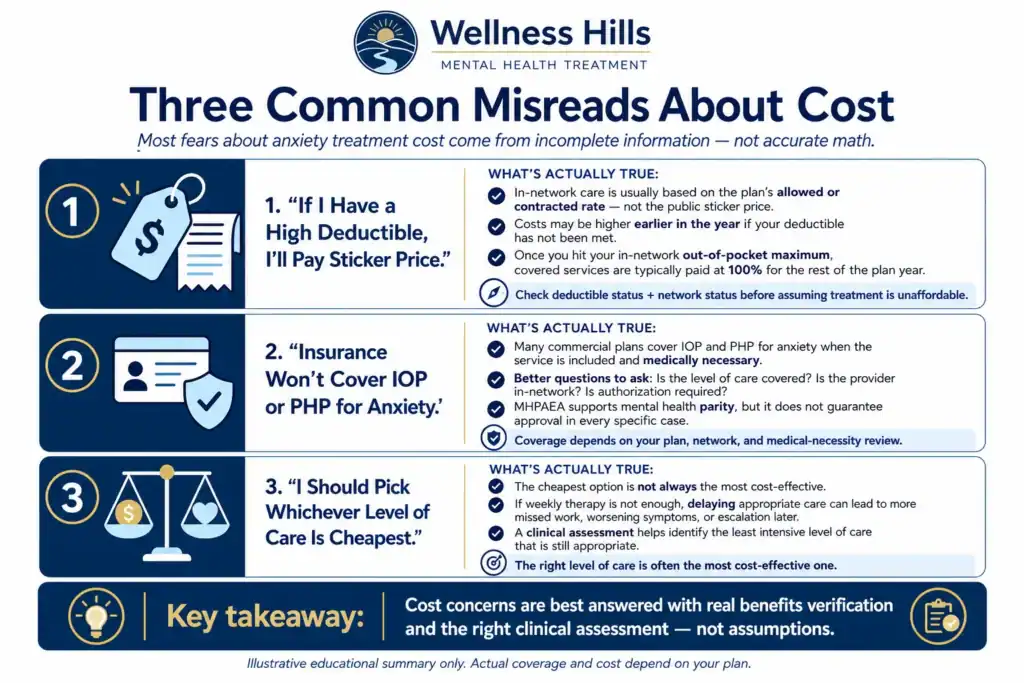
Three assumptions come up repeatedly when people start running the numbers on anxiety treatment. Each one is partly true, which is what makes them sticky, and each one tends to lead to the wrong decision when taken at face value.
"If I Have a High Deductible, I'll Pay Sticker Price."
Not always. If the provider is in-network, your responsibility is based on the plan’s allowed amount or contracted rate, not the public self-pay sticker, and once you hit your out-of-pocket maximum, covered in-network services are typically paid at 100% for the rest of the plan year. You may still owe more earlier in the plan year if your deductible hasn’t been met. Deductible status and network status should be reviewed before assuming treatment is unaffordable.
"Insurance Won't Cover IOP or PHP for Anxiety."
Many commercial plans cover IOP and PHP for anxiety when the service is included in the plan and medically necessary. The more useful questions are: Is the level of care covered? Is the provider in-network? Is authorization required? What medical-necessity criteria apply? Federal parity rules (MHPAEA) limit how restrictively plans can apply financial or treatment limits to mental health benefits, but parity is a floor, not a guarantee of approval in any specific case.
"I Should Pick Whichever Level of Care is Cheapest."
The lowest-cost option isn’t always the most cost-effective option. If weekly therapy isn’t enough for the severity of symptoms, delaying a higher level of care often leads to more missed work, worsening impairment, or eventual escalation to more intensive treatment anyway. A clinical assessment determines the least intensive level of care that’s still appropriate, which is usually also the most cost-effective.
Matching Cost to Clinical Fit
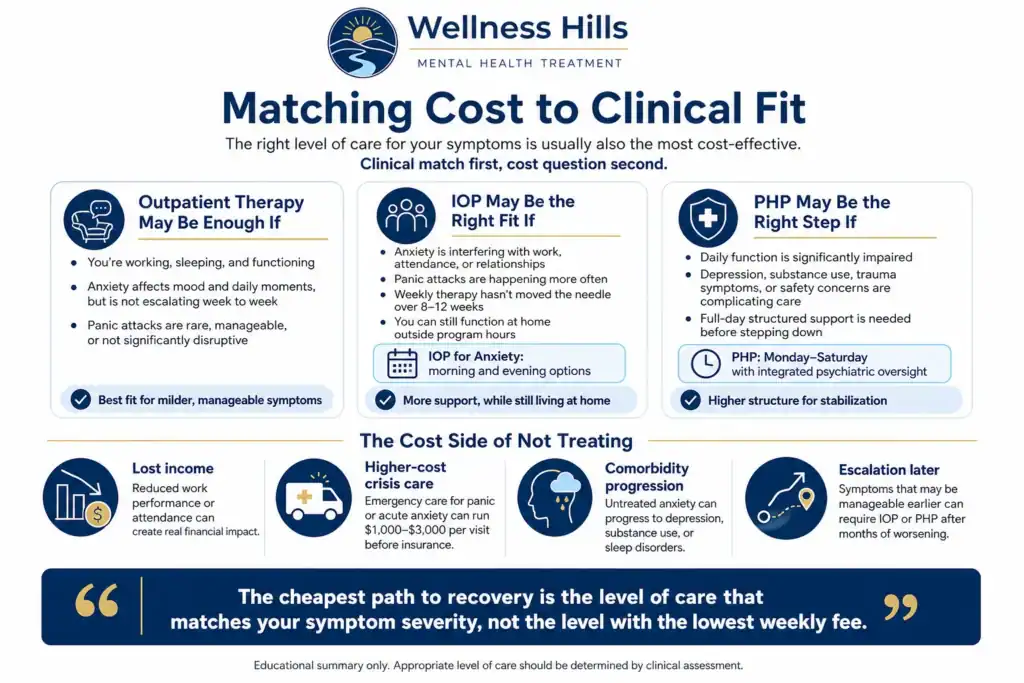
The right level of care for your symptoms is usually also the most cost-effective. The fit criteria below describe what each level of care typically addresses, clinical match first, cost question second.
Outpatient Therapy May Be Enough If
You’re working, sleeping, and functioning. Anxiety is affecting your mood and some daily moments, but it isn’t escalating week over week. Panic attacks are rare, manageable, or do not significantly disrupt daily life.
IOP May Be the Right Fit If
Anxiety is interfering with work performance, attendance, or relationships in ways you’ve started having to plan around. Panic attacks are happening more frequently. Standard weekly therapy hasn’t moved the needle over the past 8-12 weeks. You can still function at home outside of program hours. Our IOP for Anxiety runs in two scheduling formats, morning and evening, to fit around work and family.
PHP May Be the Right Step If
Daily function is significantly impaired. Co-occurring depression, substance use, trauma symptoms, or safety concerns are making it harder to hold things together with standard outpatient care. Structured, full-day support is needed to stabilize before stepping down to a lower level of care. Our Partial Hospitalization Program runs Monday through Saturday with integrated psychiatric oversight.
The Cost Side of Not Treating
Cost analysis usually compares treatment options. The often-missed comparison is treatment versus continued untreated anxiety. Common downstream costs of delayed care:
- Lost income from reduced work performance or attendance: Untreated anxiety disorders are associated with measurable productivity loss and increased absenteeism.
- Higher-cost crisis care: Emergency department visits for panic attacks or acute anxiety typically run $1,000-$3,000 per visit before insurance.
- Comorbidity progression: Untreated anxiety frequently progresses to depression, substance use, or sleep disorders, each with its own treatment cost.
- Eventual escalation to a higher level of care: Symptoms manageable at the outpatient level often require IOP or PHP after months of escalation.
“The cheapest path to recovery is the level of care that matches your symptom severity, not the level with the lowest weekly fee.”
If You're On the Fence: Next Step
Most people don’t decide to start treatment in one moment. They take the next small step, and the next one, until starting feels possible.
- Run a benefits verification: A benefits verification typically takes 10–15 minutes and identifies your deductible status, coinsurance, copay, authorization requirements, and estimated patient responsibility before you decide whether to move forward.
- Get a clinical assessment: Knowing what level of care fits your symptoms changes the cost conversation entirely.
- Ask honestly: is what I’m doing now working? If anxiety has been escalating for more than a month and current strategies aren’t helping, it may be worth a professional assessment rather than continuing to guess.
To verify your benefits and walk through your actual out-of-pocket costs, with no commitment to start treatment, reach out to our intake team at 973-532-5139 or verify your insurance benefits online.
Frequently Asked Questions
A few of the questions that come up most often when readers are working through anxiety treatment costs on their own.
Will my benefits verification estimate match my final bill?
Not always. A benefits verification reflects plan information available at the time of the call: deductible status, coinsurance, in-network rate, and authorization rules, as reported by the carrier. Final responsibility is determined by the explanation of benefits (EOB) issued after claims are adjudicated. Most estimates land within a reasonable range of the final number, but the EOB is the only fully accurate figure.
Can I use HSA or FSA funds for anxiety treatment?
Mental health treatment, including therapy, IOP, and PHP, is generally an eligible expense for HSAs and FSAs. Eligibility depends on account rules and service type; check with your plan administrator before assuming a specific service qualifies.
What if my insurance denies IOP or PHP for anxiety?
Ask the carrier for the specific reason for denial, whether the provider can submit additional clinical documentation, and what appeal options are available. Certain adverse utilization management determinations may be eligible for external review through the Independent Health Care Appeals Program (IHCAP).
How much does CBT for anxiety cost?
CBT is typically delivered through standard outpatient therapy, $100-$300 per session self-pay, or $20-$60 with most in-network plans. The same range applies to DBT and exposure therapy.
Is IOP for anxiety worth the cost?
For people whose anxiety is interfering with work, relationships, sleep, or daily responsibilities, IOP may provide more structure and clinical contact than weekly therapy alone. Whether it’s the right fit and the right anxiety-treatment cost trade-off is a clinical decision best made with an assessment, not a sticker price.
Does Wellness Hills offer payment plans for anxiety treatment?
We work with patients on payment timing for the patient-responsibility portion of treatment. The right structure depends on your level of care, plan design, and where you sit in your plan year. We discuss this during benefits verification once we have a real number to work from.
What to Take From This
Anxiety treatment cost is rarely as fixed as the search bar makes it sound. Once you know which level of care fits your symptoms and how your insurance covers it, the math becomes a decision, not a barrier.
Sources:
KFF | Mental Health Policy Research and Data – Health policy research hub with data and analysis on mental health access, affordability, coverage, parity, and behavioral health policy trends. Useful for understanding the broader insurance and cost landscape behind mental health treatment.
National Alliance on Mental Illness (NAMI) | Understanding Health Insurance – Consumer-friendly guide explaining how health insurance can help pay for mental health care, including provider networks, deductibles, copays, coinsurance, plan types, and coverage considerations.
National Institute of Mental Health (NIMH) | Anxiety Disorders – Federal clinical resource explaining anxiety disorders, including generalized anxiety disorder, panic disorder, social anxiety disorder, phobia-related disorders, symptoms, impairment, and treatment-related research.
U.S. Department of Labor | Mental Health and Substance Use Disorder Parity – Official federal resource explaining the Mental Health Parity and Addiction Equity Act, including protections related to mental health and substance use disorder benefits, financial requirements, visit limits, and plan restrictions.
Centers for Medicare & Medicaid Services (CMS) | Mental Health Parity and Addiction Equity Act – Federal overview of MHPAEA and how the law generally prevents certain health plans that offer mental health or substance use disorder benefits from applying less favorable limitations than those used for medical or surgical benefits.
Editorial Standards
Our Editorial Policy
Our editorial standards keep our mental health content accurate, compassionate, and evidence-informed. Articles are developed using credible sources, reviewed for medical accuracy when needed, and regularly updated.