



Generalized anxiety disorder responds well to evidence-based treatment in most individuals. First-line CBT and/or SSRI or SNRI medication produce clinically meaningful improvement in roughly half of patients within 12-16 weeks, with combination treatment further improving response in moderate-to-severe presentations. But treatment isn’t a single thing.
This guide walks through the therapy and medication options with the strongest evidence, how clinicians decide what fits best, what realistic improvement looks like over weeks and months, and when more support may be worth considering. It’s informational reference content, not a substitute for clinical evaluation.
How this guide was developed:
This article reflects evidence-based treatment principles for GAD drawn from current clinical practice guidelines (NIMH, APA, NICE), peer-reviewed treatment outcome research, and the level-of-care decision frameworks used in structured outpatient and partial hospitalization programs. It is educational and does not replace individualized assessment, diagnosis, or treatment planning.
Quick Answer: How is Generalized Anxiety Disorder Treated?
- First-line treatments: Cognitive behavioral therapy (CBT) and/or an SSRI or SNRI medication.
- Combination therapy: For moderate-to-severe GAD, CBT plus medication generally outperforms either alone.
- Benzodiazepines: Not first-line for GAD; may be used short-term or situationally under careful prescribing.
- Timeline: Most people see initial gains within 8–16 weeks of consistent CBT or SSRI/SNRI treatment, with full medication effect typically reached at 8-12 weeks of an adequate dose.
- Care setting: Most GAD is managed in weekly outpatient therapy; structured programs like IOP or PHP may fit when symptoms are severe or co-occur with depression, panic, or substance use.
- Diagnosis: A licensed clinician should confirm GAD and rule out medical contributors like thyroid dysfunction or stimulant use.
At Wellness Hills Mental Health Treatment in Chester, NJ, GAD treatment planning starts with the same questions covered below: symptom severity, functional impairment, co-occurring conditions, medical contributors, and whether weekly outpatient care provides enough structure or whether IOP- or PHP-level intensity is clinically warranted.
Therapy for GAD: The Approaches With the Strongest Evidence
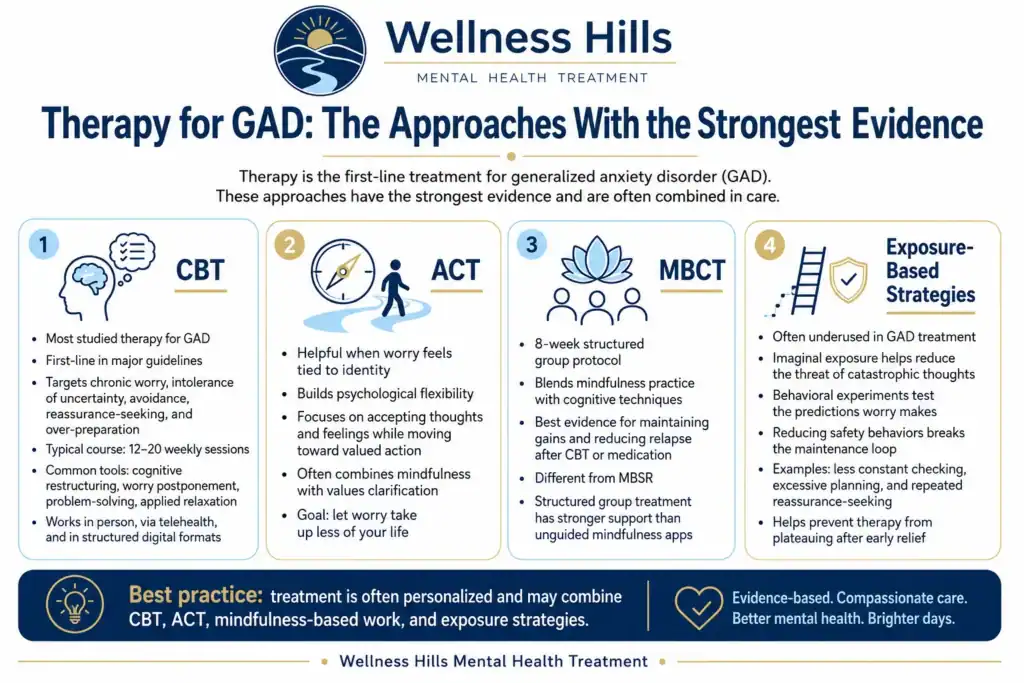
Therapy is the first-line treatment for GAD. The approaches below have the strongest evidence, and they’re often combined rather than chosen between.
Cognitive Behavioral Therapy (CBT)
CBT is the most extensively studied psychological treatment for GAD and is recommended as a first-line option in NICE, APA, and Canadian Clinical Practice Guidelines for anxiety disorders.
It targets intolerance of uncertainty, the cognitive engine of chronic worry, alongside the behavioral patterns that maintain it: avoidance, reassurance-seeking, and over-preparation.
A typical course runs 12 to 20 weekly sessions and often combines cognitive restructuring with worry postponement (deliberately scheduling worry into a contained window), problem-solving training, and applied relaxation.
Cognitive behavioral therapy for anxiety is delivered effectively in person, via telehealth, or through structured digital programs; clinical trials and meta-analyses have found comparable outcomes across delivery formats when protocols are followed.
Acceptance and Commitment Therapy (ACT)
Acceptance and Commitment Therapy (ACT) is often a strong fit when worry has fused with identity, the “I’m just a worrier” frame, or when avoidance has narrowed your life around the things you actually care about.
ACT focuses on psychological flexibility: accepting uncomfortable thoughts and feelings while moving toward valued action, rather than directly challenging the content of every worry. In practice, ACT often pairs mindfulness skills with values-clarification work; the goal isn’t to worry less, but to let worry occupy less of your life.
Mindfulness-Based Cognitive Therapy (MBCT)
Mindfulness-Based Cognitive Therapy (MBCT) is an eight-week structured group protocol that integrates mindfulness practice with cognitive techniques. MBCT’s evidence base in anxiety is strongest for sustaining gains and reducing relapse after initial treatment with CBT or medication, rather than as a first-line standalone therapy.
It is distinct from Mindfulness-Based Stress Reduction (MBSR), which is a separate 8-week protocol with its own evidence base. Unguided mindfulness apps have a thinner evidence base than the structured group format and shouldn’t be confused with the protocol; they may help, but they don’t replace it.
Exposure-Based Strategies for Worry and Avoidance
Exposure-based work is often the most underused piece of GAD treatment. Imaginal exposure, deliberately writing out feared scenarios in detail, gradually reduces the threat charge of catastrophic thoughts.
Behavioral experiments test the predictions worry makes, and reducing safety behaviors (constant checking, excessive planning, repeated reassurance-seeking) removes the maintenance loop that keeps worry alive. Therapy that skips this component often plateaus after early symptom relief.
Medication for GAD: Categories, Trade-offs, and What to Discuss With a Prescriber
Medication and therapy are roughly equivalent in monotherapy for mild-to-moderate GAD; combination treatment outperforms either alone for moderate-to-severe presentations.
Medication Categories Used in GAD
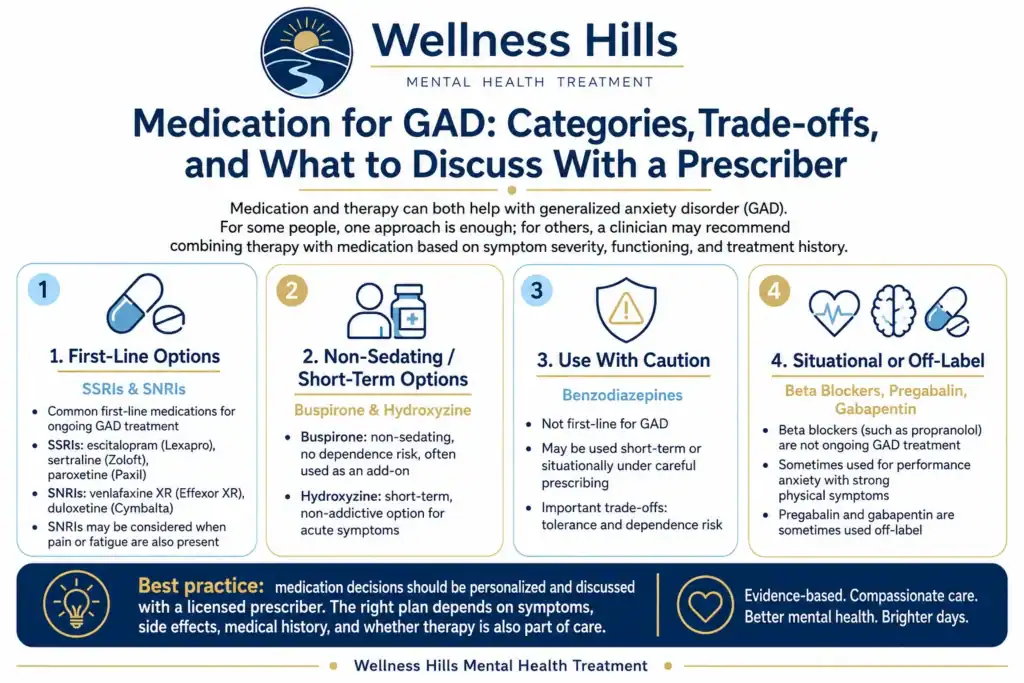
- SSRIs (escitalopram/Lexapro, sertraline/Zoloft, paroxetine/Paxil): Typically first-line.
- SNRIs (venlafaxine XR/Effexor XR, duloxetine/Cymbalta): Equally first-line; sometimes chosen for comorbid pain or fatigue.
- Buspirone: Non-sedating, no dependence risk; modest effect; often used as an add-on rather than monotherapy.
- Hydroxyzine: A short-term, non-addictive option for acute symptoms.
- Benzodiazepines: Not first-line for GAD; reserved for short-term or situational use under careful prescribing due to dependence and tolerance risk.
- Beta blockers (propranolol): Not used for ongoing GAD treatment, but sometimes prescribed off-label for situational performance anxiety with prominent physical symptoms.
- Pregabalin and gabapentin: Sometimes used off-label.
Selection among these depends on individual factors, symptom profile, comorbidities, side-effect sensitivity, drug interactions, prior response, and is made with a licensed prescriber. Worth knowing upfront: SSRIs commonly cause a brief uptick in anxiety during the first 1-2 weeks of titration before improving. That’s expected, not a sign the medication is wrong.
Medication safety note: Do not start, stop, increase, decrease, or combine psychiatric medications without guidance from a licensed prescriber. Medication changes can affect anxiety, sleep, mood, withdrawal symptoms, side effects, and overall safety, particularly when there is a history of bipolar symptoms, substance use, pregnancy, cardiac conditions, or multiple concurrent medications.
Therapy, Medication, or Both?
For mild-to-moderate GAD, CBT alone is often sufficient. For moderate-to-severe presentations, especially when sleep is disrupted, depression is co-occurring, or daily functioning has taken a real hit, combination treatment generally outperforms either approach alone.
Sequencing is also flexible: some people start with therapy and add medication if gains stall; others prefer medication first to take the edge off, which can make therapy work more accessible. Both paths are clinically reasonable.
What to Discuss With a Prescriber Before Starting
Coming to a first prescriber visit prepared makes the conversation more useful. Bring:
- Symptom profile and duration.
- Prior medication history and response.
- Current medications and supplements (including over-the-counter, herbal, and recreational substances) interactions matter.
- Medical conditions (especially thyroid, cardiac, or neurological history).
- Alcohol or cannabis use (honesty here changes the safest medication options).
- Pregnancy status or plans.
- Any history of bipolar features – SSRIs and SNRIs can destabilize undiagnosed bipolar disorder.
Side-effect tolerance varies. Naming what you can’t live with, sexual side effects, weight changes, sedation, GI symptoms, helps a prescriber narrow choices upfront.
What to Track Each Week and What Improves First vs. Last
Treatment progress in GAD isn’t linear; different aspects of the disorder shift on different timelines.

Symptoms and Behaviors to Track Weekly
A simple weekly log gives your clinician something concrete to calibrate against. Track:
- Worry intensity on a 0-10 scale.
- Sleep duration and quality.
- Muscle tension and physical symptoms (headaches, GI distress, jaw clenching).
- Irritability and concentration.
- Avoidance behaviors – declined invitations, delayed decisions, missed work.
- Reassurance-seeking frequency.
- Total daily worry time.
What Often Improves First (Weeks 1-6)
Physical symptoms tend to shift first. Sleep improves. Muscle tension eases, fewer headaches, less jaw clenching, calmer GI. Acute panic-like spikes drop in frequency. One caveat: SSRIs commonly cause a brief uptick in anxiety during the first 1-2 weeks of titration before improving; that’s expected, not a sign the medication is wrong.
What Improves in the Middle (Weeks 6-16)
The cognitive and behavioral patterns start to give. Worry frequency drops. Avoidance behaviors loosen, particularly when therapy includes exposure work. Concentration returns. Irritability eases. Confidence in functioning starts to come back.
What Improves Last and May Need Maintenance (Months 4-12+)
The deepest features change last. Intolerance of uncertainty, the cognitive engine of worry, softens slowly. Perfectionism, over-control, and catastrophizing loosen over months. Identity-level beliefs (“I’ve always been a worrier”) reframe gradually. GAD is often a chronic, manageable condition rather than a curable one.
Many people maintain gains through periodic therapy boosters, ongoing medication, or skills practice, appropriate long-term management of a chronic condition, not failure.
When GAD Looks Like Something Else: Differential Diagnosis
GAD is frequently confused with or accompanied by other conditions. Getting the diagnosis right changes the treatment plan.
| Condition | What Can Look Similar | What May Point Away From Primary GAD | Treatment Shift |
|---|---|---|---|
| Acute stress | Worry, sleep disruption, irritability | Symptoms tied to a specific stressor and resolve when it passes | Short-term skills work, sleep stabilization, stressor management |
| Panic disorder | Fear, body symptoms, avoidance | Discrete panic attacks and fear of recurrence are central | Panic-focused CBT with interoceptive exposure |
| OCD | Intrusive “what if” thoughts, checking | Compulsions or rituals are used to neutralize intrusive thoughts | Exposure and Response Prevention (ERP) |
| ADHD | Concentration problems, restlessness, overwhelm | Attention problems are baseline and lifelong, present even when anxiety is lower | ADHD assessment; both may need treatment if co-occurring |
| PTSD | Hypervigilance, sleep problems, irritability | Symptoms tied to specific past trauma and trauma reminders | Trauma-focused therapy (CPT, PE, EMDR) is first-line |
| Major depression with anxious distress | Worry, sleep problems, and concentration issues | Low mood, anhedonia, hopelessness, or appetite changes are central | Depression-first treatment (often shifts medication choice) |
| Substance or medical contributors | Anxiety, panic-like symptoms, insomnia | Symptoms worsen with caffeine, cannabis, alcohol, stimulants, thyroid issues, or medication side effects | Medical workup, substance-use assessment, medication review |
How Clinicians Choose Among GAD Treatment Options
Treatment selection isn’t formulaic; clinicians weigh several factors before recommending a plan.
Diagnostic Criteria and Functional Impairment
DSM-5-TR criteria require excessive worry across multiple domains, more days than not, for at least 6 months, plus three of the following: restlessness, fatigue, difficulty concentrating, irritability, muscle tension, or sleep disturbance, and clinically significant impairment. The impairment component often matters more than symptom count when determining treatment intensity.
How GAD is Measured: GAD-7 and Functional Tracking
The GAD-7 is the standard 7-item screening and severity measure used in primary care, psychiatry, and structured outpatient programs. It takes about two minutes, is repeatable weekly or biweekly, and is useful for tracking treatment response over time.
| GAD-7 Score | Symptom Range |
|---|---|
| 0–4 | Minimal anxiety |
| 5–9 | Mild anxiety |
| 10–14 | Moderate anxiety |
| 15–21 | Severe anxiety |
A score of 10 or higher is often used as a threshold for further clinical assessment, but scores don’t replace clinical judgment. A moderate score in someone whose work, school, or caregiving is collapsing matters more clinically than a higher score in someone with stable functioning. Measurement-based care pairs the GAD-7 with functional tracking so treatment decisions reflect both symptom intensity and real-life impact.
Take the GAD-7 anxiety screening – about two minutes, with your score and severity range delivered instantly.
A quick GAD self-check (not a diagnosis):
- Has excessive worry across multiple areas of life been present more days than not for at least 6 months?
- Is the worry difficult to control?
- Are at least three of these present: restlessness, fatigue, concentration problems, irritability, muscle tension, or sleep disturbance?
- Is functioning at work, school, in relationships, or in self-care impaired?
If most of these are true, a clinical evaluation is the appropriate next step. The GAD-7 is one input, not a diagnosis. If you’re uncertain whether your symptoms have crossed the threshold for clinical evaluation, learning to recognize when anxiety needs professional help can clarify where you stand.
Which GAD Treatment Path Fits: A Quick Reference
Treatment fit depends on severity, functional impairment, co-occurring conditions, safety, and prior response to care, not the diagnosis label alone. The table below shows how clinicians typically think through level-of-care decisions for GAD.
| If This Is True | Likely Starting Point |
|---|---|
| Worry is present, but functioning is mostly stable | Weekly outpatient CBT, with or without ACT |
| Sleep, work, school, or relationships are impaired | Weekly CBT plus prescriber evaluation for SSRI/SNRI |
| Weekly therapy has plateaued after 8–12 weeks | Reassess diagnosis, add exposure work, adjust medication, or step up to IOP |
| GAD is paired with depression, panic, OCD, or active substance use | Higher-intensity assessment (IOP or PHP) |
| Daily functioning is significantly impaired, and home support is limited | PHP evaluation |
| Active suicidal thinking or imminent safety concern | Emergency department, 988 Suicide and Crisis Lifeline, or 911 |
A clinical assessment is the most reliable way to confirm fit. This table is a starting orientation, not a treatment plan.
Medical and Substance Contributors to Rule Out
Hyperthyroidism (typically caught with a TSH check), cardiac arrhythmia, high caffeine or stimulant intake, cannabis-induced anxiety, and certain medications, steroids, and decongestants are common culprits that can mimic or worsen GAD. A medical workup is part of a thorough assessment.
Co-Occurring Conditions That Change the Plan
Depression, panic disorder, OCD, PTSD, ADHD, and substance use frequently co-occur with GAD. When they do, sequencing matters, for instance, addressing alcohol use that’s masking and worsening anxiety, or treating depression first when it’s the dominant impairment driving daily function.
When Weekly Therapy and Medication Aren't Enough
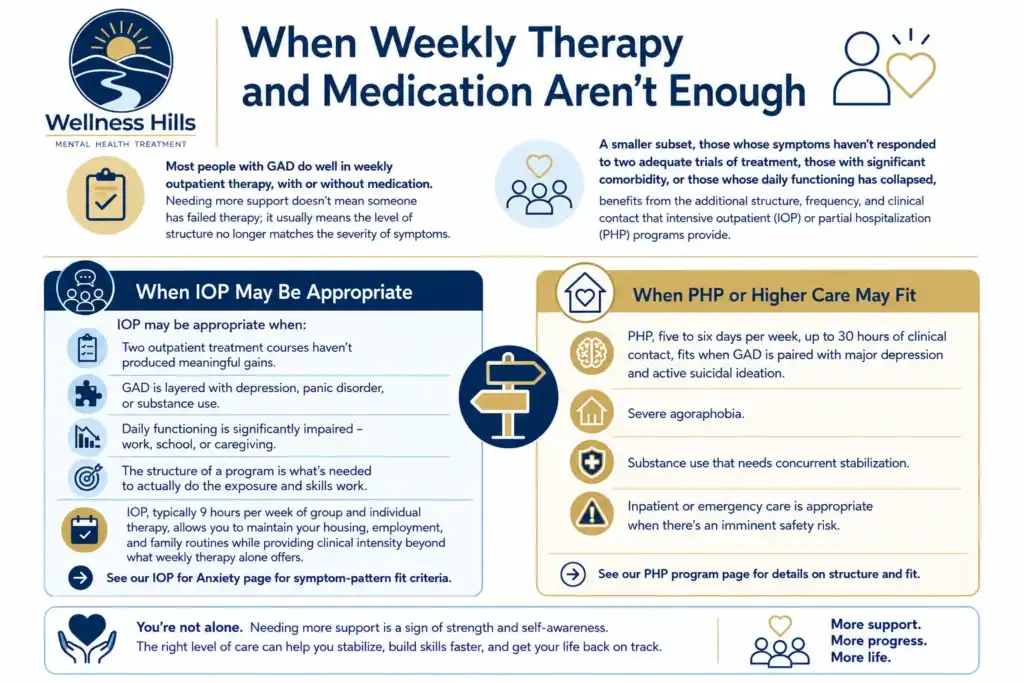
Most people with GAD do well in weekly outpatient therapy, with or without medication. For those who’d prefer not to lead with a prescription, there are well-supported non-medication approaches to anxiety that can work on their own or alongside therapy. Needing more support than that doesn’t mean someone has failed therapy; it usually means the level of structure no longer matches the severity of the symptoms.
A smaller group benefits from the added structure, frequency, and clinical contact of an intensive outpatient program (IOP) or partial hospitalization (PHP): people whose symptoms haven’t responded to two adequate trials of treatment, those with significant co-occurring conditions, or those whose day-to-day functioning has sharply declined.
When IOP May Be Appropriate
IOP may be appropriate when:
- Two outpatient treatment courses haven’t produced meaningful gains.
- GAD is layered with depression, panic disorder, or substance use.
- Daily functioning is significantly impaired – work, school, or caregiving.
- The structure of a program is what’s needed to actually do the exposure and skills work.
IOP, typically 9 hours per week of group and individual therapy, allows you to maintain your housing, employment, and family routines while providing clinical intensity beyond what weekly therapy alone offers. See our IOP for Anxiety page for symptom-pattern fit criteria.
When PHP or Higher Care May Fit
PHP, five to six days per week, up to 30 hours of clinical contact, fits when GAD is paired with major depression and active suicidal ideation, severe agoraphobia, or substance use that needs concurrent stabilization. Inpatient or emergency care is appropriate when there’s an imminent safety risk. See our PHP program page for details on structure and fit.
Red Flags That Warrant Urgent Evaluation
Some symptoms warrant same-day or emergency assessment, not a future-dated outpatient appointment:
- Active suicidal thoughts, intent, or planning.
- Inability to function in basic self-care, eating, or sleeping for several days.
- Severe agoraphobia prevents leaving home for essential needs.
- New or worsening psychotic symptoms (paranoia, hallucinations, severe disorganization).
- Substance use that has become unsafe to stop without medical supervision (especially alcohol and benzodiazepines).
- Acute manic or hypomanic symptoms emerging after starting an SSRI or SNRI.
If any of these are present, contact 988 (Suicide and Crisis Lifeline), go to the nearest emergency department, or call 911.
Wellness Hills Mental Health Treatment is a New Jersey-licensed behavioral health facility in Chester (Morris County). Our IOP runs in two formats, Mon/Tue/Thu evenings (6-9pm) and Mon-Fri mornings (9am-12pm). Our PHP runs Monday through Saturday for higher-acuity stabilization. Most major commercial insurance plans cover IOP and PHP when medically necessary; verification is part of the intake process.
Six Mistakes That Stall GAD Recovery
Common patterns that slow or reverse progress:
- Stopping medication too early – most relapses occur in the first 6 months after discontinuation.
- Using benzodiazepines as a long-term solution – short-term relief, long-term worsening of anxiety sensitivity.
- Therapy without exposure work – supportive talk therapy alone tends to plateau on GAD
- Heavy caffeine, cannabis, or alcohol use during treatment – undermines therapy and medication.
- Skipping the medical workup – untreated thyroid or cardiac issues keep treatment stuck
- Treating GAD as the whole picture – when depression, panic, or trauma is the actual driver.
Frequently Asked Questions
These are the questions that come up most often in GAD treatment conversations, covering treatment timelines, medication trade-offs, when to consider IOP or PHP, and how co-occurring conditions change the plan. The answers are general orientation; individualized treatment recommendations require a clinical assessment.
How long does GAD treatment take?
The initial response usually appears within 8-16 weeks of consistent treatment. Sustained remission typically requires 6-12 months of active treatment, often followed by longer-term maintenance to sustain gains. Medication usually reaches its full effect by 4-8 weeks; CBT progress is generally visible by session 6-8.
Can GAD be treated without medication?
Yes. For mild-to-moderate GAD, CBT alone is often sufficient. For moderate-to-severe presentations, particularly when sleep is disrupted or depression is co-occurring, combination treatment tends to outperform either approach alone. The right choice depends on severity, comorbidity, and personal preference, and is best made with a clinician.
When should I consider IOP or PHP for GAD?
When weekly outpatient therapy isn’t holding the symptoms, when GAD is layered with depression, panic, or substance use, or when daily functioning is significantly impaired. A clinical assessment is the most reliable way to make that call.
What if CBT alone isn’t working for my GAD?
If you’ve completed 12-16 weeks of CBT with consistent attendance and homework and worry, avoidance, or functional impairment hasn’t meaningfully changed, the next clinical conversations are usually: was the CBT delivered with exposure work or only cognitive components, would adding SSRI or SNRI medication help, are co-occurring conditions (depression, panic, ADHD, substance use) being missed, and would IOP-level structure make exposure and skills practice more achievable?
Can medication make anxiety worse at first?
Yes, temporarily. SSRIs commonly cause a brief uptick in anxiety, jitteriness, or GI symptoms during the first 1-2 weeks of titration before improving. This is expected, not a sign the medication is wrong. Prescribers often start at low doses and titrate slowly to reduce this. If the worsening is severe, prolonged, or accompanied by manic-like features, contact your prescriber.
How do I know if my anxiety is severe enough for IOP?
IOP is generally appropriate when two outpatient treatment courses haven’t produced meaningful gains, when GAD is layered with depression, panic, or substance use, when daily functioning is significantly impaired, or when the structure of a program is what’s needed to actually do the exposure and skills work that weekly therapy hasn’t sustained. A clinical assessment is the most reliable way to confirm fit.
Is GAD treated differently when depression is also present?
Often yes. Depression with anxious distress can mimic GAD but generally responds best to depression-first treatment, especially in medication selection. SSRIs and SNRIs treat both, but dosing strategy, sequencing, and the focus of therapy may shift when depression is the dominant impairment. A clinician should clarify which is primary before treatment planning.
What happens during a GAD assessment at Wellness Hills?
A clinical assessment includes review of current symptoms, history, prior treatment, medical and substance use, functional impairment, and screening tools such as the GAD-7. The clinician then recommends a level of care, outpatient referral, IOP, or PHP, based on clinical need, not enrollment volume. Assessments are free and carry no obligation to enroll.
What to Do Next: A Practical Path Forward
If symptoms are mild and you haven’t started treatment, your primary care provider or an outpatient therapist is the right first step. Psychology Today’s directory is a useful starting point. If symptoms are moderate-to-severe, treatment-resistant, or affecting your ability to function, a clinical assessment can help determine whether structured care, such as IOP or PHP, is appropriate.
Wellness Hills offers free, confidential assessments at our Chester, NJ facility, by phone or in person, with no obligation to enroll. The first call is with an admissions representative; clinical evaluation is the next step before any treatment begins.
Request a free assessment at 973-532-5139 or verify your insurance benefits.
Sources:
National Institute of Mental Health (NIMH) | Generalized Anxiety Disorder: What You Need to Know – Official NIMH resource explaining GAD symptoms, diagnosis, co-occurring conditions, and treatment options, including psychotherapy, medication, or both.
National Institute for Health and Care Excellence (NICE) | Generalized Anxiety Disorder and Panic Disorder in Adults: Management – Clinical guideline covering care and treatment recommendations for adults with generalized anxiety disorder and panic disorder, including stepped-care treatment planning and medication considerations.
Sipe WE, Eisendrath SJ | Mindfulness-Based Cognitive Therapy: Theory and Practice – Peer-reviewed article reviewing the theory and clinical use of Mindfulness-Based Cognitive Therapy (MBCT).
American Academy of Family Physicians (AAFP) | Generalized Anxiety Disorder and Panic Disorder in Adults – Clinical review summarizing diagnosis and treatment of GAD and panic disorder in adults, including CBT, SSRIs, SNRIs, benzodiazepine cautions, and use of validated screening tools.
National Institute of Mental Health (NIMH) | Mental Health Medications – Official NIMH medication resource explaining common psychiatric medication categories, including antidepressants, anti-anxiety medications, benzodiazepines, beta blockers, buspirone, and medication safety considerations.
Substance Abuse and Mental Health Services Administration (SAMHSA) | 988 Suicide & Crisis Lifeline – Official federal resource for 24/7 crisis support by call, text, or chat for people experiencing mental health, substance use, or suicidal crisis concerns.
Editorial Standards
Our Editorial Policy
Our editorial standards keep our mental health content accurate, compassionate, and evidence-informed. Articles are developed using credible sources, reviewed for medical accuracy when needed, and regularly updated.