


Quick Answer:
An intensive outpatient program (IOP) for anxiety is a structured outpatient treatment program, typically 9 to 15 hours per week across three to five sessions, for adults whose anxiety has outgrown weekly therapy but does not require hospitalization.
Most courses run 6 to 10 weeks and combine group therapy, individual sessions, and medication management when clinically appropriate. Wellness Hills offers morning and evening IOP options in Chester, NJ, with PHP available when a higher level of care is clinically indicated.
What an IOP Program for Anxiety Is
An intensive outpatient program for anxiety is a structured course of treatment, typically 9 to 15 hours per week, delivered across three to five sessions, that combines group therapy with individual sessions and, when clinically appropriate, medication management. Most individuals complete an IOP in roughly 6 to 10 weeks, depending on response and clinical judgment.
In IOP, intensive mainly refers to treatment dose and structure, multiple sessions per week, not 24/7 hospitalization or residential care. You live at home, sleep in your own bed, and continue work or family responsibilities around the schedule.
What separates IOP from standard weekly outpatient is the dose, the group component, and the coordinated treatment team working from a shared clinical picture rather than a single therapist working alone.
How IOP for Anxiety Differs From IOP for Substance Use
The term IOP is more publicly associated with addiction treatment, which can be confusing for people researching anxiety care. Anxiety-focused IOPs are built around evidence-based anxiety treatment, CBT, DBT skills, and graduated exposure work, rather than relapse-prevention curricula or substance-use education. The structure is similar; the clinical content is different.

Which Anxiety Disorders an Anxiety-Focused IOP Typically Treats
Anxiety is not a single condition. The disorders below frequently respond to the dose and structure of IOP-level care, though clinical fit is determined in assessment.
Generalized anxiety disorder (GAD): Persistent, broad worry across multiple life domains, often with sleep disruption, muscle tension, and difficulty concentrating. IOP-level care can help when worry has stopped responding to weekly therapy and is interfering with daily functioning.
Panic disorder: Recurrent, unexpected panic attacks with anticipatory anxiety about future attacks. Anxiety IOP combines cognitive work, interoceptive exposure (controlled exposure to physical sensations of panic), and skills-based group practice, a combination that weekly therapy is often unable to deliver at a sufficient dose.
Social anxiety disorder: Significant fear of social or performance situations leading to avoidance of work meetings, social events, or relationships. The group-based structure of IOP can function as a working laboratory for graduated social exposure, which is part of why social anxiety often responds well to this level of care.
Agoraphobia: Avoidance of situations where escape feels difficult, such as driving, public transit, stores, crowds, or leaving home. Graduated in-vivo exposure work, central to IOP, is one of the most supported approaches.
Specific phobias: Intense fear of specific objects or situations. Specific phobias more often respond to focused outpatient exposure work; IOP-level care is typically reserved for cases with significant comorbidity or functional impairment beyond the phobia itself.
OCD overlap: Obsessive-compulsive disorder is technically a separate diagnostic category (no longer classified with anxiety disorders in DSM-5) and often responds best to specialized OCD-focused programs using exposure and response prevention (ERP). When OCD presents alongside generalized anxiety or panic, a clinical assessment determines whether anxiety-focused IOP is appropriate or whether a referral to an OCD specialty program is the better fit.
The right level of care is determined by symptom presentation, functional impairment, treatment history, and risk, not by diagnosis alone.
Symptom Patterns That Suggest IOP-Level Anxiety Care
Certain patterns commonly come up when people find that weekly outpatient anxiety care isn’t keeping pace with what they’re experiencing. None of the following is diagnostic on its own. They are signals that warrant a closer clinical look.
- Panic frequency and intensity have escalated: Multiple panic attacks in a week, or panic that’s no longer confined to discrete episodes and is leaking into baseline daily functioning, often suggest the dose of weekly therapy isn’t matching the dose of the symptoms.
- Avoidance has expanded rather than contracted: Situations or people you used to manage are now off-limits, and the avoidance list, driving, social settings, work meetings, and leaving the house, is growing rather than shrinking.
- Sleep and physical symptoms are persistent: Ongoing insomnia, GI symptoms, or muscle tension with anxiety as the suspected driver often points to a nervous system that hasn’t had a chance to down-regulate.
- Work or school functioning is slipping: Missed days, declining performance, accommodations being raised, or actively considering leave are commonly one of the more concrete markers that anxiety has crossed into functional impairment.
- Outpatient therapy has plateaued: Weekly therapy has helped to some degree, but progress has stalled, or symptoms are increasingly interfering with daily life, sometimes after several months of consistent work, sometimes sooner when symptoms are escalating.
- A recent stressor has overwhelmed usual coping: A loss, medical event, postpartum period, or major life transition has destabilized strategies that previously worked, and the previous level of care no longer feels sufficient.
The presence of several of these patterns doesn’t diagnose anything or assign a level of care; it suggests that an IOP-level evaluation is reasonable.
What Clinicians at Wellness Hills Look for When Recommending IOP for Anxiety
Level of care isn’t determined by symptom severity alone. The decision lens used by our clinical team weighs functioning, treatment history, and risk together, and the same symptom picture can point toward different levels of care depending on what’s around it.
- Functional impairment: Concrete effects on work performance, relationships, parenting, and self-care often carry more weight in the decision than symptom intensity on a given day.
- Standard outpatient response: Has weekly therapy, and, where clinically appropriate, medication management, been tried at an adequate dose and duration? A stalled response after consistent engagement is one of the clearest signals to step up.
- Risk and safety factors: Suicidal ideation, severe avoidance restricting basic functioning, or escalating panic with deteriorating sleep can shift the recommendation upward, sometimes toward PHP or an inpatient evaluation.
- Engagement readiness: IOP relies on group work and active skill-building. When acuity is high enough that participating in a group setting isn’t realistic right now, PHP or a higher level of care often comes first.
- Support system stability: Outpatient treatment depends on a home environment that can hold the work between sessions, and a destabilized setting can make IOP less viable than more contained care.
- Comorbidity load: Co-occurring depression, OCD, PTSD, or substance use often need coordinated rather than sequential treatment, and that complexity factors into the level-of-care recommendation.
IOP vs. Standard Outpatient vs. PHP: How to Tell Which You Need
Mental health care exists on a continuum of intensity, and the same person can need different levels at different points. The table below lays out where each option fits, followed by how Wellness Hills delivers them.
| Feature | Standard Outpatient | Intensive Outpatient (IOP) | Partial Hospitalization (PHP) | Inpatient | Crisis Resources |
|---|---|---|---|---|---|
| Hours/Week | ~1 hr | 9–15 hrs | 25–30 hrs | 24/7 | — |
| Frequency | Weekly | 3–5 days/week | 5–6 days/week | Daily admission | As needed |
| Best Suited For | Mild–moderate anxiety with stable functioning | Moderate anxiety where weekly therapy has plateaued; functional impairment in work, sleep, or relationships | Severe symptoms requiring near-daily structure; recent step-down from inpatient | Acute safety risk, severe symptoms requiring medical stabilization | Active suicidal ideation or imminent safety concern |
| Typical Length | Variable; often ongoing | 6–10 weeks | 2–6 weeks | Days to weeks | — |
| Step-Up Trigger | Symptoms persist or worsen despite consistent weekly care | Acuity rises beyond what group-based outpatient can hold | Safety risk, severe daily impairment, or destabilized home environment | Imminent risk to self or others; medical complications | Call or text 988; go to nearest ER |
The right level of care depends on functioning, treatment history, and risk, not symptom severity alone. Two people describing similar anxiety can need different levels of care depending on how it’s affecting their work, sleep, and relationships, and what’s already been tried. Support system stability and engagement-readiness factors as well.
At our facility, the practical options are:
- IOP 3 Evening – Monday, Tuesday, and Thursday, 6–9pm. Designed for people maintaining a daytime work or school schedule.
- IOP 5 Morning – Monday through Friday, 9am–12pm. Built for people on leave, working part-time, or with flexible schedules.
- PHP – Monday through Saturday. Used when symptoms warrant a higher level of care than IOP can provide.
- Standard Outpatient and psychiatry/medication management are also available as standalone care or as step-down care.
An intake conversation with a clinician is the only reliable way to know which fits.
How an IOP Actually Treats Anxiety
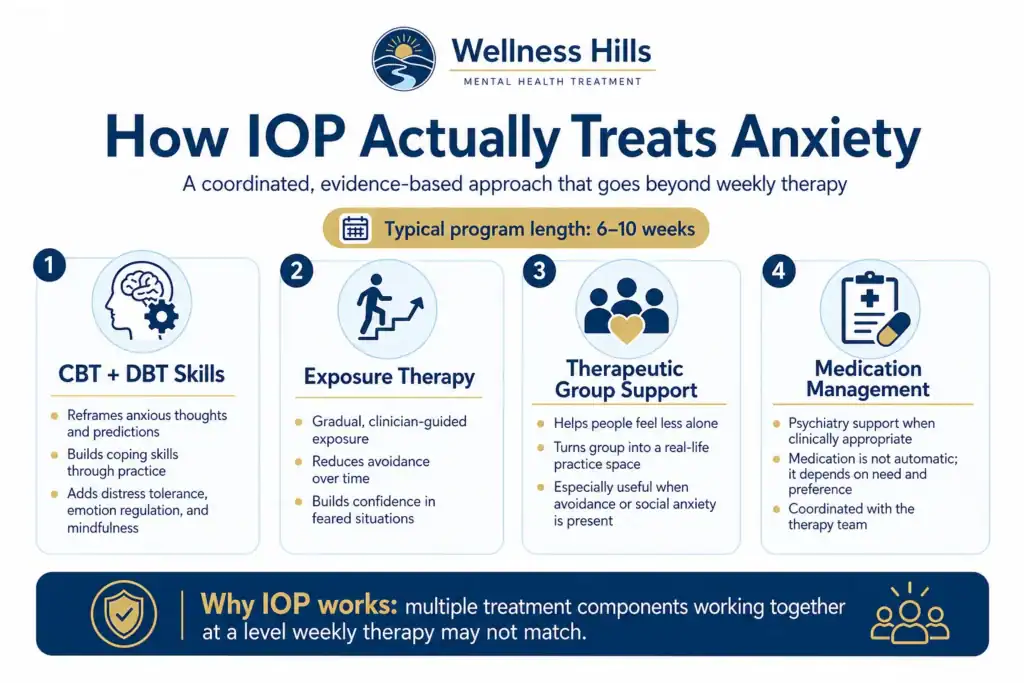
Anxiety-focused IOP isn’t one therapy delivered more often; it’s a coordinated set of clinical components, each doing different work. The combination produces change at a dose that weekly therapy can’t match, and the components below are central to what most people experience during a 6–10-week program at Wellness Hills.
Cognitive Behavioral Therapy (CBT) and Dialectical Behavior Therapy (DBT) Skills
CBT is the most-researched psychotherapy for anxiety and forms the spine of most anxiety-focused IOPs. The core work involves cognitive restructuring (testing the accuracy of anxious predictions), behavioral experiments, and graded behavioral practice that retrains the relationship between thought, sensation, and action.
DBT skills layer in when anxiety co-occurs with intense emotional reactivity, panic, or self-harm urges; distress tolerance, emotion regulation, and mindfulness are particularly useful when the nervous system is running too hot for cognitive work alone to land.
Exposure Therapy
Formal exposure therapy is one of the most-supported components of evidence-based anxiety treatment, and one of the most carefully calibrated. Many people researching IOP worry that exposure will make their anxiety worse; that fear is understandable and worth addressing directly. Graduated exposure, conducted collaboratively in a clinical setting, is paced so that the work is challenging yet tolerable, with the clinician adjusting based on your response.
The discomfort is real; the structure is what makes it productive. The goal is to gradually reduce avoidance and rebuild confidence in situations where anxiety has narrowed. Wellness Hills incorporates formal exposure therapy as a clinical component of anxiety-focused IOP.
Group as a Therapeutic Mechanism
Group is often the surprising-but-effective part of IOP. The belief that “I’m the only one who experiences this” tends to weaken quickly in a structured group, and the simple act of showing up is itself therapeutic when avoidance is part of the presentation. For social anxiety in particular, the group becomes a working laboratory rather than only a discussion space.
Medication Management
Coordinated psychiatry is part of the treatment team when clinically appropriate. At Wellness Hills, Paula Weisman, PMHNP-BC, provides medication evaluation and ongoing medication management, working alongside the therapy team so changes are informed by what’s happening in session. Whether medication is recommended at all depends on clinical picture, history, and preference; it isn’t a default.
What an IOP Week Actually Looks Like in NJ
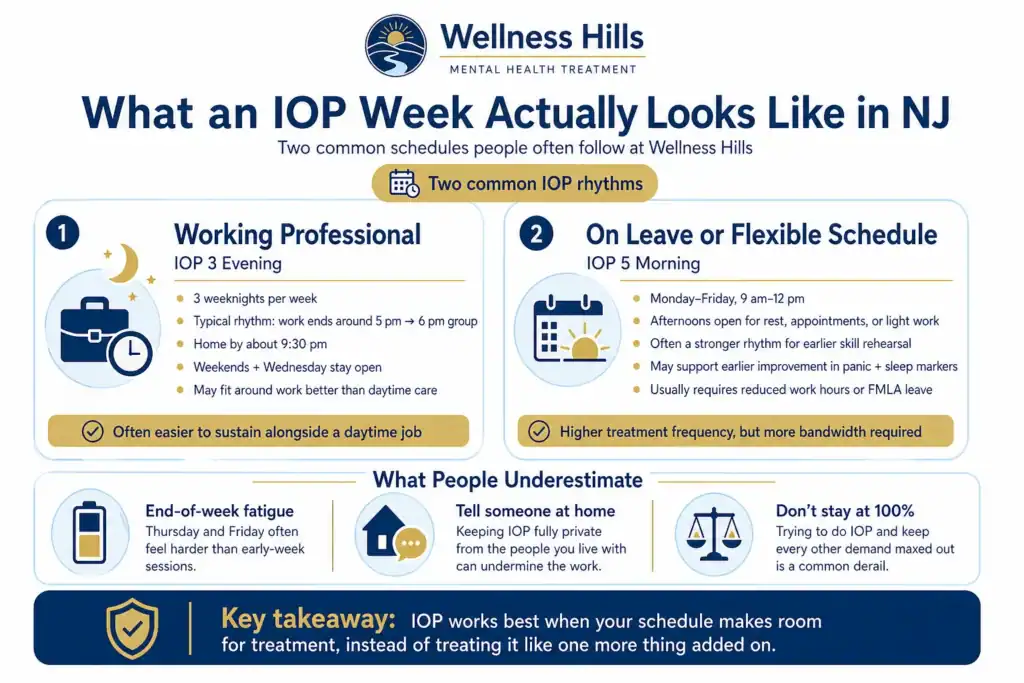
How an IOP fits into your week is often the deciding practical question, especially for people weighing whether they can do this without stepping back from work or family. Two scheduling patterns cover most of what people actually run at Wellness Hills, and the realities below are worth knowing before you start.
Working Professional: IOP 3 Evening
A typical pattern: finishing work at 5pm in Morristown or Parsippany, taking Route 24 to a 6pm group at Wellness Hills, and home by around 9:30. Evening IOP may allow some working professionals to attend without daytime PTO, depending on schedule and commute, though some employer communication or scheduling adjustment may be needed. Three weeknights of structured care, with weekends and Wednesday open, is a rhythm many people sustain across a full course.
On Leave or Flexible Schedule: IOP 5 Morning
For someone on FMLA leave, postpartum, or working part-time, the morning IOP runs Monday through Friday, 9am-12pm. Afternoons are typically open for rest, appointments, light part-time work, or whatever recovery requires that day.
In clinical practice, the five-day morning rhythm tends to produce earlier improvements in panic frequency and sleep markers than the three-day evening track, likely because skill rehearsal occurs before the prior session’s work fades.
The trade-off is bandwidth: a five-day IOP usually requires reduced work hours or FMLA leave, where IOP 3 Evening can sometimes be sustained alongside a daytime schedule.
What People Underestimate
- End-of-week energy crashes are common; Thursday and Friday hit harder than early-week sessions.
- Telling at least one person at home what you’re doing matters more than people expect; keeping IOP fully private from the people you live with usually undermines the work.
- The “I’ll do this AND keep everything else running at 100%” trap is the most common derail. IOP requires bandwidth, and treating it as additive rather than as a replacement for some demands tends to stall progress.
What Progress Tends to Look Like, Week to Week
A typical IOP course at Wellness Hills runs 6-10 weeks. The arc below describes what often unfolds, not a timeline anyone is held to or a guarantee of pace.
- Weeks 1–2: Stabilization: The early weeks focus on symptom mapping, skill introduction, getting oriented in group, and baseline measures like the GAD-7 and PHQ-9. This stretch often feels harder before it feels better, partly because attention to symptoms tends to amplify them in the short term.
- Weeks 3–5: Skill Building and Exposure: CBT and DBT skills move from concept to practice, and graduated exposure work begins where clinically appropriate. Sleep and panic frequency are often the first markers to shift, though gains can be uneven across the week.
- Weeks 6–8: Generalization and Step-Down: Skills get tested outside group, and step-down planning typically begins, most often weekly outpatient therapy with continued medication management when relevant.
Progress is rarely linear, and a tough week mid-program is common, not a sign IOP isn’t working.
How Progress is Measured
IOP is delivered as measurement-based care, meaning progress is tracked using standardized tools rather than relying solely on self-report. Two categories of markers tend to move on different timelines.
Clinical markers:
- GAD-7 score change (a brief anxiety severity scale completed at intake and periodically throughout treatment).
- PHQ-9 score change (depression screening, since depression frequently co-occurs with anxiety).
- Panic attack frequency and duration.
- Sleep onset latency and continuity.
- Avoidance behavior counts.
Functional markers:
- Work or school attendance.
- Reintroduction of avoided situations (driving, public spaces, social settings).
- Engagement with relationships and family routines.
- Reduction in safety behaviors and reassurance-seeking.
- Self-rated daily functioning.
Clinical and functional markers do not always move in lockstep. Many patients experience meaningful functional gains before symptom scores reflect them, and the reverse is also possible. Treatment teams use both columns to inform pace, exposure planning, and step-down decisions.
Insurance, Cost, and What to Ask Before You Start
Wellness Hills accepts most major commercial insurance plans in New Jersey, and benefits are verified directly with your insurer before you start. Realistic out-of-pocket cost depends on your deductible, coinsurance, and annual out-of-pocket maximum; the same plan can produce very different numbers in January versus October.
A few questions worth asking your insurer:
- Is an intensive outpatient program for anxiety covered under my behavioral health benefits?
- What’s my mental health deductible, and how much of it have I met?
- How many days of IOP are authorized initially, and what’s the reauthorization process?
A verification of benefits is free and doesn’t commit you to anything.
When IOP Isn't the Right Fit
IOP is the right level of care for a defined pattern, not for everyone with anxiety. A few situations where something else fits better:
- Mild anxiety with stable day-to-day functioning – standard weekly outpatient is usually enough.
- Active suicidal crisis or inability to maintain safety at home – call or text 988, go to an emergency room, or seek an inpatient evaluation first.
- Active psychosis or severe mania – stabilization in a higher level of care is typically required before group-based outpatient programming is clinically appropriate.
- Uncontrolled substance withdrawal or active substance dependence – medical detoxification or substance-specific treatment usually precedes IOP, and concurrent care may be coordinated when stabilized.
- Inability to participate safely in a group setting – when acuity, agitation, or interpersonal risk make group work unrealistic in the moment, PHP or one-to-one care is a better starting point.
- No scheduling flexibility at all – telehealth-only outpatient may be a more realistic starting point than committing to 9–15 hours of in-person care.
If you’re unsure, an evaluation is the lowest-friction way to find out.
Frequently Asked Questions
A few additional questions come up often enough to be worth answering directly. The answers below address the most common questions people ask before starting treatment.
Will I have to stop working to do an IOP for anxiety?
Most people enrolled in IOP 3 Evening continue working their regular daytime schedule. IOP 5 Morning typically requires reduced hours, FMLA leave, or a flexible arrangement, since sessions run Monday through Friday from 9am to noon. Fit depends on your specific role, employer, and commute.
How long does an intensive outpatient program for anxiety usually last?
A typical course runs 6–10 weeks and is individualized based on response to treatment, clinical goals, and ongoing recommendations from the treatment team. Some people step down sooner; others benefit from a longer course or a transition into PHP if symptoms warrant.
Do I need a referral to start?
No, you can self-refer. An assessment by our team determines whether IOP is the appropriate level of care or whether another option is better suited to your situation.
Can I do anxiety IOP virtually, or does it have to be in person?
In-person attendance is generally preferred for IOP-level care because group dynamics and exposure work tend to be stronger in shared physical space, though some hybrid arrangements may be available depending on clinical recommendation. Telehealth-only may be a more realistic starting point for people with no scheduling flexibility.
Talk to the Wellness Hills Team
- Call admissions. A first conversation with our admissions team is free and confidential. They’ll answer practical questions about scheduling, insurance, and what an assessment involves.
- Verify your insurance. Benefits are checked directly with your insurer at no cost. This step does not commit you to enrolling.
- Schedule a clinical assessment. A licensed clinician on our team conducts the assessment and determines whether IOP, PHP, standard outpatient, or another option is the appropriate fit.
- Receive a level-of-care recommendation. The recommendation reflects the symptom picture, functioning, history, and risk factors. If IOP isn’t the right starting point, the team will say so and help with the next steps.
- Set a start date. If IOP is the recommended fit, admissions coordinates start date, schedule (IOP 3 Evening or IOP 5 Morning), and any pre-treatment paperwork.
- Plan step-down before discharge. Continuity is built into the course. Most patients step down to weekly outpatient, often with continued medication management.
To start, call 973-532-5139, request an assessment through our contact form, or verify your insurance online. Wellness Hills is located at 425 Main St, Floor 1, Chester, NJ 07930.
If you are in crisis or having thoughts of suicide, call or text 988 for immediate, confidential support.
Sources:
American Psychological Association (APA) | Anxiety – APA overview explaining common anxiety symptoms, including worried thoughts, physical tension, and bodily changes. Useful for supporting general patient-facing definitions of anxiety and how anxiety can affect daily functioning.
National Library of Medicine / PMC | Wolgensinger, L. Cognitive Behavioral Group Therapy for Anxiety: Recent Developments – Peer-reviewed article discussing how anxiety disorders can affect quality of life and reviewing cognitive behavioral group therapy as a structured treatment approach for anxiety.
988 Suicide & Crisis Lifeline | Get Help Now – Official crisis support resource explaining that people can call, text, or chat 988 for free, confidential help 24/7/365 during mental health struggles, emotional distress, substance use concerns, or imminent safety concerns.
Editorial Standards
Our Editorial Policy
Our editorial standards keep our mental health content accurate, compassionate, and evidence-informed. Articles are developed using credible sources, reviewed for medical accuracy when needed, and regularly updated.