


If you’re looking into how to treat anxiety without medication, you most likely want real relief, you’d just rather not start a prescription, or you want to know whether you can avoid one. That’s a reasonable, evidence-supported goal. For many people with mild-to-moderate anxiety, non-medication approaches are a recognized first step that often helps a great deal.
This guide won’t just hand you a list of techniques. It will help you choose the ones that fit your kind of anxiety and tell you honestly when your own efforts may need reinforcement.
Quick Answer: Can Anxiety Be Treated Without Medication?
Yes, for many people, especially those with mild-to-moderate anxiety, it can, through therapy approaches, behavioral change, exposure work, and lifestyle foundations. Even when medication is used, these approaches usually carry the long-term work. The highest-value places to start:
- Structured therapy such as CBT.
- Facing avoided situations gradually.
- Regular movement and consistent sleep.
- Less caffeine and alcohol.
- Cutting back on reassurance-seeking.
If anxiety is persistent, worsening, or limiting daily life, a professional assessment can help match the right support. If anxiety ever comes with thoughts of self-harm or being unable to stay safe, contact 988 or call 911.
Without Medication Doesn't Mean Without Treatment
It’s easy to assume medication is the real treatment and everything else is willpower or wellness fluff. That belief is worth letting go of. Therapy, particularly CBT and exposure-based approaches, is itself a first-line, evidence-based treatment, not a lesser substitute.
Without medication also means different things to different people. For some, it’s lifestyle changes alone. For others, it’s therapy without a psychiatric prescription or structured treatment that doesn’t start with medication. Some prefer this route; others experience difficult side effects.
This article isn’t anti-medication; medication helps many people, and that decision belongs with a clinician. It helps to know the difference, too: everyday anxiety often passes on its own, while an anxiety disorder is persistent, out of proportion, and interferes with daily life. If you currently take medication for anxiety, don’t stop, reduce, or change the dose without first talking to your prescriber; stopping abruptly can cause withdrawal or rebound symptoms.
First, Identify the Anxiety Pattern You're Treating
These are general patterns, not a diagnosis. Anxiety often overlaps, and only a licensed clinician can identify what’s actually going on. The point is that different patterns respond to different kinds of support.
Here’s how each pattern maps to the strategies below. Most people draw from more than one row.
| Anxiety Pattern | Best-Fit Non-Medication Strategy |
|---|---|
| Mostly chronic worry | CBT / cognitive restructuring, worry scheduling, getting worries onto paper, and acceptance-based skills (ACT). |
| Panic-type symptoms | Medical rule-out first, then interoceptive exposure to reduce fear of bodily sensations rather than avoid them. |
| Social / performance anxiety | Gradual exposure, plus dropping safety behaviors such as over-preparing or avoiding eye contact. |
| Avoidance-driven anxiety | Graded exposure: a ranked list of avoided situations worked through step by step. |
| Tied to trauma, OCD, depression, or substance use | Clinical assessment first; non-medication care can still help, but it should be structured and matched to what’s driving it. |
Mostly Chronic Worry
Rumination, what-if loops, reassurance-seeking, and trouble switching off the persistent worry are often linked to generalized anxiety disorder. This pattern responds best to cognitive work that challenges anxious predictions, plus getting worry out of your head and onto paper.
Panic-Type Symptoms
Racing heart, shortness of breath, dizziness, or fear of losing control. The aim is to reduce fear of these sensations. If symptoms are new, severe, or unclear, get a medical check first.
Social or Performance Anxiety
Fear of being judged or watched in front of others. This pattern eases with gradual exposure and by dropping the safety behaviors, over-preparing, and avoiding eye contact, which keep the fear alive.
Avoidance-Driven Anxiety
The pattern that most often grows anxiety: life quietly shrinking as you steer around anything uncomfortable. It responds to graded exposure by facing avoided situations in small, incremental steps.
Anxiety Tied to Trauma, OCD, Depression, or Substance Use
When anxiety is bound up with any of these, it needs more careful assessment. Non-medication care may still help, but the plan should be more structured and matched to what’s driving it.
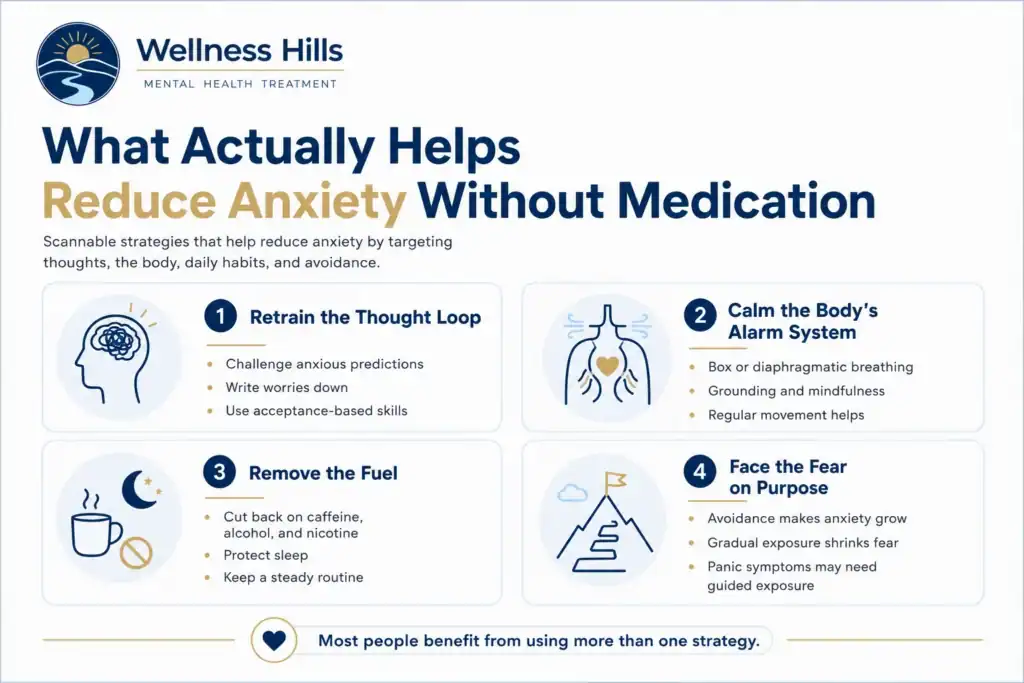
What Actually Helps Reduce Anxiety Without Medication
The techniques that follow are grouped by what they do, not listed at random. Match them to the pattern you identified above; most people draw from more than one group.
Retrain the Thought Loop
Anxiety runs on predictions, usually that something bad is about to happen. Cognitive work, the core of cognitive behavioral therapy for anxiety, teaches you to catch those predictions, test them against what actually happens, and loosen the catastrophic thinking and safety behaviors that hold them in place.
It takes practice between sessions, and it’s not just positive thinking; you’re weighing evidence, not forcing cheerfulness. Writing worries down helps too: a what-if on paper is easier to question than one looping in your head. Acceptance-based skills from acceptance and commitment therapy (ACT), letting a worry exist without arguing with it, can ease chronic worry and the urge to control everything.
Calm the Body's Alarm System
Anxiety is partly physical: the fight-or-flight response, governed by the sympathetic nervous system, is stuck on high alert. Slowing the body turns the alarm volume back down. Diaphragmatic or box breathing, progressive muscle relaxation, mindfulness, and 5-4-3-2-1 grounding all work this way.
Treat them as a reset that buys room to use your other skills, not the whole plan, and not a way to escape anxiety the moment it shows up. Regular aerobic movement is one of the best-supported non-medication approaches, and it needn’t be intense: a daily walk, yoga, or light strength work counts. It eases anxiety for many people, though it isn’t a cure.
Remove the Fuel
Some everyday habits quietly amplify anxiety. Caffeine, alcohol, nicotine, and hours of screen overstimulation can crank up arousal or disrupt the systems that keep you steady. Easing off them won’t fix anxiety, but it removes fuel from the fire.
Sleep is a force-multiplier: when it’s short or broken, everything else feels harder, and protecting it makes the other strategies work better. A predictable daily routine helps too, since uncertainty tends to ramp anxiety up and a steady rhythm offers more stability. Treat all of this as a foundation, not a substitute for treatment when anxiety is interfering with your life.
Face the Fear on Purpose
This is the approach most lists skip, and it’s often the most powerful. When you avoid what scares you, the fear grows; when you return to it gradually and on purpose, the fear shrinks. The method is planned and repeated, not just facing your fears or forcing yourself into panic.
You build a ranked list of avoided situations and work your way up it step by step, letting your nervous system learn that the feared outcome usually doesn’t occur. Each repetition retrains the response.
When the fear is of physical sensations rather than situations, as in panic, the same method becomes interoceptive exposure: deliberately and safely bringing on sensations such as a racing heart or breathlessness until they no longer register as dangerous.
At disorder-level severity, this works best with professional guidance, which keeps the steps challenging but manageable.
Supplements and Natural Remedies: What the Evidence Actually Shows
You’ll see magnesium, ashwagandha, L-theanine, chamomile, and lavender recommended widely, along with non-supplement options like weighted blankets and aromatherapy.
Here’s the honest picture: a few may help some people, but the evidence is mostly limited or mixed, and none is a substitute for treatment when anxiety is impairing your life.
Natural also doesn’t mean safe; supplements can interact with medications and other health conditions, so check with a clinician or pharmacist before starting one. Treat these as minor supports at best, not on a par with therapy or exercise, which have far stronger evidence.
The Most Common Mistake: Treating Every Anxiety Spike Like an Emergency
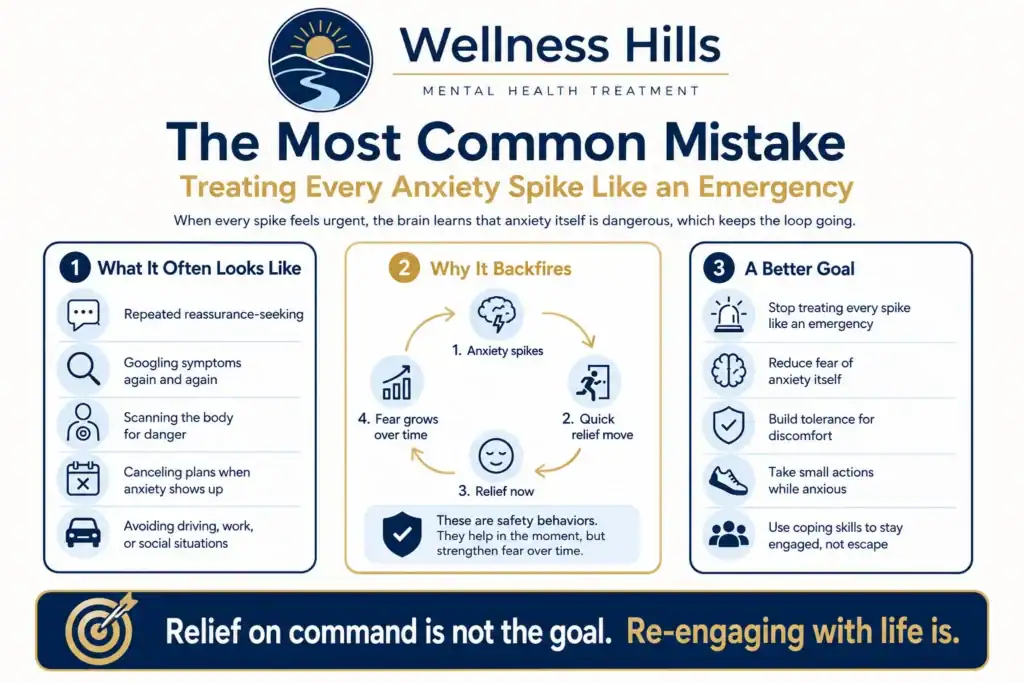
If your non-medication efforts have stalled, this is the most likely reason, and it’s not a personal failing. When anxiety spikes, the natural instinct is to make it stop right now. But treating every spike like an emergency quietly teaches your brain the opposite of what you want it to learn: that anxiety itself is dangerous. That belief tightens the loop and keeps anxiety in charge.
It usually shows up as small, understandable moves. Texting someone for reassurance, then needing to ask again an hour later. Googling your symptoms one more time. Scanning your body over and over for the next wave. Canceling plans the moment anxiety appears and steering clear of driving, work, or social events.
Even using breathing exercises only to make the feeling vanish. These are safety behaviors, actions that bring relief in the moment but strengthen the fear over time. Each one tells your nervous system the threat was real, and that you only got through it because you escaped.
The better goal isn’t to feel calm on command. It’s to stop treating every spike as an emergency and to lower how urgently your brain reacts to ordinary discomfort. That means reducing your fear of anxiety itself, building tolerance for ordinary discomfort, and taking small actions while anxious instead of waiting to feel ready, going to the event, and letting the nerves come with you.
Used this way, coping skills help you stay engaged with your life rather than escape every uncomfortable feeling, and that shift is often what finally loosens the loop.
What Realistic Progress Looks Like
Progress rarely arrives on a neat schedule, and it doesn’t move evenly. For many people, the physical side eases soonest: a calmer heart rate, less restlessness, steadier sleep, as breathing practice, regular movement, and cutting back on stimulants take hold.
The slower part is usually the worry loop and the avoidance habits, which tend to respond most to consistent cognitive work and gradual exposure over time. Two things worth remembering: feeling physically calmer isn’t the finish line, and slow change in the worry loop isn’t failure. With this kind of work, consistency matters far more than speed.
How Long Should You Try Before Adding Support?
Don’t wait for anxiety to disappear, and don’t hold yourself to a fixed schedule. Watch the direction of travel instead. After a stretch of consistent effort, consider adding professional support if any of the following is true: avoidance is still spreading into new parts of life, your day-to-day functioning hasn’t improved, the checking and reassurance habits aren’t easing, or symptoms are getting worse, regardless of how many weeks it’s taken.
How to Know If You Should Add Professional Support
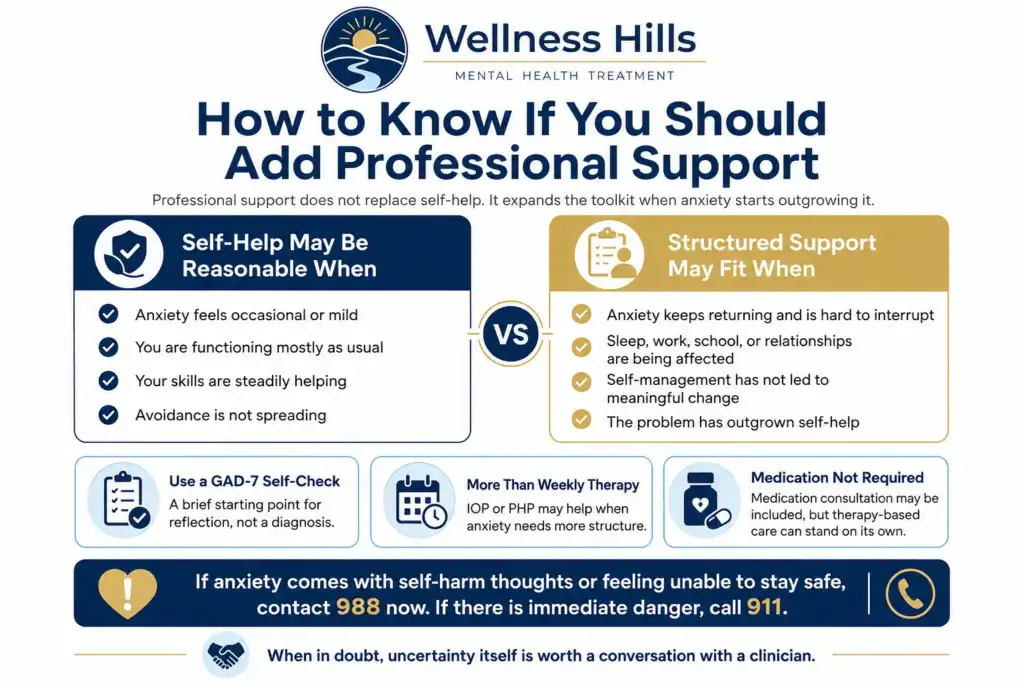
Adding professional help isn’t giving up on the non-medication goal; it’s expanding the toolkit. Here’s a simple way to gauge where you stand.
Self-Help May Be Reasonable When
Your anxiety is occasional or mild, you’re functioning mostly as usual, your skills are steadily reducing symptoms, and your avoidance isn’t spreading into new parts of life.
Structured Support May Fit When
Anxiety keeps returning and is hard to interrupt; it’s affecting your sleep, relationships, work, or school; or you’ve practiced self-management consistently without meaningful change. None of these means something is wrong with you; they’re signs the problem has outgrown self-help. For more, here are the signs it’s time to see a professional.
You can take a brief self-check based on the GAD-7 to reflect on how intense your anxiety has been over the past two weeks. It doesn’t diagnose an anxiety disorder and isn’t a substitute for an evaluation by a licensed clinician; it’s a starting point for that conversation.
If you’re unsure which side you’re on, that uncertainty is itself worth a conversation with a clinician. For anxiety that has outgrown weekly therapy but doesn’t need inpatient care, an intensive outpatient program for anxiety (IOP) and partial hospitalization (PHP) can be largely therapy-driven levels of care. Medication consultation may be included when clinically appropriate, but it isn’t required to take part.
If anxiety comes with thoughts of self-harm or feeling unable to stay safe, reach out now or contact 988; if in immediate danger, call 911.
What to Track Weekly
Going without medication doesn’t mean going without measurement; in fact, tracking matters more when no prescription is doing part of the work for you. The trap is measuring the wrong thing. “Did I feel anxious this week?” will almost always be yes; anxiety is uncomfortable, not rare, and that question keeps your attention on the feeling.
The more useful one is: “Did anxiety control less of my behavior this week?” That’s the number that actually moves when treatment is working, and it’s the shift the strategies in this article are built to produce. Once a week, jot down five things:
- Symptom intensity – your average and peak levels on a 0-10 scale, plus how often panic hits if that’s part of your picture.
- Avoidance – what anxiety stopped you from doing, set against what you did anyway despite the discomfort.
- Reassurance and checking – Googling symptoms, asking others for reassurance, body-scanning, or replaying conversations in your head.
- The inputs – sleep, caffeine, alcohol, and screen time, not the whole story, but they move the nervous system in ways you’ll feel.
- Functional wins – you went to work, made the call, drove the route, stayed in the situation, or finished one task you’d been avoiding.
Over a few weeks, watch the pattern, not any single day. If avoidance is shrinking, the checking habits are easing, and the functional wins are adding up, your plan is working, even on weeks when the anxiety still feels loud.
What If These Strategies Aren't Working?
If you’ve been at this a while without much change, usually it’s fixable: strategies too scattered, used only mid-panic, or avoidance that hasn’t budged. Severe sleep loss, or untreated depression or trauma, can stall it too, and sometimes you need more structure and frequency than self-help offers.
Not improving doesn’t mean you failed; more often, it means the level of support is too low. Next steps include anxiety-specific therapy, IOP or PHP, a diagnostic reassessment, or revisiting with a clinician whether medication has a role, one option among several, no pressure either way. Explore your anxiety treatment options.
Frequently Asked Questions
If you’re still weighing whether you can manage anxiety without medication, these are the questions that come up most:
Can anxiety go away without medication?
For many people with mild-to-moderate anxiety, yes, through therapy, behavioral change, and lifestyle foundations. If symptoms are persistent or impairing, a professional evaluation can confirm what fits.
What's the most effective non-medication treatment?
There’s no single best. The strongest evidence is for cognitive-behavioral skills and regular exercise; combining the two usually beats either alone. The right fit depends on your anxiety pattern.
How do I calm anxiety naturally in the moment?
Breathing, grounding, and stepping away from overstimulation can ease a spike in the short term. Lasting change usually comes from reducing avoidance over time, not from calming each individual episode.
When is anxiety too severe to manage on my own?
When it disrupts work, school, sleep, relationships, or self-care over time, or when consistent self-management hasn’t helped. That’s a signal to add support, not a personal failing.
What if self-help and weekly therapy aren't enough?
Often, it’s time to add structure. Options include anxiety-specific therapy or an intensive outpatient program, and a clinical assessment helps match the right level of support.
Where to Go From Here
If anxiety is starting to shape your sleep, relationships, or ability to follow through on daily life, a clinical assessment can help clarify what level of support fits, without medication as the default.
Wellness Hills Mental Health Treatment in Chester, New Jersey, offers structured care that’s largely therapy-driven for adults who need more than weekly therapy but not inpatient care and who prefer not to lead with medication. Reaching out doesn’t commit you to anything.
Sources:
National Institute of Mental Health (NIMH) | Anxiety Disorders – Overview of anxiety disorders, including how anxiety differs from occasional worry, common anxiety disorder types, functional impairment, and when to seek help.
Kandola A, Vancampfort D, Herring MP, Rebar A, Hallgren M, Firth J, Stubbs B. | Moving to Beat Anxiety: Epidemiology and Therapeutic Issues with Physical Activity for Anxiety – Peer-reviewed review on the relationship between physical activity and anxiety, including the role of exercise as a supportive non-medication strategy.
National Center for Complementary and Integrative Health (NCCIH) | Natural Doesn’t Necessarily Mean Safer, or Better – Federal health resource explaining why natural products and supplements are not automatically safe or effective and may still carry risks or interactions.
Editorial Standards
Our Editorial Policy
Our editorial standards keep our mental health content accurate, compassionate, and evidence-informed. Articles are developed using credible sources, reviewed for medical accuracy when needed, and regularly updated.