



Many people searching for ACT for anxiety are not only afraid of their triggers; they are afraid of anxiety itself. So ACT can sound backward at first. Why would accepting a feeling help when you are working this hard to get rid of it?
This page explains why acceptance is the most misread word in ACT, what the skills do, which anxiety patterns they fit, and when other care should come first. One idea runs through all of it. Progress is measured less by how quiet anxiety becomes and more by how much of your life returns.
Quick Answer: What is Acceptance and Commitment Therapy for Anxiety?
Acceptance and commitment therapy for anxiety often helps people build psychological flexibility, which means noticing anxious thoughts, sensations, and urges without letting them automatically control behavior. It does not mean liking anxiety, giving up on improvement, or waiting to feel calm before acting.
ACT may fit generalized anxiety disorder, panic disorder, social anxiety disorder, and phobia-related avoidance, often alongside exposure-based work. It may not be the best standalone first step when OCD rituals, acute trauma symptoms, mania, psychosis, unstable substance use, or active safety concerns are present.
What the Research Says About ACT for Anxiety
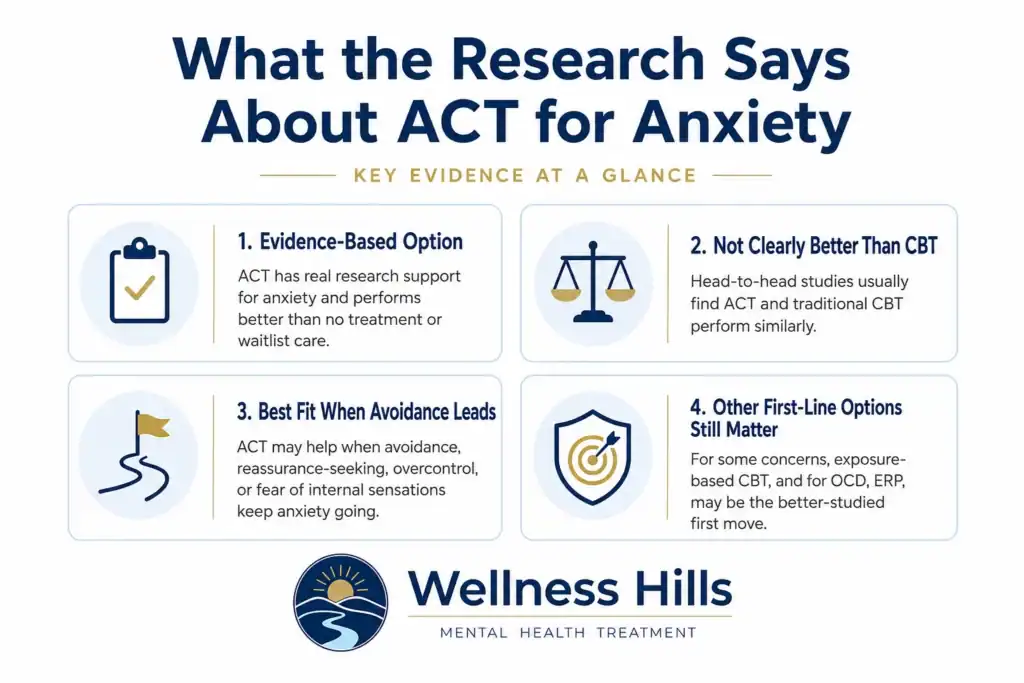
ACT has a real evidence base for anxiety, though it is worth being precise about what that evidence does and does not show. Across controlled trials, ACT generally outperforms no treatment, waitlist, and treatment as usual, and a 2020 umbrella review by Gloster and colleagues found it effective across a range of conditions, including anxiety. The Society of Clinical Psychology lists modest research support for ACT in mixed anxiety.
What the evidence does not show is that ACT is clearly better than traditional CBT for anxiety. In head-to-head comparisons, the two tend to perform similarly, which is why clinicians usually treat ACT as one well-supported option rather than a replacement for first-line care.
ACT often fits best when avoidance, reassurance-seeking, overcontrol, or fear of internal sensations are keeping anxiety going, or when standard thought-challenging has only gone so far. For some presentations, exposure-based CBT, or in the case of OCD, ERP, remains the better-studied first move.
Why Fighting Anxiety Usually Makes It Louder
When anxiety spikes, trying to make it stop is the natural response. You leave the situation, avoid it next time, check and recheck, cancel the plan, search your symptoms online, ask for reassurance, or over-prepare so nothing goes wrong. Relief comes fast, which is exactly the problem. Each time escape works, the brain learns that the trigger was dangerous and that avoidance kept you safe, so the pull to avoid grows stronger.
In ACT, this whole pattern of trying to suppress, escape, or control uncomfortable inner experience has a name: experiential avoidance. It is the common thread ACT works to loosen, because the effort to not feel anxious is often what keeps anxiety in charge.
This plays out in ordinary ways. Someone stops driving after a panic attack on the highway. Social anxiety becomes rehearsing a short conversation for hours. Health anxiety becomes another round of reassurance-seeking. Perfectionism stalls a task indefinitely, and over-planning tries to remove all uncertainty.
None of this means you are weak; it means a fast-learning brain is doing its job a little too well. The cost is that life slowly narrows. ACT targets that narrowing, not only the intensity of the feeling, which is why its central move is acceptance rather than the surrender it can sound like.
Four Things ACT Doesn't Mean
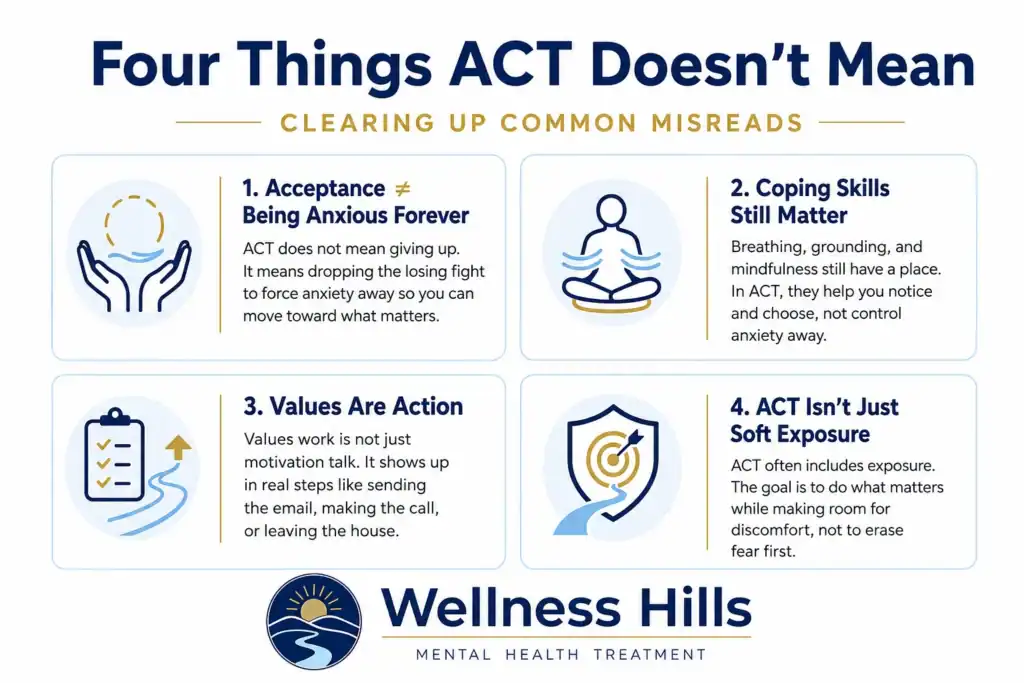
Several predictable objections stop people from giving ACT a fair look. Most of them come from how the words sound rather than how the approach works, so they are worth clearing up directly.
Does Acceptance Mean I’ll Be Anxious Forever?
This is the misread that matters most. In ACT, acceptance does not mean approving of anxiety or giving up on getting better, and it is not a prediction that the feeling is permanent. It means dropping the exhausting, losing struggle to force the feeling away, so your energy can go toward the life you actually want. Anxiety often eases once you stop fighting it, but that easing is a byproduct, not the goal.
Does ACT Mean Giving Up My Coping Skills?
Not quite. Grounding, breathing, and mindfulness still have a place in ACT. The shift is in how you use them. They become ways to notice what is happening and choose your next move, rather than tools to force yourself to calm down. Used to control anxiety, the same skills can quietly turn into one more form of avoidance.
Is Values Work Just Motivation Talk?
Values are not a pep talk. In ACT, they only count when they show up as something observable: sending the email, attending the appointment, leaving the house, making the call you have been putting off. The point is not to feel inspired; it is to take a small, concrete step in a direction that matters, even while anxiety is present.
Is ACT Just a Softer Version of Exposure?
ACT is not the gentle alternative to facing fears. It often includes exposure, approaching the situations and sensations you have been avoiding, guided by what matters to you. The difference is the aim. The goal is to do what you value while making room for discomfort, not to make the fear vanish first.
ACT Interventions for Anxiety: The Six Core Skills
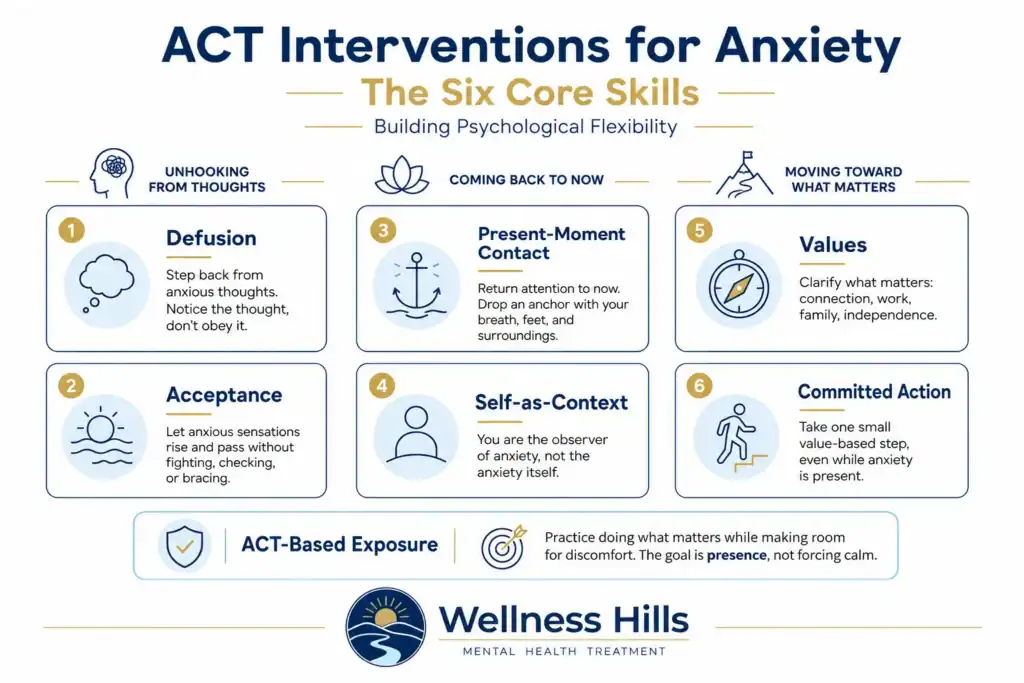
The aim that ties these skills together is psychological flexibility. The Association for Contextual Behavioral Science describes increasing psychological flexibility through these processes as the central goal of ACT. ACT works through six related skills, usually grouped into three moves: unhooking from anxious thoughts, returning to the present, and acting on what matters.
Defusion and Acceptance: Unhooking From Anxious Thoughts
Cognitive defusion means stepping back from a thought so you see it as a thought, not a fact. Instead of “I’m going to panic,” you might note, “I’m having the thought that I’ll panic,” or name it as the familiar “panic story.”
Acceptance and willingness are the partner skills: allowing a wave of anxious sensation to rise and pass without fleeing, checking, or bracing against it. ACT calls this flipping off the struggle switch. You are not inviting the feeling; you are stopping the fight with it.
Present-Moment Contact and Self-as-Context: Coming Back to Now
Present-moment contact means bringing attention back to what is actually happening now, rather than to predicted catastrophes, which helps steady the mind when sensations spike. A common version is to drop an anchor: notice your feet on the floor and your breathing, then widen your attention to the room around you.
Self-as-context is the recognition that you are the one noticing the anxiety, not the anxiety itself. The anxious story is something you are observing, and an observer is bigger than any single thought or sensation passing through.
Values and Committed Action: Moving Toward What Matters
Values are the directions you want your life to take: connection, work you care about, being present with family. Clarifying them, sometimes called values clarification, shows exactly what anxiety has been pulling you away from. Committed action turns that into behavior: one small, value-based step taken while anxiety is still present, such as accepting the invitation or starting a task before feeling ready.
ACT-Based Exposure
In ACT, exposure does not mean white-knuckling fear until it disappears. It means practicing presence in the midst of discomfort while doing something that matters to you, so the approach is tied to values rather than to forcing calm.
For someone who stopped driving after a panic attack, that might mean driving a planned route while allowing the sensations to be present, because regaining independence matters more than staying comfortable. When symptoms are intense or complex, this is done with a clinician rather than alone.
What to Expect in ACT Therapy
ACT is shaped around the person rather than running to a fixed schedule, so the order and pace vary. Still, some things tend to come early, and others later.
Early on, much of the work is mapping rather than changing. A clinician usually helps you see the situations you have been avoiding, the moves you make to feel safer (checking, canceling, reassurance-seeking, over-preparing), and what those moves have been costing you. Alongside that, you begin clarifying values, naming the directions you actually want your life to take, so later steps have something to aim at.
From there, the work becomes more active. You practice defusion and willingness with anxious thoughts and sensations as they show up, and you start taking small, value-based steps while anxiety is still present rather than waiting for it to quiet first. When approaching avoided situations is part of the plan, that exposure is tied to what matters to you, and when symptoms are intense, it is done with a clinician rather than alone.
Later, the focus often shifts toward consistency and durability: keeping routines, handling setbacks without abandoning the approach, and noticing when a different or additional kind of care is needed. None of this runs on a set timeline. Some people move quickly, others gradually, and the pieces often arrive out of order.
Which Anxiety Patterns ACT May Fit
Anxiety is not one thing, and ACT fits some patterns more cleanly than others. The table below is a general guide to where ACT skills may help and what else is often needed. It is not a diagnosis.
| Anxiety Pattern | What ACT May Target | What Else May Be Needed |
|---|---|---|
| Generalized worry | Unhooking from “what if” thoughts; acting despite uncertainty | CBT tools; assessment if functioning is impaired |
| Panic | Making room for body sensations without escape behaviors | Interoceptive exposure; medical rule-out when appropriate |
| Social anxiety | Moving toward connection while carrying self-critical thoughts differently | Social exposure, behavioral experiments |
| Phobias | Approaching avoided situations in values-based steps | Graded exposure |
| OCD-style patterns | Defusion and willingness may help | ERP-focused, OCD-specialized care is often central |
| Trauma-related anxiety | Making room for avoided reminders after stabilization; values-based re-engagement | Trauma-focused care such as CPT, prolonged exposure, EMDR, or trauma-focused CBT may be needed; stabilization and safety come first when symptoms are acute |
One reason a guide like this cannot replace assessment is that the same symptom can come from very different patterns. Avoidance, for example, can stem from generalized worry, a specific phobia, or OCD, and the right starting point differs in each case.
That is also why OCD-style patterns sit a little apart here: they are related to anxiety but distinct, and they are usually best served by ERP-focused, OCD-specialized care, which the International OCD Foundation describes in detail. A clinician can tell which pattern is driving things and where ACT fits.
Is ACT a Good Fit for Your Anxiety?
ACT and CBT are close relatives, not rivals. Traditional CBT often works by examining a thought directly, assessing its accuracy and usefulness, and adjusting it. ACT therapy for anxiety usually asks a different question.
Can this thought be present while you do what matters to you, without having to fix or win the argument with it first? The two questions can work together, noticing a thought clearly and then acting with it present, which is one reason clinicians often combine the two.
A quick way to see the difference is to look at the question each therapy starts from.
| Dimension | Traditional CBT | ACT |
|---|---|---|
| Starting question | Is this thought accurate and useful, and can it be adjusted? | Can this thought be present while you do what matters, without winning the argument with it first? |
| Main target | The content of anxious thoughts and the behaviors that follow | Your relationship to anxious thoughts, plus value-based action taken alongside them |
| Often, a good first move when | You want structured tools to test and reframe specific worries | Thought-challenging has helped only so far, or anxiety is tied to broader life direction |
| How exposure is used | Graded exposure to disconfirm feared predictions | Values-linked exposure to build willingness while doing what matters |
| Evidence standing | Most extensively researched; named a first-line psychotherapy for most anxiety disorders in major clinical guidelines | Well-supported; broadly comparable, not clearly superior |
Whether it is the right primary approach for you is something a clinician can help you sort out.
ACT often appeals to people who have done thought-challenging work and found it only goes so far, or who would rather build a fuller life than wait for anxiety to quiet first. Whether it is the right primary approach for you is a question for an evaluation, not a quiz. ACT is also not always the right first move on its own.
When anxiety is driven by severe OCD rituals, acute trauma symptoms, active safety concerns, mania, psychosis, or substance use instability, those situations call for a clinical assessment first, and severe OCD in particular is usually addressed with ERP-focused care rather than ACT alone.
A professional, not a self-assessment, sorts out which applies to you. If your anxiety feels unmanageable or if you are having thoughts of harming yourself, reach out to a professional or the 988 Suicide & Crisis Lifeline.
How Clinicians Decide Whether ACT Is the Right Starting Point
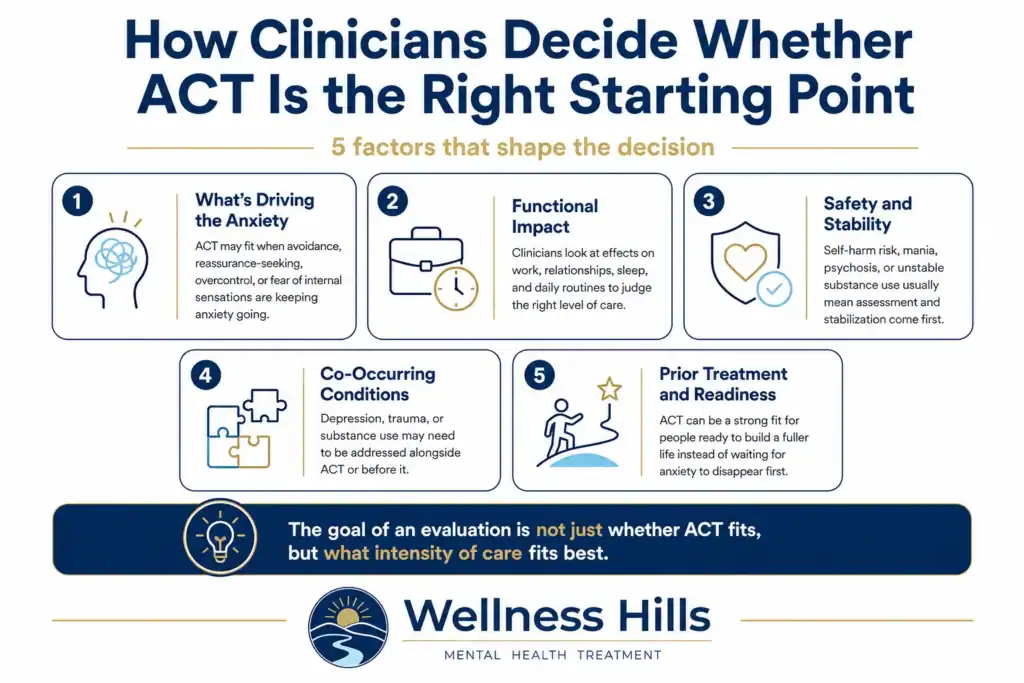
Whether ACT is the right first move, and at what level of care, is a clinical judgment rather than a yes-or-no answer. At Wellness Hills, a few factors tend to drive that decision.
The first is what is keeping the anxiety going. ACT tends to fit well when avoidance, reassurance-seeking, overcontrol, or fear of internal sensations are central, and less well as a standalone when rituals, acute trauma symptoms, or a specific phobia point toward a more targeted protocol such as ERP or trauma-focused care.
The second is functional impact. A clinician looks at how anxiety affects work, relationships, sleep, and daily routines. Someone who is anxious but still functioning has different needs than someone whose avoidance has narrowed major parts of life, and that difference often shapes the level of care.
The third is safety and stability. Active thoughts of self-harm, mania, psychosis, or unstable substance use change the immediate next step; those situations call for assessment and stabilization before ACT becomes the focus.
The fourth is co-occurring conditions. Depression, trauma, or substance use frequently travel with anxiety, and whether they are addressed first, alongside, or after ACT depends on which is driving the impairment.
The fifth is prior treatment. People who would rather build a fuller life than wait for anxiety to settle are often good candidates for an ACT-forward approach.
This is usually sorted out in an evaluation rather than a self-quiz. The output is not only whether ACT fits, but at what intensity, and whether medication evaluation or care for a co-occurring condition should run alongside it.
Questions to Ask a Therapist Before Starting ACT
If you are considering ACT, a short conversation up front can tell you whether a therapist’s approach fits your situation. A few questions worth asking:
- Do you use exposure when avoidance is part of the anxiety pattern, and how do you approach it?
- How do you track progress besides whether symptoms feel lower?
- What would make you recommend ERP, trauma-focused care, a medication evaluation, or a higher level of care such as IOP or PHP instead of or alongside ACT?
- What kind of between-session practice should I expect?
What Progress Tends to Look Like
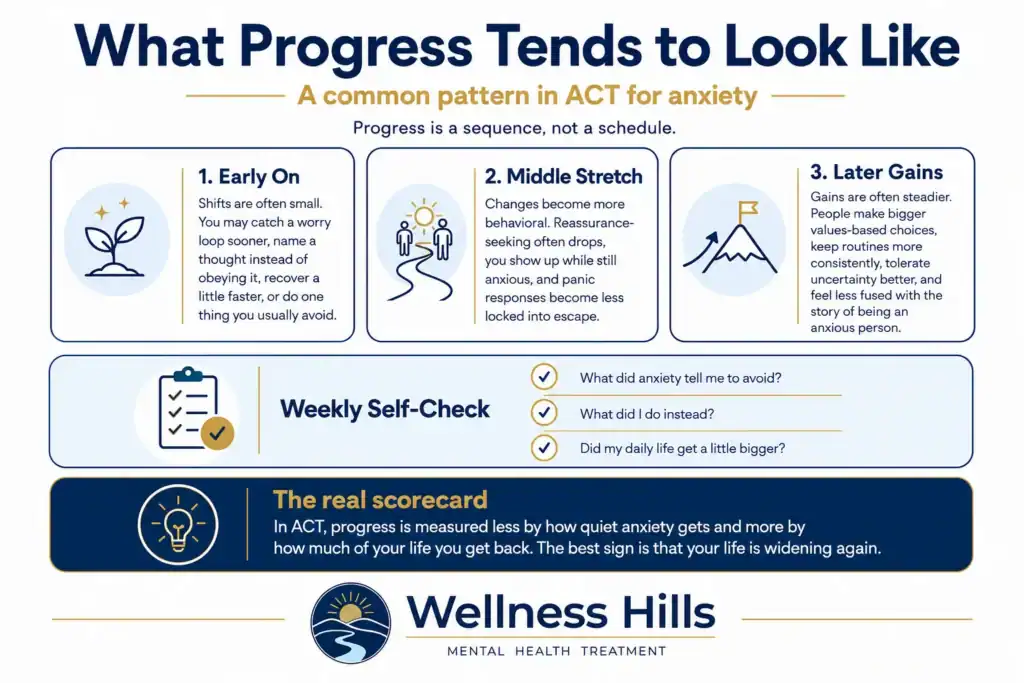
People often want to know what to expect. Here is a common pattern. It is a rough sequence, not a schedule, and it looks different for everyone. Some people move through them quickly; others, more gradually; and the pieces often arrive out of order.
Early on, the shifts tend to be small and easy to miss. You may catch a worry loop sooner, name a thought instead of automatically obeying it, recover a little faster after a spike, or complete one thing you would normally have avoided.
In the middle stretch, the changes often get more behavioral. Reassurance-seeking tends to drop; you become more willing to show up while still anxious, and your responses to panic grow more flexible rather than locked into escape. For someone with social anxiety, that might mean going to the gathering and staying, even with the self-critical commentary still running.
Later, the gains tend to be larger and steadier. People often make bigger values-based decisions, keep routines more consistently, tolerate uncertainty better, and feel less fused with the story “I am an anxious person.”
A simple weekly self-check can track the progress that matters:
- What did anxiety tell me to avoid this week?
- What did I do instead?
- Did my daily life get a little bigger?
That last question is the point. In ACT, progress is measured less by how quiet your anxiety becomes and more by how much of your life you get back, the conversations, plans, and responsibilities that it had been shrinking. Symptom intensity may ease too, and often does, but it is not the main scorecard. The better measure is whether your life is widening again.
How ACT Skills Can Fit Within Structured Anxiety Treatment
ACT is one approach used within structured anxiety treatment programs, not a program of its own. For many people, weekly outpatient therapy is the entry point, but some need more than one session a week to gain traction.
When anxiety significantly impairs daily functioning, a higher level of care, such as an IOP for anxiety or a PHP program, can offer more repetition and clinical feedback, along with room to stabilize and to address co-occurring depression or trauma, and to involve psychiatry when appropriate.
Frequently Asked Questions
If you are still weighing ACT, these are the questions that tend to come up next.
Is ACT good for anxiety?
It can be. ACT therapy for anxiety has modest research support and helps many people relate to anxiety differently, though it is one option among several, not a guaranteed fix.
What is an example of ACT for anxiety?
Imagine social anxiety before an event. You might notice the thought “I’ll embarrass myself,” label it as a thought, reconnect with how much connection matters, and attend to the small plan anyway.
Is ACT better than CBT for anxiety?
Not necessarily. Both can help with anxiety; the evidence does not crown a clear winner, and they often combine; the fit section above covers how to choose.
Does ACT include exposure?
It can. ACT often uses values-linked exposure, approaching what you have avoided in the service of what matters, and it is clinician-guided when symptoms are intense.
How long does ACT take to help anxiety?
There is no fixed timeline; it varies from person to person. Many people notice shifts in how they respond before symptoms consistently feel lower, but the timing varies.
Ready to Find Out What Fits?
If anxiety has started to influence where you go, what you avoid, how often you seek reassurance, or whether you can keep up with daily life, an assessment can clarify which level of support is appropriate. Wellness Hills works with adults in New Jersey to sort out whether weekly outpatient therapy, IOP, PHP, medication evaluation, or another pathway makes sense.
You do not have to decide whether ACT is the right therapy before reaching out. If you want a low-commitment first step, the GAD-7 self-check is a place to start.
Sources:
Gloster, Walder, Levin, Twohig, & Karekla | The Empirical Status of Acceptance and Commitment Therapy: A Review of Meta-Analyses – Peer-reviewed review of meta-analyses examining the evidence base for Acceptance and Commitment Therapy across mental health conditions, including anxiety.
Society of Clinical Psychology, APA Division 12 | Acceptance and Commitment Therapy for Mixed Anxiety Disorders – Clinical treatment summary describing the research support for ACT in mixed anxiety disorders and how ACT is classified within evidence-based psychological treatments.
International OCD Foundation | Exposure and Response Prevention (ERP) – Overview of ERP as a specialized treatment approach for OCD, including why exposure and response prevention is often central when compulsions or OCD-style patterns are present.
988 Suicide & Crisis Lifeline | 988 Lifeline – National crisis resource for people experiencing suicidal thoughts, emotional distress, or immediate mental health safety concerns.
Editorial Standards
Our Editorial Policy
Our editorial standards keep our mental health content accurate, compassionate, and evidence-informed. Articles are developed using credible sources, reviewed for medical accuracy when needed, and regularly updated.