



For many people, anxiety is more than too many thoughts; it can surface as emotional overwhelm, avoidance, reassurance-seeking loops, panic-like body alarm, or tension that spills into relationships. DBT for anxiety is one approach often raised when those patterns take hold.
Dialectical behavior therapy (DBT) teaches concrete skills across four areas: distress tolerance, emotion regulation, mindfulness, and interpersonal effectiveness. DBT for anxiety can help when symptoms are closely tied to emotional intensity, panic, avoidance, or relationship reactivity.
It is not a cure, and it is not the right starting point for everyone. A clinical assessment determines whether DBT, cognitive behavioral therapy (CBT), exposure therapy, a medication evaluation, or a structured program is the better fit.
What DBT Is
Dialectical behavior therapy (DBT) is a structured, skills-based therapy in the cognitive behavioral family that balances acceptance and change; dialectical means holding two opposing truths at once: accepting where you are while working to change it.
Psychologist Marsha Linehan developed DBT to treat chronic suicidality and borderline personality disorder before its use broadened, part of why DBT’s anxiety-specific evidence base is less established than for CBT and exposure-based approaches.
DBT therapy for anxiety draws on four skill modules: mindfulness (noticing the present without judgment), distress tolerance (riding out crises without making them worse), emotion regulation (managing intense emotions), and interpersonal effectiveness (communicating needs and handling conflict).
One distinction matters when you compare programs: learning DBT-informed skills in individual therapy or a group is not the same as full-model DBT, which combines individual therapy, a skills group, and between-session phone coaching.
Does DBT Actually Work for Anxiety?
For most anxiety disorders, the best-studied first-line treatments are cognitive behavioral therapy and exposure-based approaches, including exposure and response prevention (ERP) for OCD. That framing is reflected by the Anxiety and Depression Association of America, and corroborated abroad: NICE guideline CG113 recommends CBT or applied relaxation for generalized anxiety disorder, and CBT or medication for panic disorder.
A 2017 CADTH review concluded that DBT’s strongest evidence sits in borderline personality disorder and chronic suicidal behavior, with thinner support across broader adult conditions, including anxiety.
That does not make DBT therapy for anxiety a leftover option. When anxiety is closely tied to intense emotional reactivity, self-harm urges, impulsive coping, or relationship reactivity, DBT is often an appropriate primary choice rather than a fallback, though whether it is the right starting point is a question for a clinical evaluation, not an article. It also layers on top of other care rather than replacing it.
There is an honest mechanism overlap, too. One core DBT skill, opposite action (acting against an anxious urge instead of obeying it), works through much the same doorway as exposure: approaching what anxiety tells you to avoid so that the fear can ease over time.
DBT Skills for Anxiety, by Symptom Pattern
Skills land differently depending on how anxiety shows up. The DBT techniques for anxiety below are grouped by pattern; a therapist tailors which fit you, so this is a map, not a self-guided protocol.
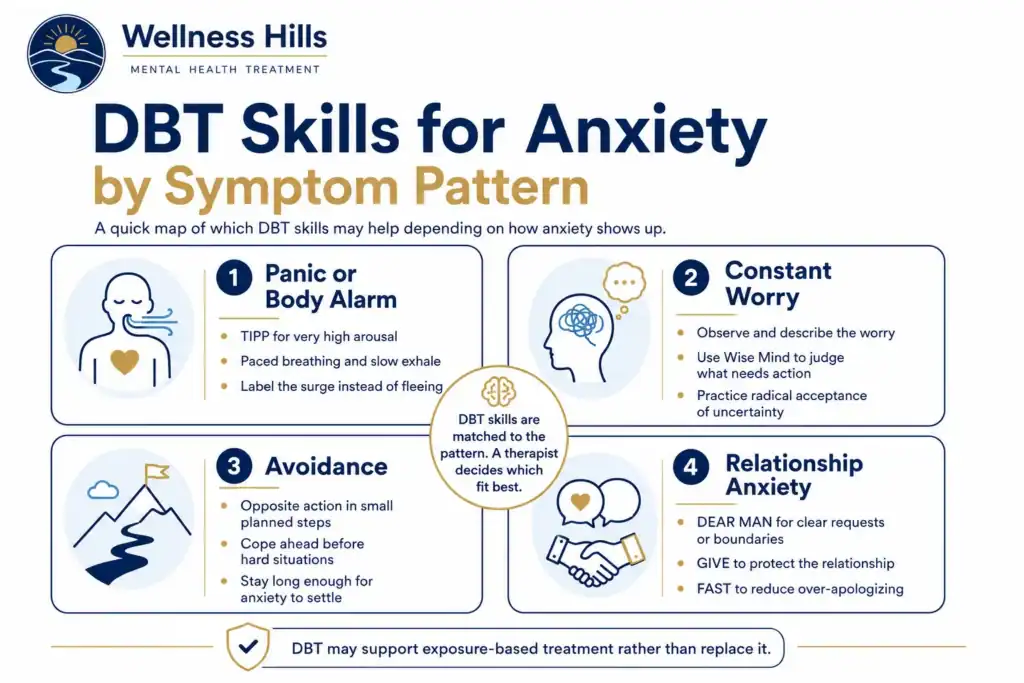
When Anxiety Feels Like Panic or Body Alarm
Panic floods the body: racing heart, tight chest, a surge to flee or check. Distress-tolerance skills aim to bring that arousal down without making it worse. TIPP is a clinician-taught set of fast-acting skills that use the body to lower very high arousal; it’s learned and practiced with a therapist, not improvised.
Paced breathing, slowing the exhale, and mindful labeling (“this is a panic surge, not danger”) help you ride the wave rather than flee or check. New, severe, or unusual physical symptoms deserve a medical evaluation first; not every body alarm is anxiety.
When Anxiety is Constant Worry
Chronic worry tends to run all day. Mindfulness skills like observe and describe create a small gap: you notice a worry as a mental event rather than a fact. Wise Mind, the balance between emotion and reason, helps you judge whether a worry needs action now or none at all.
Radical acceptance applies to the uncertainty that worry hates: accepting that some outcomes can’t be known, rather than trying to solve them in a loop. Many clinicians pair this with scheduled problem-solving, a set time for real problems, so worry stops taking the whole day.
When Anxiety Drives Avoidance
Avoidance quietly shrinks life, showing up as declined invitations, postponed calls, and sidestepped topics. Opposite action means doing the thing anxiety says to skip, in a planned, manageable step. Coping ahead means rehearsing a hard situation in advance, which lowers the odds of bailing in the moment.
Distress-tolerance skills help you stay in a situation long enough for anxiety to settle rather than escape it. Here especially, DBT often supports exposure-based work rather than replacing it; a clinician decides how the two fit together.
When Anxiety Shows Up in Relationships
Anxiety often hides inside relationships. It can look like constant reassurance-seeking, over-apologizing, avoiding any conflict, or reading a flat text or clipped tone as proof that something’s wrong.
These patterns lower anxiety for a moment but tend to feed it, and they wear on the people around you. When the fear centers on being judged, embarrassed, or scrutinized across situations, a clinician may screen for social anxiety disorder.
For social anxiety, CBT with exposure is often the better-studied starting point, while DBT’s interpersonal skills may support that work rather than replace it.
DBT’s interpersonal effectiveness skills target this directly. DEAR MAN is a script for asking for something or saying no clearly, without escalating or caving. GIVE focuses on maintaining the relationship during a difficult conversation by staying gentle, interested, and validating.
FAST protects your self-respect, including not over-apologizing or abandoning your position to defuse tension. Used together, these techniques replace anxious reflexes (the apology you didn’t owe, the text you re-read ten times) with responses you choose. Because these skills work directly on the requests, boundaries, and conflict that relationship anxiety runs on, clinicians often weigh DBT when anxiety shows up mainly through relationship reactivity.
Is DBT for Anxiety the Right Fit for You?
By this point, the more useful question isn’t whether DBT works, but whether it’s the right starting point for your specific anxiety. The table below pairs common anxiety patterns with the better-studied option to raise in an evaluation. It isn’t a diagnosis or a recommendation, only a starting point for a conversation with a clinician.
| Anxiety Pattern | A Better-Studied Starting Point to Ask About |
|---|---|
| Mainly panic, phobias, or OCD-style rituals. | CBT, exposure-based CBT, or ERP, depending on diagnosis. |
| Anxiety plus emotional blowups, shutdown, impulsive coping, or self-harm urges. | DBT-informed care may be worth assessing. |
| Anxiety with severe impact on daily functioning. | A higher level of structure, such as IOP or PHP, may fit. |
| Anxiety plus trauma, depression, substance use, or mood instability. | Full clinical assessment before choosing a therapy. |
In practice, it’s rarely either/or. DBT skills often layer onto first-line treatments rather than competing with them, and many people use more than one approach over time. One distinction matters: OCD is related to but clinically distinct from the anxiety disorders, and its specifically indicated treatment is exposure and response prevention (ERP), not DBT.
Wherever you land in the table, the next right step is a professional evaluation rather than self-diagnosis. A clinician weighs your history, symptoms, and goals before matching you to a therapy.
What a Clinician Weighs Before Recommending DBT for Anxiety
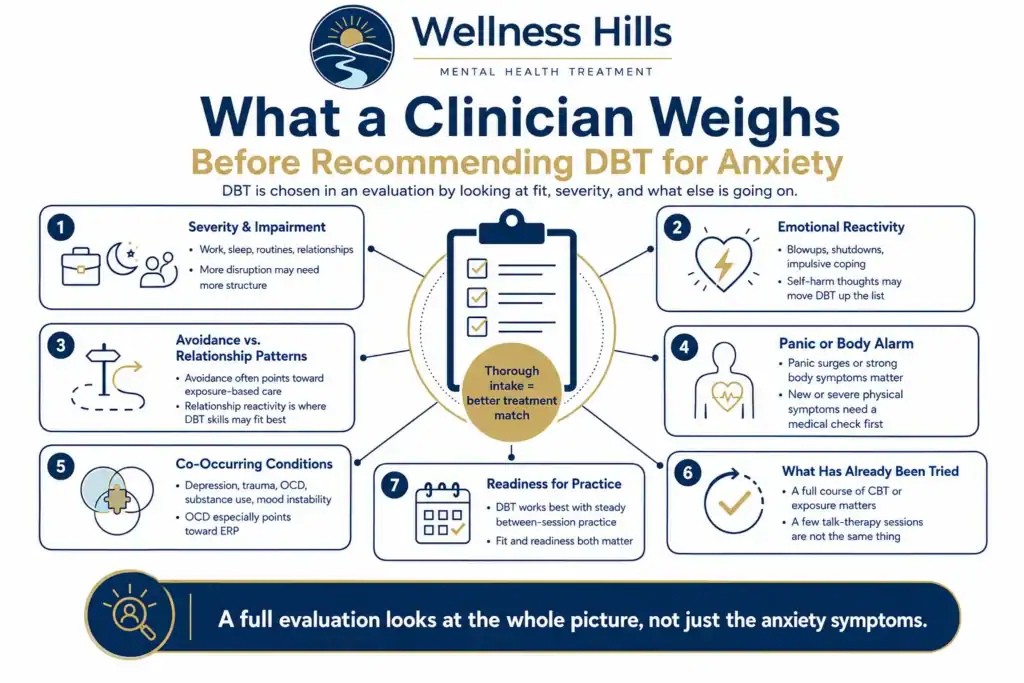
An evaluation is where this gets decided. A clinician is not tallying symptoms; they are looking at how anxiety is affecting you and what else is in the picture. The questions below are the ones that move DBT up or down the list.
- How much is anxiety disrupting work, sleep, relationships, and daily routines? Severity and impairment shape whether weekly therapy is enough or whether more structure fits.
- Does it come with emotional blowups, shutdowns, impulsive coping, or thoughts of self-harm? These are closer to the patterns DBT was originally built to address, and they may move it up the list.
- Is it driven by avoidance, reassurance-seeking, or relationship reactivity? Avoidance points toward exposure-based work; relationship reactivity is where DBT’s interpersonal skills fit best.
- Are panic surges or strong body-alarm symptoms part of the picture? Distress-tolerance skills target these, though new or severe physical symptoms deserve a medical check first.
- What else is present: depression, trauma, OCD, substance use, or mood instability? Co-occurring conditions change which therapy comes first and in what order, and OCD specifically points to ERP.
- Has a full course of CBT or exposure therapy already been tried? A few general talk-therapy sessions are not the same as a complete first-line course, and that changes what to try next.
- Is there room for the steady between-session practice a model like DBT asks for? DBT is practice-heavy, so readiness matters as much as fit.
Most of this surfaces during a thorough intake, which is what an evaluation is for.
What Improves First and What Changes Last
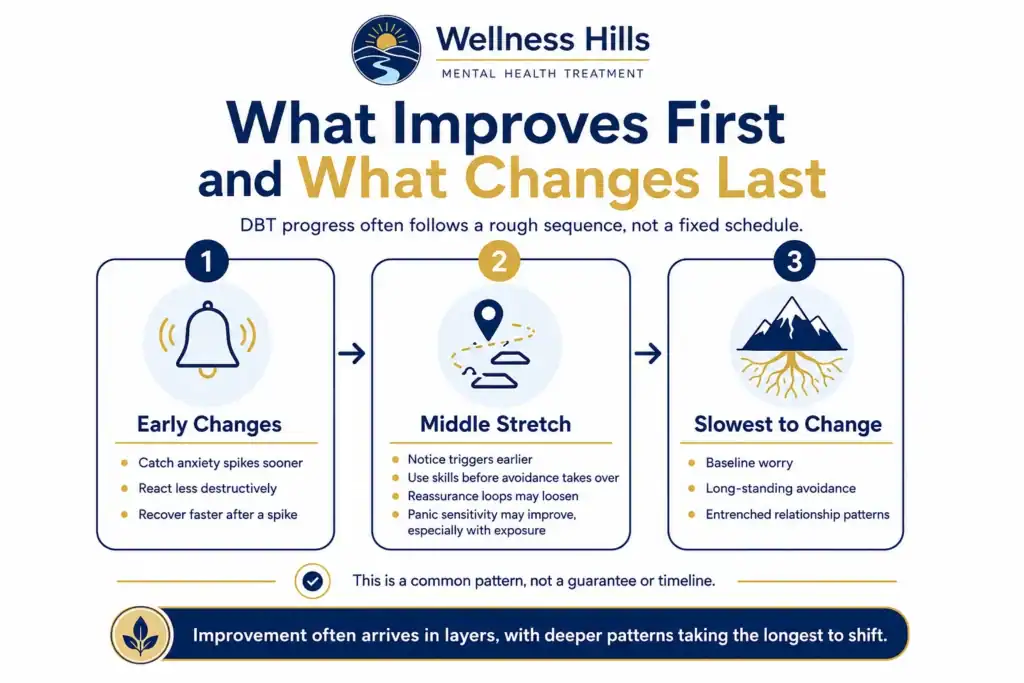
Change in DBT tends to follow a rough sequence rather than a fixed schedule, and it varies from person to person.
Earlier on, many people notice they catch an anxiety spike sooner and react to it less destructively, with fewer impulsive, make-it-worse responses. Many people report a shorter recovery time after a spike before they notice any change in baseline worry.
In the middle stretch, triggers tend to become recognizable earlier, skills get used before avoidance takes over, and reassurance-seeking loops may loosen. Panic and body-alarm sensitivity can also shift here, especially when exposure work is part of the plan; it isn’t necessarily the slowest thing to move.
The slowest to change is usually the deepest material: baseline worry, long-standing avoidance, and entrenched relationship patterns, which often take months of steady practice. None of this is a guarantee or a timeline, just the order in which improvement tends to arrive.
How DBT Fits Into Levels of Care
For many people, DBT skills are introduced in outpatient therapy, a skills group, or individual therapy. When anxiety significantly impairs daily functioning, a higher level of care can deliver those skills more intensively: an IOP or PHP raises contact hours. It adds group skills practice and clinical monitoring, which can stabilize symptoms that weekly therapy is not containing. Whether that step makes sense is a function of impact, decided in an evaluation.
For individuals in New Jersey, Wellness Hills may include DBT-informed skills as part of a broader anxiety treatment plan, with fit determined by assessment. Program options include IOP for anxiety, offered in daytime and evening tracks, and a partial hospitalization program (PHP) for those who need more structure.
Frequently Asked Questions
Quick answers to common questions. None of this replaces the clinical evaluation, during which the right plan is decided.
Is DBT good for anxiety?
It can be, especially when anxiety is tied to intense emotions, panic, avoidance, or relationship reactivity. For most anxiety disorders, though, CBT and exposure-based therapy stay first-line.
What are the best DBT skills for anxiety?
Commonly used ones include mindfulness, TIPP, Wise Mind, opposite action, radical acceptance, DEAR MAN, and cope ahead. Which help most depends on your symptom pattern, so a therapist tailors the set.
Is DBT better than CBT for anxiety?
Not as a rule. CBT and exposure-based therapy are better-studied first-line for most anxiety; DBT fits better when strong emotional reactivity or self-harm urges are involved. See the table above.
How long does DBT take to help anxiety?
It varies. Some people pick up usable skills within a few weeks, while a fuller course often runs several months, depending on your goals, symptoms, and practice.
Can DBT replace exposure therapy for anxiety?
Usually not. For panic, phobias, and OCD, exposure-based therapy (and ERP specifically for OCD) is the better-studied and more directly indicated treatment. DBT’s opposite action overlaps with exposure in practice and often supports exposure work, but it does not replace a structured exposure course.
Can I use DBT techniques for anxiety on my own?
Some, like paced breathing or mindful labeling, can help on their own. But when anxiety is severe, impairing, or tied to thoughts of self-harm, that’s a sign to seek professional support, and self-harm thoughts warrant prompt help, including the 988 Suicide & Crisis Lifeline (call or text 988).
Finding the Right Starting Point
If anxiety is shrinking your routine, straining your relationships, or weekly therapy isn’t feeling like enough, an assessment can help clarify the next step. Wellness Hills works with adults in New Jersey to determine whether outpatient therapy, an IOP, a PHP, a medication evaluation, or another pathway is a good fit. If you’d like a low-commitment place to start, the GAD-7 self-check can give you a sense of where things stand.
Sources:
Anxiety and Depression Association of America (ADAA) | Types of Mental Health Therapy – Overview of therapy options used for anxiety, depression, and related conditions, including cognitive behavioral therapy and other evidence-based approaches.
National Institute for Health and Care Excellence (NICE) | Generalized Anxiety Disorder and Panic Disorder in Adults: Management, CG113 – Clinical guideline recommendations for generalized anxiety disorder and panic disorder, including CBT, applied relaxation, and medication considerations.
Canadian Agency for Drugs and Technologies in Health (CADTH), via NCBI Bookshelf | Dialectical Behavioral Therapy for Adults with Mental Illness: A Review of Clinical Effectiveness and Guidelines – Evidence review examining DBT for adults with mental illness, including where the evidence is stronger and where it is more limited across adult conditions.
Editorial Standards
Our Editorial Policy
Our editorial standards keep our mental health content accurate, compassionate, and evidence-informed. Articles are developed using credible sources, reviewed for medical accuracy when needed, and regularly updated.