

If you’re trying to figure out how to help a partner with anxiety, you’ve probably noticed that the usual playbook stops working. Reassurance calms them for an hour, then they need it again. Plans get canceled. You start walking on eggshells, then push too hard, then back off and feel guilty either way.
Anxiety disorders respond to evidence-based treatments, primarily cognitive behavioral therapy and exposure therapy, for the majority of patients who complete a full course of care. But the right kind of support depends on how much anxiety is affecting daily life, and on whether the instincts you’re falling back on are quietly making things worse.
Whether you’re trying to support a husband, wife, boyfriend, girlfriend, or long-term partner, the dynamics covered here apply across relationship types. This guide isn’t about turning you into your partner’s therapist. It’s about supporting them without letting anxiety run both of your lives.
Quick Answer: How to Help a Partner with Anxiety
- Validate the feeling; don’t argue with the worry. “This sounds really scary” lands better than “but that won’t happen.”
- Ask what kind of support they want: listening, grounding, problem-solving, or space. Guessing usually misses.
- Don’t answer the same anxious question for the tenth time. Repeated reassurance tightens the loop rather than loosening it.
- Set kind, clear limits on what you can sustain. Boundaries protect the relationship; they aren’t punishment.
- A professional evaluation may help if anxiety has been interfering with sleep, work, parenting, or daily function for more than a few weeks.
If your partner mentions suicide, self-harm, or not being able to stay safe, contact 988 (Suicide and Crisis Lifeline), call 911, or go to the nearest emergency department.
Start With What Your Partner Actually Needs From You
Most partners default to fixing, making the worry smaller, the day easier, the situation safer. That instinct comes from love, but it usually misses what’s actually wanted. The first job isn’t solving. It’s asking.
Ask Before You Act
Anxious people need different things at different times: listening, grounding, problem-solving, presence, or space. Treating these as interchangeable is the entry-level mistake. The simplest fix is to ask:
“Do you want me to listen, help you ground, or help you think through the next step?”
Awkward the first time. The most efficient thing you’ll say all week.
Validation Is Not Agreement
Validation is acknowledging the emotional experience. It isn’t agreeing that the feared outcome will happen. “I can see this feels really scary” is different from “Yes, you’re right, something terrible will happen.” The first steadies your partner.
The second feeds the loop. Partners who blur this line swing between dismissive (“it’s not a big deal”) and frightened themselves, both of which make anxiety worse. Validation without agreement is the skill effective anxiety treatment builds on.
What to Say and What to Avoid When Anxiety Shows Up
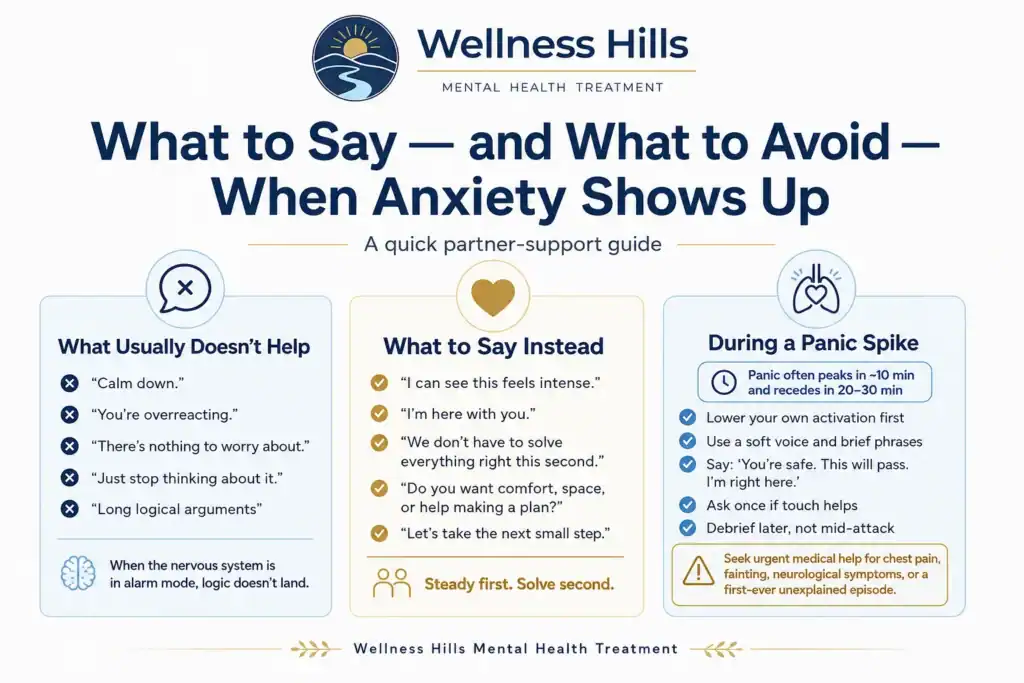
Most partners default to logic when anxiety spikes, explaining why the feared outcome won’t happen, listing reasons to calm down. Logic doesn’t land when the nervous system is in alarm mode. The phrases below, what to skip, what to try instead, and how to navigate a panic attack, work because they steady before they solve.
What Usually Doesn’t Help
When the nervous system is in alarm mode, logic doesn’t land. Steadiness comes first. Avoid:
- “Calm down.”
- “You’re overreacting.”
- “There’s nothing to worry about.”
- “Just stop thinking about it.”
- “You always do this.”
- Long logical arguments while they’re activated.
None of these are cruel; most partners say them because they’re scared too. But they all communicate that your reaction is the problem.
What to Say Instead
These are steady before they solve.
- “I can see this feels intense.”
- “I’m here with you.”
- “We don’t have to solve everything right this second.”
- “Do you want comfort, space, or help making a plan?”
- “I love you. This doesn’t change how I feel about you.”
- “Let’s take the next small step.”
The last one matters more than it looks; anxiety often makes people see only catastrophic or perfect options.
During a Panic Spike
Panic attacks typically peak within about 10 minutes and recede within 20–30 minutes. Your job is to not add to the activation:
- Drop your own activation first, soft voice, slow exhale, low affect.
- Speak briefly. “You’re safe. This will pass. I’m right here.”
- Ask once whether touch helps. Don’t keep asking.
- Don’t argue with the fear or problem-solve mid-attack.
- Wait 20-30 minutes before debriefing.
For someone with a known history of panic, staying present is usually more helpful than calling 911. Call 911 or seek emergency evaluation if any of the following are present:
- A first-ever episode in someone with no prior history of panic.
- Chest pain, arm pain, or irregular heartbeat that doesn’t ease as the episode passes.
- Fainting, loss of consciousness, or near-fainting.
- Symptoms persist well beyond the typical 20–30 minute peak-and-recede window.
- Sudden severe headache, one-sided weakness, or other neurological symptoms.
- Known cardiac history or significant cardiovascular risk factors.
- Any symptom you genuinely believe may be a medical emergency.
When Helping Starts Feeding the Anxiety
Most partners reading this are already doing some of what comes next. There’s a clinical name for the pattern: family accommodation. It describes how a loved one’s behavior gradually organizes around the anxious person’s fear. Most couples don’t catch it until the relationship is already shaped by it.
Giving Reassurance Every Time They Ask
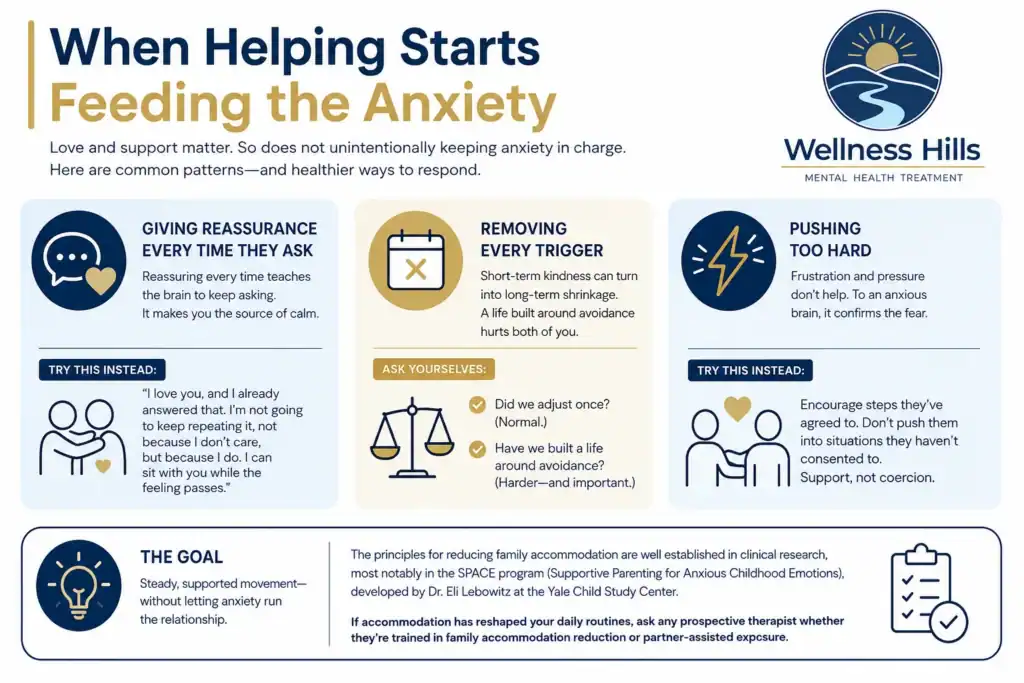
They sound caring: “Are you sure you’re not mad at me?” “Are you sure I’m okay?” “Promise me nothing bad will happen.” Once is loving. By the fifth or tenth time, the brain learns that you are the source of calm and reaches for you again the next time anxiety spikes.
A different response:
“I love you, and I already answered that. I’m not going to keep repeating it, not because I don’t care, but because I do. I can sit with you while the feeling passes.”
Staying available without rehearsing the answer is what makes the script work.
Clinical observation from Wellness Hills: Partners who avoid burnout are often not the ones with the most willpower; they are the ones who stop trying to be the only source of regulation and get their own support early.
Removing Every Trigger
This is where family accommodation shows up most concretely, canceling plans together. Taking over phone calls your partner can’t make. Ordering for them at restaurants and rerouting shared routines around situations they avoid. Each can feel like a kindness.
Duration changes the picture. Carrying more for a hard week is a normal partnership. Carrying it indefinitely while your partner’s world shrinks hurts both people. The easy question is “Did we adjust once?” Every couple does that. The harder one is “Have we built a life around avoidance?”
Pushing Too Hard
The opposite failure mode. Frustration accumulates, plans keep canceling, and at some point, the supportive partner snaps: “Just do it.” “You’re being ridiculous.” “I’m tired of this.” Exhaustion drives most of it. To a nervous system already on alert, though, it comes across as proof that the people closest don’t get it.
Encouraging your partner to take a hard step they have agreed to is a form of support. Pushing them into a situation they haven’t consented to is coercion, even when it’s one they’d benefit from facing.
The goal isn’t to remove every uncomfortable feeling, and it isn’t to throw your partner into situations they’re not ready for. The goal is steady, supported movement without letting anxiety run the relationship.
The principles for reducing family accommodation are well established in clinical research, most notably in the SPACE program (Supportive Parenting for Anxious Childhood Emotions), developed by Dr. Eli Lebowitz at the Yale Child Study Center.
SPACE itself was built for parents of anxious children. Still, the same accommodation-reduction principles inform adult-focused work, including partner-assisted exposure within CBT and ERP treatment, where a clinician coaches the non-anxious partner through helping their loved one face feared situations without taking over.
If accommodation has reshaped your daily routines, ask any prospective therapist whether they’re trained in family accommodation reduction or partner-assisted exposure.
How Support Changes Based on the Anxiety Pattern
Support that works for one anxiety pattern can miss for another.
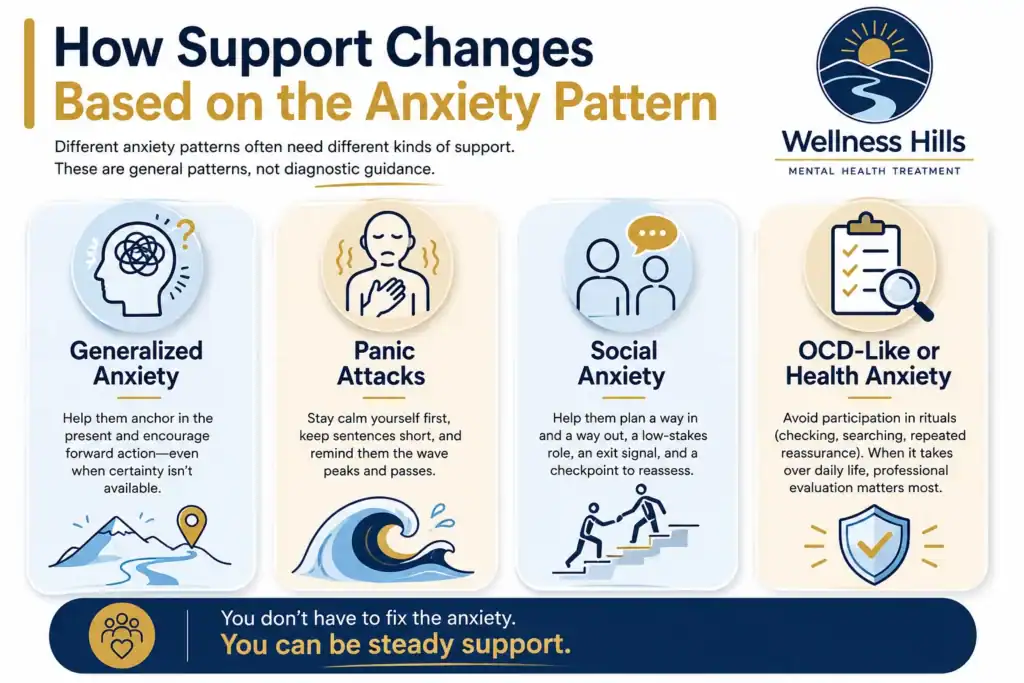
These are general patterns, not diagnostic guidance. Anxiety presentations often overlap, and only a licensed clinician can identify what’s actually going on. The point is that different anxiety patterns often need different kinds of support.
Generalized Anxiety
GAD lives in the what-if. Don’t follow your partner down every spiral; chasing catastrophes with them reinforces them. Help them anchor in the present (this room, this hour, what’s actually happening), and encourage forward action even when certainty isn’t available.
Panic Attacks
Panic is physiological more than cognitive, with a racing heart, shortness of breath, and the conviction that the body is dying. Stay calm yourself first; keep sentences short; remind them the wave peaks and passes.
Social Anxiety
Social anxiety pulls toward accommodation: you cover the conversation, decline invitations, manage every interaction. Resist the autopilot. Help them plan a way in and a way out, a low-stakes role, an exit signal, a checkpoint to reassess.
OCD-Like Anxiety or Health Anxiety
OCD-spectrum and health anxiety thrive on participation. Don’t check the lock together. Don’t Google symptoms. Don’t reassure the freckle isn’t cancer a fourth time. Joining the ritual reinforces it. When checking, searching, or rumination dominates daily life, professional evaluation matters more than another conversation.
How to Set Boundaries Without Sounding Cold
Boundaries are where most partners of someone with anxiety get stuck. Saying no, even kindly, can feel like withholding love at the exact moment your partner needs it most. The frameworks below distinguish boundaries from ultimatums, show what sustainable limits actually sound like, and explain when boundary conflict signals the situation has outgrown home support.
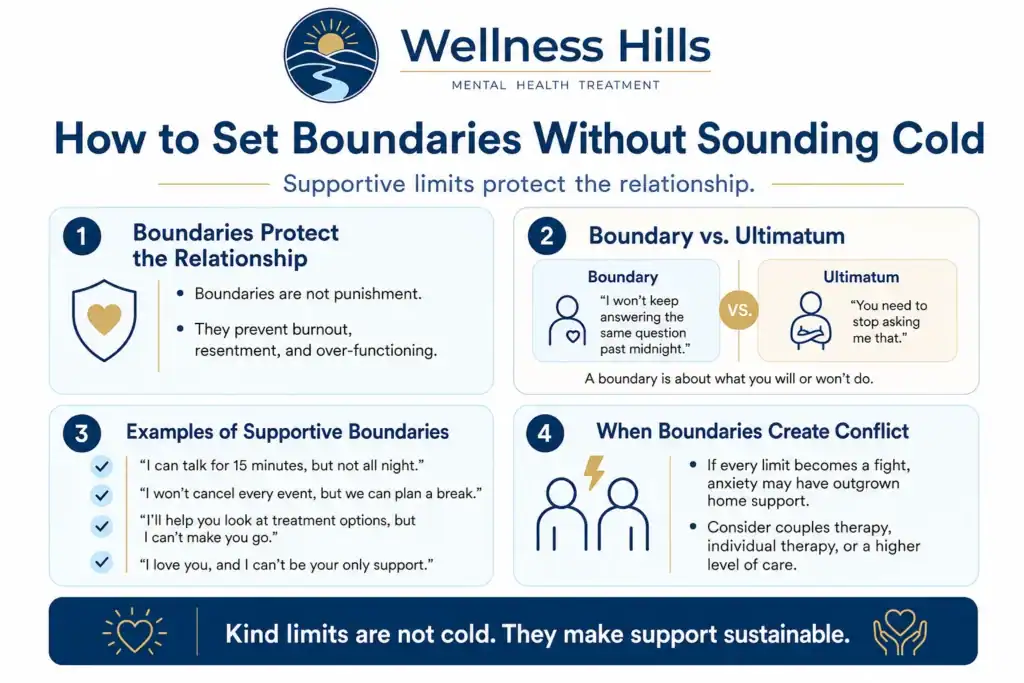
Boundaries Protect the Relationship
Boundaries are not punishment. They’re how the supporting partner avoids becoming the relationship’s full-time emotional regulator, and how resentment doesn’t quietly take over the love underneath.
The distinction that gets blurred most often: a boundary is something you will or won’t do, “I won’t keep answering the same question past midnight.” An ultimatum is a demand on your partner dressed up as a boundary: “You need to stop asking me that.” Same words, very different effect.
Examples of Supportive Boundaries
In practice:
- “I can talk this through for fifteen minutes, but I can’t repeat the same reassurance all night.”
- “I won’t cancel every family event, but we can plan a break if you feel overwhelmed.”
- “I’ll help you look at treatment options, but I can’t make you go.”
- “I love you, and I also need to sleep.”
- “I want to support you, and I can’t be your only support.”
The last two are the hardest. Most partners need permission to say them out loud.
When Boundaries Create Conflict
If every boundary turns into a fight, that’s a signal that anxiety has gotten more entangled than home support can address. Couples therapy, individual therapy for you, or a higher level of care for your partner may be worth considering.
When Home Support Isn’t Enough
Knowing when home support has hit its ceiling is one of the hardest calls a partner makes. The line moves slowly, and most people only recognize they’re past it in retrospect.
Normal Discomfort You Can Usually Support
Some anxiety is expected, especially during stressful seasons or while your partner is actively in treatment. Things that usually fall inside the range of home support:
- Short anxiety spikes that pass within minutes.
- Worry that responds to grounding or a change of focus.
- Avoidance around one or two specific situations, not most of life.
- Temporary sleep disruption during stressful weeks.
- Nervousness before hard conversations.
- Anxiety while still attending therapy and functioning at work and home.
Recovery often involves tolerating some anxiety while taking small steps forward. Discomfort doesn’t always mean danger.
Signs More Help May Be Needed
These suggest the situation has moved past what weekly therapy and home support can address:
- Anxiety affecting work or school attendance.
- Parenting or caregiving.
- Sleep disrupted for several weeks.
- Driving or leaving the house.
- Daily responsibilities, finances, or basic decisions.
- Intimacy or relationship stability.
- Repeated panic attacks with no clear trigger pattern.
- Avoidance that keeps expanding.
- Substance use creeping into the way anxiety gets managed – alcohol, cannabis, or non-prescribed medication.
- Depression, hopelessness, or withdrawal from previously enjoyed activities.
When several of these show up together, structured options between weekly therapy and inpatient care become worth considering. An intensive outpatient program for anxiety provides daytime or evening structure several days a week. A partial hospitalization program offers full-day clinical support without an overnight stay.
Safety Changes the Next Step
If your partner talks about wanting to die, harming themselves, disappearing, or not being able to stay safe, this isn’t a relationship-support issue; it’s a clinical emergency. Contact 988 (Suicide and Crisis Lifeline), call 911, or go to the nearest emergency department. This is not a moment for “let’s see how the week goes.”
How to Encourage Treatment Without Pushing
Recognizing the need is one thing. Bringing it up to your partner is another. Most boyfriends, girlfriends, husbands, and wives rehearse this conversation for weeks before having it. Many never do; the fear of saying it wrong feels worse than the cost of saying nothing.
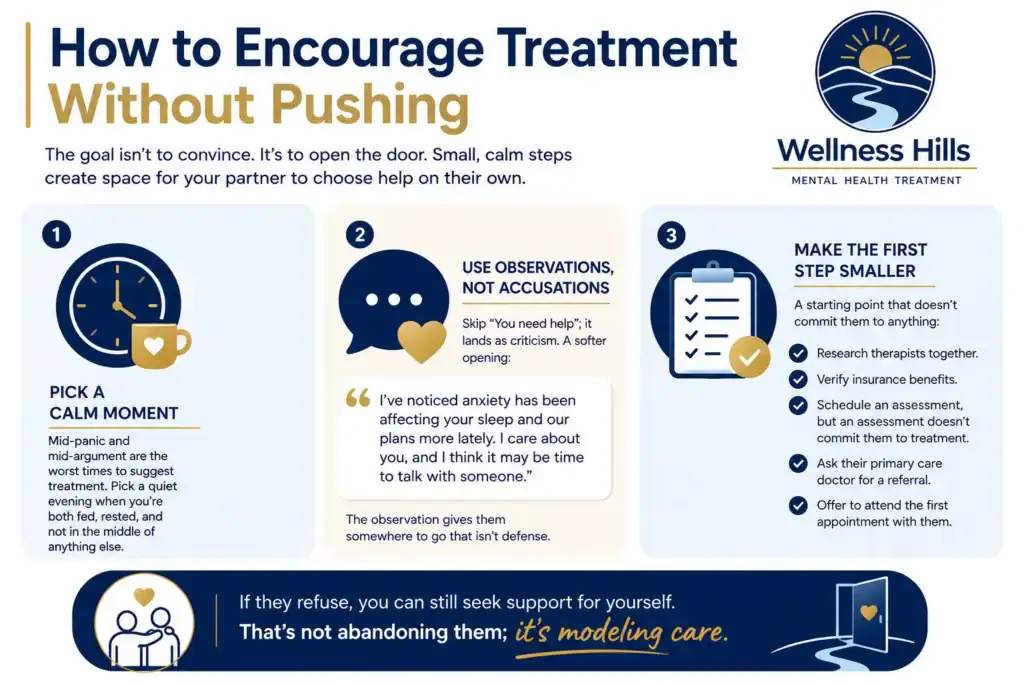
Pick a Calm Moment
Mid-panic and mid-argument are the worst times to suggest treatment. Pick a quiet evening when you’re both fed, rested, and not in the middle of anything else.
Use Observations, Not Accusations
Skip “You need help”; it lands as criticism. A softer opening:
“I’ve noticed anxiety has been affecting your sleep and our plans more lately. I care about you, and I think it may be time to talk with someone.”
The observation gives them somewhere to go that isn’t defense.
Make the First Step Smaller
A starting point that doesn’t commit them to anything:
- Research therapists together.
- Verify insurance benefits.
- Schedule an assessment, but an assessment doesn’t commit them to treatment.
- Ask their primary care doctor for a referral.
- Offer to attend the first appointment with them.
If they refuse, you can still seek support for yourself. That’s not abandoning them; it’s modeling care.
Am I Supporting My Partner or Accommodating the Anxiety?
If reading this guide has raised more questions than answers, the table below maps common situations to more supportive responses. None of these is diagnostic. Use them to sort what you can still address at home from what may need clinical input.
| What's Happening | More Supportive Response |
|---|---|
| They ask the same reassurance question repeatedly. | Answer once. Stay present without repeating the answer. |
| Avoidance is starting to shape shared plans. | Agree on one small step forward, not full avoidance, not forced exposure. |
| Their world is visibly shrinking. | Encourage a clinical assessment instead of continuing to compensate. |
| You are becoming their only source of regulation. | Set a boundary on what you can sustain. Bring in professional support. |
| They mention self-harm or not being able to stay safe. | Contact 988, call 911, or go to the nearest emergency department. |
When IOP or PHP May Enter the Conversation
Weekly outpatient therapy is where most people start. More structured care may be appropriate when anxiety is significantly disrupting daily functioning, or when weekly sessions haven’t moved things forward after several months.
An intensive outpatient program (IOP) typically runs three to five sessions per week, around nine to twelve hours total, and works for someone who needs more than weekly therapy but can continue living at home.
A partial hospitalization program (PHP) typically runs five to six days per week, around twenty-five to thirty hours, and fits when symptoms call for full-day clinical structure without an overnight stay. Both bridge the gap between weekly therapy and inpatient care and sit within the broader range of structured anxiety treatment.
Frequently Asked Questions
A few questions partners often want answered before or right after picking up the phone:
How do I help my partner with anxiety without enabling them?
Validate the feeling and ask what kind of support they actually want: listening, grounding, problem-solving, or space. Avoid repeated reassurance loops, and resist taking over every task they’re avoiding. Short-term help is a normal partnership, but doing it indefinitely lets anxiety keep shrinking their world. Encourage small steps forward, and a professional evaluation if anxiety has been affecting daily function for more than a few weeks.
What should I not say to a spouse with anxiety?
Avoid “calm down,” “you’re overreacting,” “just stop worrying,” and “there’s nothing to worry about.” These usually land as dismissive, even when they’re meant kindly, and to a partner whose nervous system is already on alert, dismissal feels like criticism. Steady, validating language works better: “I’m here. This will pass. We don’t have to figure it out right now.”
What if my partner refuses treatment?
You can’t force treatment unless there’s an immediate safety risk. What helps more is asking what specifically scares them about it: fear of the diagnosis, the cost, the time, looking weak, the medications, and addressing that fear rather than arguing about the refusal itself. Set boundaries on what you can sustain. Get into therapy yourself, regardless. Modeling care is not abandoning them.
Is reassurance bad for anxiety?
No, not always. Reassurance can be supportive once, especially in times of distress. The problem is repeated reassurance that becomes the main way anxiety gets regulated.
Validate the feeling and ask what kind of support they actually want: listening, grounding, problem-solving, or space. Avoid repeated reassurance loops, and resist taking over every task they’re avoiding. Short-term help is a normal partnership, but doing it indefinitely lets anxiety keep shrinking their world. Encourage small steps forward, and a professional evaluation if anxiety has been affecting daily function for more than a few weeks.
Avoid “calm down,” “you’re overreacting,” “just stop worrying,” and “there’s nothing to worry about.” These usually land as dismissive, even when they’re meant kindly, and to a partner whose nervous system is already on alert, dismissal feels like criticism. Steady, validating language works better: “I’m here. This will pass. We don’t have to figure it out right now.”
You can’t force treatment unless there’s an immediate safety risk. What helps more is asking what specifically scares them about it: fear of the diagnosis, the cost, the time, looking weak, the medications, and addressing that fear rather than arguing about the refusal itself. Set boundaries on what you can sustain. Get into therapy yourself, regardless. Modeling care is not abandoning them.
No, not always. Reassurance can be supportive once, especially in times of distress. The problem is repeated reassurance that becomes the main way anxiety gets regulated.
A Supportive Next Step
If anxiety is reshaping your partner’s life and your relationship, an assessment can help clarify what level of support may actually fit.
Wellness Hills Mental Health Treatment offers anxiety-focused IOP (roughly nine hours per week) and PHP (roughly thirty hours per week) for adults who may need more than weekly therapy but don’t necessarily need inpatient care.
Reaching out doesn’t commit your partner to a program; it simply helps you both understand what kind of care may be appropriate.
Sources:
National Institute of Mental Health (NIMH) | Anxiety Disorders – Federal mental health resource explaining anxiety disorders, including how anxiety can interfere with daily life, relationships, work, school, and routine activities.
988 Suicide & Crisis Lifeline | 988 Lifeline – National crisis support resource providing free, confidential 24/7 support by call, text, or chat for people experiencing emotional distress, suicidal thoughts, substance use concerns, or mental health crisis.
National Institute of Mental Health (NIMH) | Panic Disorder: What You Need to Know – Federal resource explaining panic attacks, panic disorder symptoms, physical warning signs, treatment options, and when panic symptoms may affect daily functioning.
Yale School of Public Health | About Family Accommodation – Academic resource explaining family accommodation, including reassurance, participation in rituals, avoidance, and how accommodating behaviors can maintain anxiety-related symptoms.
SPACE Treatment | Supportive Parenting for Anxious Childhood Emotions – Clinical treatment resource developed by Dr. Eli Lebowitz describing SPACE, a parent-based treatment model for childhood anxiety, OCD, and related problems that focuses on reducing accommodation.
International OCD Foundation | Families and OCD – Expert resource for family members of older teens and adults with OCD, including education on family accommodation behaviors, reducing enabling patterns, and seeking support as a loved one.
Anxiety & Depression Association of America (ADAA) | Spouse or Partner – Mental health education resource for spouses and partners of people with anxiety disorders, including relationship strain, social isolation, partner stress, and the importance of maintaining outside support.
National Institute of Mental Health (NIMH) | Anxiety Disorders – Federal mental health resource explaining anxiety disorders, including how anxiety can interfere with daily life, relationships, work, school, and routine activities.
988 Suicide & Crisis Lifeline | 988 Lifeline – National crisis support resource providing free, confidential 24/7 support by call, text, or chat for people experiencing emotional distress, suicidal thoughts, substance use concerns, or mental health crisis.
National Institute of Mental Health (NIMH) | Panic Disorder: What You Need to Know – Federal resource explaining panic attacks, panic disorder symptoms, physical warning signs, treatment options, and when panic symptoms may affect daily functioning.
Yale School of Public Health | About Family Accommodation – Academic resource explaining family accommodation, including reassurance, participation in rituals, avoidance, and how accommodating behaviors can maintain anxiety-related symptoms.
SPACE Treatment | Supportive Parenting for Anxious Childhood Emotions – Clinical treatment resource developed by Dr. Eli Lebowitz describing SPACE, a parent-based treatment model for childhood anxiety, OCD, and related problems that focuses on reducing accommodation.
International OCD Foundation | Families and OCD – Expert resource for family members of older teens and adults with OCD, including education on family accommodation behaviors, reducing enabling patterns, and seeking support as a loved one.
Anxiety & Depression Association of America (ADAA) | Spouse or Partner – Mental health education resource for spouses and partners of people with anxiety disorders, including relationship strain, social isolation, partner stress, and the importance of maintaining outside support.
Editorial Standards
Our Editorial Policy
Our editorial standards keep our mental health content accurate, compassionate, and evidence-informed. Articles are developed using credible sources, reviewed for medical accuracy when needed, and regularly updated.